

When reviewing a false ceiling specification, the question often arises: “Should we use GI channel or wood batten?” This decision typically prompts strong opinions from the team.
This scenario is common in architectural practice, and the choice is more significant than it is often given credit for in project discussions.
This article provides a practical comparison to support informed decision-making and help avoid issues that may arise later in the project lifecycle.
---
First, What Are We Even Comparing?
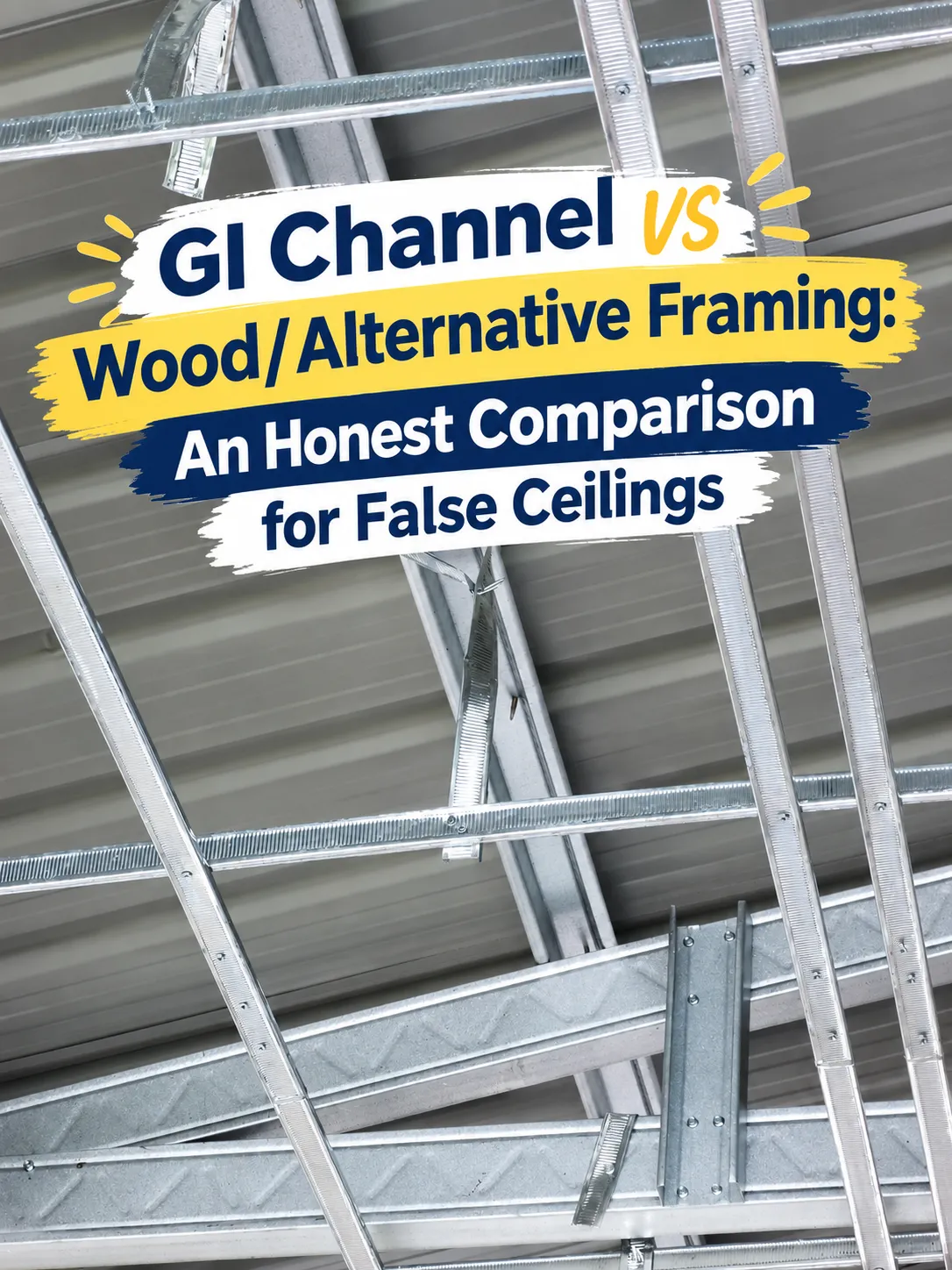
GI (Galvanised Iron) channels are cold-rolledmed steel sections used to buihe framing for false ceilings. They come in specific profiles, punched and cut for easy installation, and they sit behind your drywall or gypsum boards, holding everything in place.
Wood battens are timber strips used for the same framing purpose. They have a long history in construction and were the standard in many older projects across India.
However, the default option is not always the optimal choice.
---
The Core Difference Nobody Talks About Enough
A key consideration often overlooked is that wood moves.
Timber expands and contracts with changes in moisture and temperature. In cities such as Hyderabad, significant humidity fluctuations and extended construction timelines can cause warping, gaps, and visible bowing or separation at ceiling joints.
GI channels do not experience this movement. Steel maintains its shape, and a properly manufactured channel stays consistent year-round.
This issue has occurred in actual projects. For example, a commercial building in Secundarabad used wood battens for an internal office false ceiling. Within 18 months, humidity near the HVAC vents caused enough movement that three sections required re-fixing, resulting in additional labour and material costs and client dissatisfaction.
This wasn't random rework; it was preventable.
---
What Architects Are Actually Weighing
The following factors are typically considered in specification sheets and project review meetings.
1. Dimensional Consistency
Wood battens can vary in dimension, even within the same batch. In large commercial spaces, these small differences can accumulate, causing grid lines to drift and board joints to misalign.
GI channels produced through cold roll forming are consistent in width, thickness, and punch spacing across batches. This consistency is inherent to the roll forming process.
2. Moisture and Corrosion Resistance
Wood absorbs moisture, which can create structural problems in areas adjacent to exteriors, bathrooms, utility spaces, or any location at risk of condensation. Rot, fungal growth, and weakening may occur within the ceiling cavity.
GI channels are galvanized to address these concerns. The zinc coating protects against outdoor exposure, condensation, and long-term humidity, which is especially important near air conditioning units or external walls.
3. Fire Behaviour
Steel is non-combustible, while wood is combustible.
Most commercial project specifications require non-combustible framing materials, particularly in buildings with mandated fire ratings. GI channels meet this requirement, whereas wood battens do not by default.
4. Installation Accuracy
Pre-punched GI channels are designed for efficient and accurate installation. Their punch patterns align with standard suspension systems, reducing on-site cutting, adjustments, and errors.
Wood battens require manual cutting and drilling on site, introducing variability. Installation quality depends on the carpenter’s skill, tool condition, and measurement accuracy.
5. Long-Term Performance
A false ceiling should require minimal maintenance and remain intact for 10 to 15 years. GI channels, when properly installed, provide this reliability. Wood battens present ongoing risks from moisture, pests, and mechanical deformation.
---
Where Wood Batten Still Has a Place
It would be an oversimplification to suggest that wood battens have no value.
For small residential projects with limited budgets, minimal moisture risk, and skilled carpenters, wood battens can be suitable. In aesthetic applications, such as decorative ceiling panels in dry indoor environments, some architects prefer timber for its workability.
However, for commercial, institutional, or industrial projects, GI channels are recommended. Apply the same manufacturing standards when specifying UPVC door and window systems.
---
Expert Tip: When evaluating ceiling framing options for commercial projects, verify the galvanization grade of the GI channel. A minimum of 120 GSM zinc coating is recommended for long-term corrosion resistance in humid climates. Lower grades may result in future maintenance issues.
---
The UPVC Reinforcement Connection
Architects should also consider that the quality of steel inside UPVC frames is as important as the ceiling framing choice.
UPVC door and window profiles are internally reinforced with steel sections that support structural loads, resist wind pressure, and prevent frame distortion over time. For projects in Hyderabad, the quality of steel reinforcement directly impacts long-term performance.
Selecting reputable UPVC reinforcement manufacturers in Hyderabad is a critical procurement decision, not merely a line item.
Manufacturers employing cold roll forming for UPVC steel inserts achieve tight dimensional tolerances, consistent wall thickness, and uniform zinc coating. In contrast, general-purpose fabrication shops that cut and bend sections manually often produce inconsistencies, resulting in loose frames, poor fit, and eventual warping of window units.
This reflects the same principle as the GI channel versus wood batten comparison: precision manufacturing versus minimal standards. While differences may not be immediately apparent, they become significant over time.
---
Pro Insight: Roll-formed steel sections for UPVC reinforcement must precisely match the internal cavity of the PVC profile. Even a 0.5mm deviation can cause fitment issues during extrusion or fabrication, resulting in weak joints and poor sealing. Request dimensional inspection reports from your supplier.
---
What to Ask Your Manufacturer Before Specifying
When shortlisting suppliers for GI false ceiling channels or UPVC steel reinforcements, ask these practical questions.
* What gauge range can you produce, and can you match my project spec exactly?
* What zinc coating grade do you apply, and how do you verify it?
* What are your batch consistency controls? How often do you do dimensional checks?
* Can you produce to custom profiles based on my drawings?
* What’s your lead time for bulk orders, and how do you handle urgent project requirements?
Manufacturers who provide specific, detailed answers to these questions are more likely to meet project requirements effectively.
---
From Our Experience: At Rudran Infra Metals, dimensions are checked every five pieces during production, including night shifts. This process ensures batch consistency, which protects architects, contractors, and end clients. If we find any discrepancy, we halt production until we resolve the issue.
---
GI Channel or Wood Batten: The Decision
For most modern commercial, industrial, or infrastructure projects, GI channels are recommended due to their dimensional accuracy, moisture resistance, fire performance, and long-term stability.
For small residential projects with suitable conditions and a skilled team, wood battens may be appropriate, as long as you understand the associated risks.
When specifying UPVC framing systems, give equal importance to the quality of reinforcement steel as to the profile specification. The steel inside the frame performs structural functions and should come from a manufacturer that recognises its importance.
---
Ready to Specify the Appropriate Steel for Your Next Project?
Contact Rudran Infra Metals to discuss project requirements, obtain custom profile specifications, or request dimensional data sheets for GI false ceiling channels and UPVC steel reinforcements.
We collaborate directly with architects, contractors, and procurement teams across Hyderabad and throughout India. Providing project drawings helps make discussions more productive.
---


























Sign in to leave a comment.