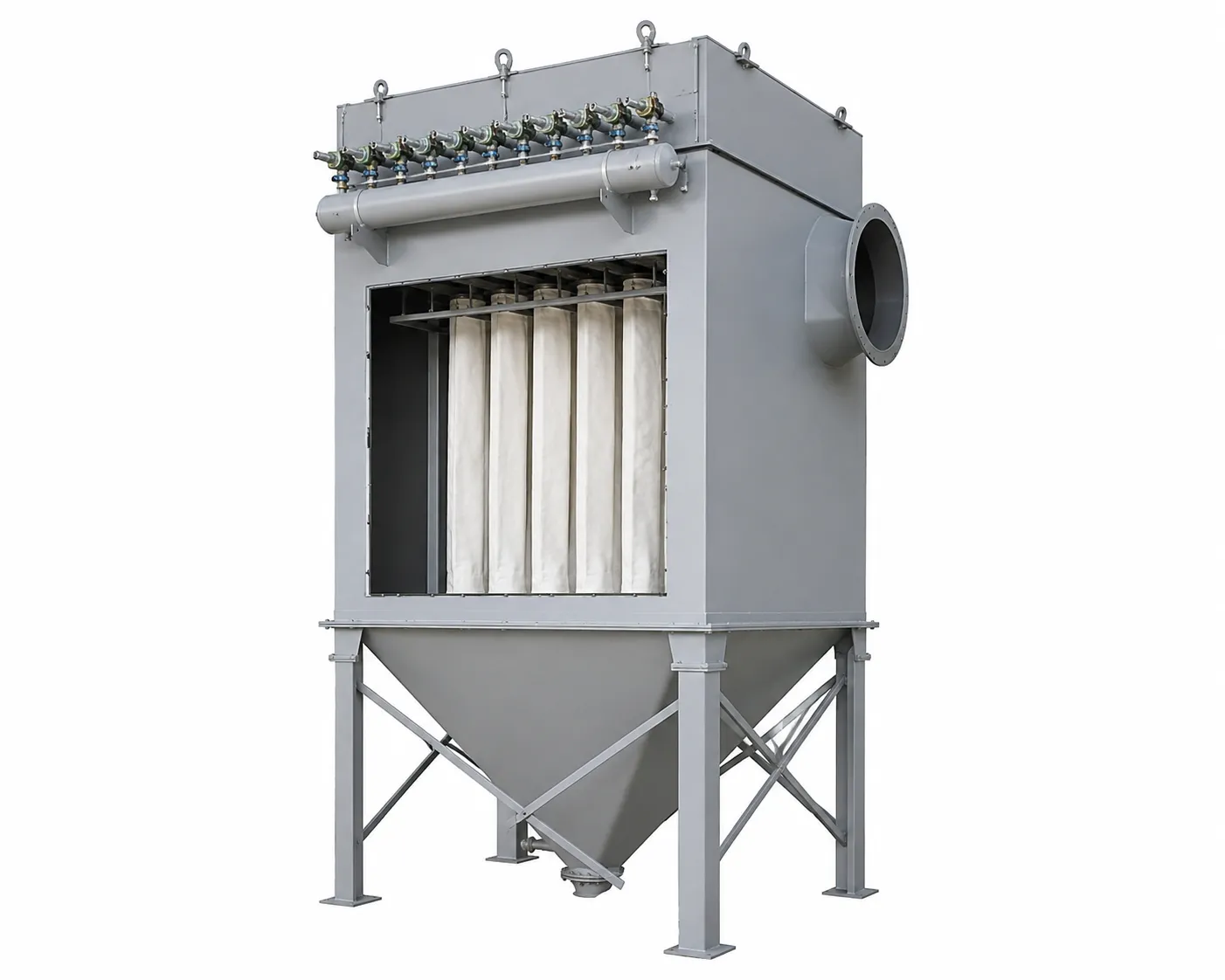

Two factories can generate the same amount of dust and still require very different filtration systems.
The reason is simple: dust is not a uniform material. Particle size, density, temperature, moisture, chemical composition, abrasiveness, and concentration can all change how particulate matter behaves inside a filtration system.
This is why selecting a Bag Filter should begin with understanding the dust and the process rather than simply choosing equipment according to airflow capacity.
A filtration system that performs well in one application may experience rapid pressure-drop increase, premature filter-bag wear, or difficult dust discharge when placed in a completely different operating environment.
For industrial plants, the practical goal is to create a filtration arrangement that remains stable as production conditions change.
Why Dust Characteristics Matter More Than They First Appear
Dust particles behave differently depending on their physical and chemical properties.
Heavy particles may settle quickly, while very fine particles can remain suspended in the process air for extended periods. Abrasive dust can cause mechanical wear. Hygroscopic materials can absorb moisture and become sticky. Certain particles can react with moisture or temperature changes.
These differences affect almost every part of the filtration system.
The filtration media, air-to-cloth ratio, cleaning method, hopper arrangement, inlet configuration, and dust-discharge equipment may all need to be selected accordingly.
For this reason, a good system design begins with questions about the material being collected.
The Role of a Pulse jet Bag filter
A Pulse jet Bag filter is designed for continuous filtration with periodic cleaning of the filter bags using compressed-air pulses.
During normal operation, dust-laden air enters the filtration chamber and passes through the filter media. Particles are retained while filtered air continues through the system.
As dust accumulates, the cleaning system activates selected rows of bags. A short pulse of compressed air causes the bags to flex, releasing the accumulated dust.
The released material falls into the hopper and is subsequently discharged.
The cleaning cycle must be balanced with the actual dust load. If cleaning is unnecessarily aggressive, filter-bag wear and compressed-air consumption may increase. If cleaning is inadequate, pressure drop can rise and airflow may become unstable.
Filter Media Should Match the Process
Choosing Filter bags is not simply a matter of matching dimensions.
The media must be compatible with the temperature, dust chemistry, particle characteristics, moisture conditions, filtration velocity, and cleaning method.
Different synthetic and fibre-based media have different properties. Surface treatment and construction can also influence filtration behaviour.
For a process involving dry, fine dust, the requirements may differ substantially from an application involving abrasive particles or elevated temperatures.
A technically suitable filter bag should therefore be selected from process information rather than from size alone.

What Happens When the Filter Media Is Wrong?
Incorrect filter-media selection can produce several symptoms.
Pressure drop may rise faster than expected. Dust penetration may increase. Cleaning may become less effective. Filter bags may experience premature wear or chemical degradation.
In some applications, the bags may appear physically intact while their filtration performance gradually deteriorates.
Replacing the bags without identifying the reason for the deterioration can result in repeated maintenance costs.
This is why filter-bag failure analysis can be valuable when a filtration system is experiencing unusually short service intervals.
Filtration Velocity and Dust Loading
The relationship between airflow and filtration area is an important part of bag-filter design.
If too much air is forced through an insufficient filtration area, the filtration velocity can become unnecessarily high. This may increase pressure drop and place greater stress on the filter media.
On the other hand, providing excessive filtration area can increase equipment size and cost without necessarily delivering proportional benefits.
The appropriate design depends on dust characteristics, media, cleaning method, required operating conditions, and expected loading.
A properly engineered system seeks a practical balance between filtration performance, equipment size, energy use, and maintenance.
Temperature Can Change Filter Performance
Temperature is another factor that should be considered throughout the operating range.
A process may have a normal operating temperature as well as temporary peaks during startup, shutdown, production changes, or abnormal conditions.
Filter media must be selected to withstand the expected thermal environment. Seals, cages, housing components, and other parts of the collector may also require consideration.
In applications involving hot process gases, temperature control or cooling may be necessary before the air reaches the filtration media.
Ignoring temperature peaks can shorten filter life even when the average process temperature appears acceptable.
Moisture and Condensation Are Common Challenges
Moisture can significantly change the way dust behaves.
When fine particles combine with moisture, they may form deposits on the filter surface. In severe cases, the material can become sticky enough to interfere with cleaning.
Condensation can create similar problems, particularly when hot process air cools below its dew point.
Once moisture-related deposits form, pressure drop can increase rapidly.
The system should therefore consider insulation, temperature management, filter-media selection, hopper design, and process conditions wherever condensation or wet dust is possible.
Abrasive Dust Requires Special Attention
Some industrial processes generate particles capable of wearing down filtration media through repeated mechanical contact.
Abrasive dust can damage filter bags, particularly when high-velocity air enters the filtration chamber or when particles repeatedly strike the same area.
Inlet design can help reduce this problem by controlling the movement and distribution of dust-laden air before it reaches the filter bags.
Appropriate media and construction can also contribute to longer service life.
This demonstrates why collector design should be based on the behaviour of the dust rather than solely on the required airflow.
Dust Discharge Should Match Material Behaviour
Once particles are removed from the air stream, they need to be collected and discharged.
Different materials behave differently inside hoppers. Some flow easily, while others bridge, compact, or become sticky.
A suitable dust-discharge arrangement can help maintain reliable operation.
Depending on the process, systems may incorporate rotary air locks, collection bins, screw conveyors, or other mechanisms.
The discharge arrangement should also consider whether the collected material is being recycled, reused, or disposed of.
A filtration system cannot be considered fully engineered if the collected dust has no reliable path out of the equipment.
What Happens When Production Conditions Change?
Factories rarely operate under exactly the same conditions for years.
Production rates may increase. New raw materials may be introduced. Machines may be added to an existing extraction network. Operating hours may change.
These changes can affect the original filtration system.
For example, increasing production may increase dust loading without changing the collector's filtration area. Adding another machine may reduce available airflow at existing extraction points. A change in raw material may produce dust with different moisture or particle characteristics.
The filtration system should therefore be reviewed whenever there is a significant process change.
Choosing Bag Filter Suppliers With Application Knowledge
When comparing Bag filter suppliers, it is useful to determine whether they understand the actual process rather than simply selling standard equipment.
A technically capable supplier should be able to discuss dust properties, airflow, pressure drop, filtration area, media selection, cleaning, temperature, moisture, and dust discharge.
The supplier should also be able to explain how the proposed equipment will respond to the expected operating conditions.
This type of technical discussion can be more valuable than comparing equipment prices alone.
What to Expect From Bag Filter Manufacturers
Bag filter manufacturers play an important role in converting process requirements into a practical filtration system.
Manufacturing quality affects the collector housing, hopper, access doors, filter-bag mounting, cages, pulse-cleaning components, seals, and structural integrity.
However, manufacturing capability should be supported by appropriate engineering.
The final system needs to accommodate the required airflow and pressure while remaining accessible for inspection and maintenance.
For customized industrial applications, equipment dimensions, inlet configuration, hopper geometry, and discharge arrangement may need to be adapted to the plant.
Selecting Filter Bags Suppliers for Replacement Requirements
Replacement filter bags should be treated as application-specific components.
When working with Filter bags suppliers, the original collector details should be checked carefully. Bag dimensions, media type, temperature conditions, dust characteristics, cage configuration, mounting arrangement, and cleaning method all matter.
A replacement bag that physically fits the collector may still be unsuitable if its media is not compatible with the process.
Maintaining a record of previous bag specifications and failure patterns can make future replacement decisions more informed.
The Manufacturing Quality of Filter Bags
Filter bags manufacturers need to maintain consistency in material, dimensions, stitching, finishing, and construction.
This becomes particularly important in pulse-cleaned systems because the bags experience repeated mechanical movement during cleaning cycles.
Poor dimensional accuracy can create installation problems or sealing issues. Weak construction can reduce service life.

For industrial users, the focus should therefore be on compatibility and consistent manufacturing rather than treating filter bags as generic textile products.
GPT-INDIA: Engineering Filtration Around the Process
Green Planet Technologies, popularly known as GPT-INDIA, works in industrial air pollution control, dust extraction, ventilation, and filtration applications.
Its approach to fabric filtration considers the characteristics of the process and dust before determining the appropriate filtration arrangement. Depending on the application, systems can incorporate pulse-jet cleaning, suitable filter media, controlled dust discharge, and associated air-handling equipment.
This process-oriented approach is particularly relevant when a filtration system must operate under variable dust loading, temperature, moisture, or production conditions.
GPT-INDIA NAP Details
Business Name: Green Planet Technologies popularly known as GPT-INDIA
Address: 59/2/1, Site 4, Industrial Area, Sahibabad, Distt. Ghaziabad–201010, Uttar Pradesh, India
Phone: +91-9773500660
Email: [email protected]
Frequently Asked Questions
What factors should be considered before selecting a Bag Filter?
Important factors include airflow, dust concentration, particle size, temperature, moisture, chemical characteristics, filtration velocity, cleaning method, dust-discharge requirements, and operating hours.
Why is dust type important when selecting Filter bags?
Different dusts can be abrasive, sticky, hygroscopic, corrosive, or extremely fine. These characteristics affect filter-media selection, cleaning behaviour, pressure drop, and service life.
How does a Pulse jet Bag filter clean its bags?
Compressed-air pulses are directed through the cleaning system to flex the filter bags and release accumulated dust into the hopper or collection section.
Can moisture damage a bag filtration system?
Yes. Moisture can cause certain dusts to become sticky and can also lead to condensation, deposits, increased pressure drop, and cleaning difficulties.
How should Bag filter suppliers evaluate an application?
They should consider the actual process, airflow requirement, dust characteristics, temperature, moisture, filtration media, cleaning arrangement, pressure conditions, and dust-discharge requirements.
What should I check when selecting Bag filter manufacturers?
Consider engineering capability, manufacturing quality, filtration experience, customization, technical documentation, maintenance support, and experience with comparable process conditions.
Are all replacement Filter bags interchangeable?
No. Replacement bags must match the collector's dimensions and mounting arrangement while also being suitable for the actual dust, temperature, moisture, cleaning method, and filtration conditions.
Conclusion
A successful bag-filtration system starts with understanding the material it needs to collect. Dust characteristics influence filtration media, airflow distribution, cleaning, pressure drop, dust discharge, and ultimately filter-bag life.
As industrial processes change, the filtration system may also need to be reviewed. A collector designed for one production condition should not automatically be assumed to remain optimized after significant changes in dust loading, temperature, materials, or airflow requirements.
For industries seeking dependable fabric filtration, treating the Bag Filter, filter media, cleaning system, airflow network, and dust-discharge equipment as one integrated process can create a more stable foundation for long-term operation.






















Sign in to leave a comment.