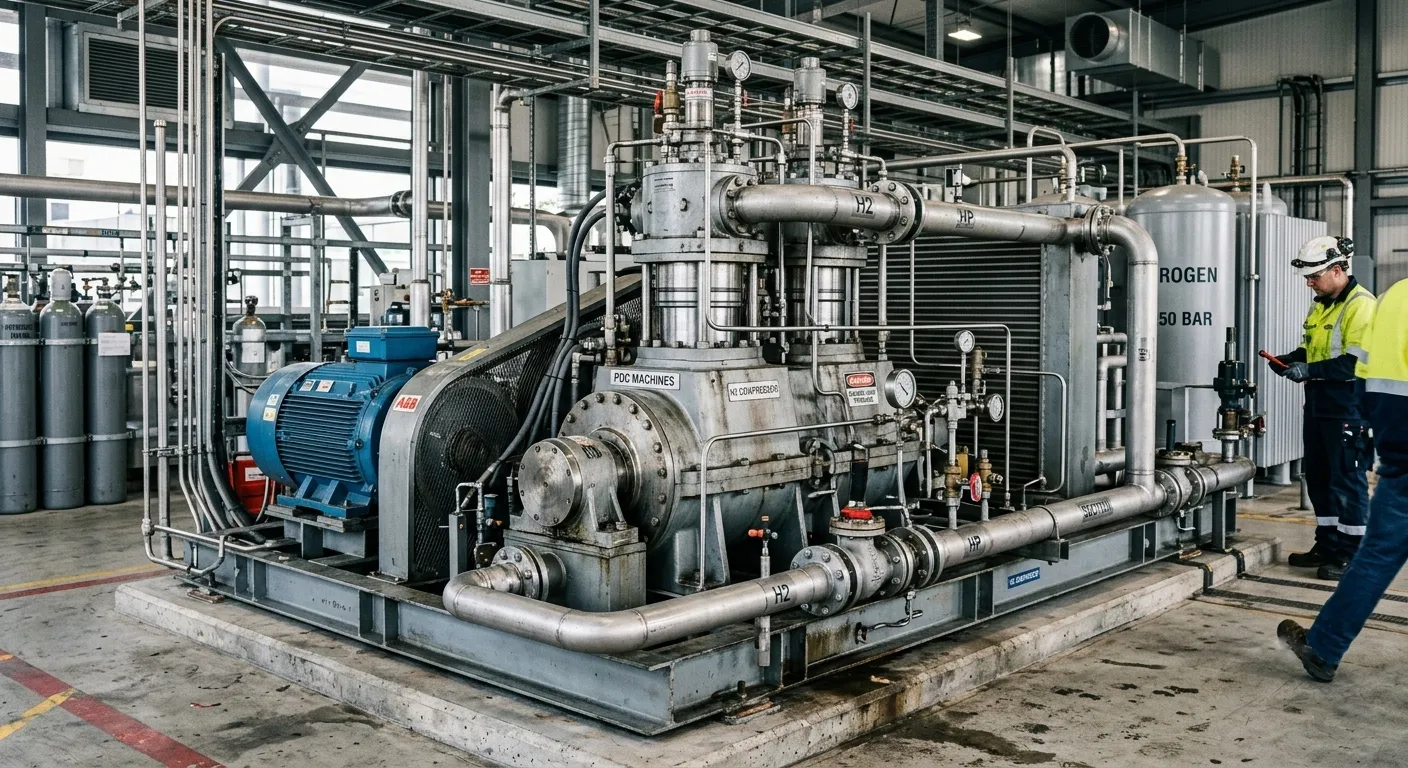

There are many labels attached to hydrogen. The most common ones are grey, blue and green, each of which represents a different way the molecule is made and the carbon footprint associated with it. These color designations are not just a description of a production method. They set the process conditions, gas compositions, pressures, and equipment specifications that engineers must work around. But nowhere is that difference more critical than in the choice and design of compression systems.
Compressor technology is not transferable across hydrogen pathways without meaningful engineering adaptation. To understand why, it is important to examine the operation of each production method and the requirements it places on rotating equipment.
The Three Pathways and Their Process Fundamentals
Grey Hydrogen: Steam Methane Reforming at Scale
Grey hydrogen is made by reacting natural gas with high-temperature steam in a process known as steam methane reforming (SMR). The reaction produces hydrogen and carbon monoxide which is then converted to carbon dioxide in a shift reactor. The CO2 is then released to the atmosphere (this is the “grey” classification).
Compressors are used for hydrogen-rich synthesis gas (syngas) of different compositions in grey hydrogen facilities instead of pure hydrogen. This is important because syngas contains hydrogen, methane, CO2 and water vapor. The mixture of molecular weight helps to alleviate some of the compression issues associated with pure hydrogen. The pressure ratio at the head station (from the reformer to pipeline or downstream processing) is usually between 2.2 and 6.0, depending on the configuration of the facility.
Blue Hydrogen: The Same Process, with Carbon Capture Added
Blue hydrogen is based on the same SMR or autothermal reforming (ATR) technology as grey hydrogen, but the CO2 is captured before it is released into the atmosphere through carbon capture and storage (CCS) technology. The addition of CCS has a huge impact on the equipment ecosystem. Now the facility requires not only syngas compressors and hydrogen compression but also CO2 compression systems to bring captured carbon dioxide to pipeline transport pressure, typically 80 to 150 bar.
This implies that a blue hydrogen plant has a double compression load. The hydrogen side of the plant is similar to a grey plant. The carbon capture side includes centrifugal or reciprocating CO2 compressor trains, solvent circulation pumps for amine-based absorption systems, and process utilities. In terms of rotating equipment, blue hydrogen projects are some of the most complex in the clean energy industry.
Green Hydrogen: Pure Hydrogen from Electrolysis
Green hydrogen is produced through electrolysis, using renewable electricity to split water into hydrogen and oxygen. No combustion, no syngas and no CO2 to capture. The product of the electrolyzer is almost pure hydrogen at a relatively low pressure, typically 10 to 30 bar depending on the technology.
It is this purity that makes compression of green hydrogen so technically demanding.
Pure Hydrogen Compression Is An Engineering Category of Its Own
Natural gas has a molecular weight of 16.8, while pure hydrogen is 2.0. That disparity translates to all aspects of compressor design.
The speed of sound in hydrogen is about 4480 ft/sec, compared to 1375 ft/sec in natural gas. The ratio of impeller tip speed to gas acoustic velocity is the key to centrifugal compressor aerodynamics, and hydrogen compressors must operate at much higher tip speeds to attain the same pressure ratio as a natural gas compressor.
The outcome is a basic stage count problem, as described in NETL research on hydrogen compression options. For a typical centrifugal compressor, using standard impeller tip speeds, it would take about 40 impeller stages to move hydrogen from the electrolyzer pressure to the pipeline pressure with a pressure ratio of 2.5. This can be lowered to approximately 10 stages by using a high-speed compressor with high tip speeds, but at the expense of a new set of material and mechanical challenges.
The governing standard for centrifugal compressors used in oil, gas and process services, API 617, restricts impeller material yield strength to 120 ksi (827 MPa). This constraint is in place to avoid hydrogen embrittlement, which is the process of atomic hydrogen diffusing into the grain boundaries of the metal, reducing its ductility and potentially leading to stress cracking or fatigue failure. Industrial solutions are available today that are within this limit, and advanced materials such as high strength aluminum alloys and composite impeller concepts are being developed to extend performance beyond this.
Sealing Challenges in Hydrogen Service
The low molecular weight of hydrogen poses sealing problems. The molecule is small enough to pass through many elastomer compounds that are used successfully in natural gas service. Dynamic seal systems, such as dry gas seals (DGS) often employed in centrifugal compressors, must be configured carefully for hydrogen service to control leakage rates and prevent fugitive emissions. Static seals require materials that are chosen with the knowledge that they will be resistant to hydrogen permeation and the resulting decompression damage to polymer components.
Pipeline and Recompression Applications
Recompression stations are required to keep the line pressure high over long distances when hydrogen is added to a transmission pipeline. The pressure ratio for hydrogen pipeline recompression is usually 1.2 to 1.4, which may seem low, but for low molecular weight, there are implications for the number of stages. One or two stages of pipeline recompression for natural gas service can require eight or more stages for pure hydrogen service.
There are industrial solutions available that have been demonstrated and are in operation for hydrogen pipeline transport, including multiple barrel compressor casings, intercooling between compressor bodies, and variable frequency drives to adjust throughput variation across the pipeline.
How Compression Requirements Differ Across All Three Pathways
| Pathway | Primary Fluid | Pressure Ratio Range | Key Compression Challenge |
| Grey Hydrogen | Syngas (mixed MW) | 2.2 to 6.0 | Stage count, gas composition variation |
| Blue Hydrogen | Syngas plus CO2 | Dual duty across two separate trains | CO2 supercritical compression plus hydrogen service |
| Green Hydrogen | Pure H2 | 2.5 to 10 and above | Molecular weight, embrittlement, sealing, stage count |
The table above makes visible what color labels alone obscure: each pathway places fundamentally different demands on the compression system, and the engineering response must be pathway-specific.
The Practical Implications of Equipment Selection
The compression duty is relatively well understood for grey hydrogen, as it has been used in decades of SMR experience in refining and petrochemical applications. The industrial supplier base is well equipped to support standard centrifugal or reciprocating compressors that are used for hydrogen-rich syngas service.
The next big question for blue hydrogen is how CO2 compression is combined with hydrogen compression. Skid-packaged CO2 compression systems with modular process controls are becoming more popular due to the reduction of project schedule risk and the ability to have one scope of responsibility for the CO2 capture and compression system.
The choice of compressor is more technology specific for green hydrogen. High-speed integrally geared centrifugal compressors are compact multi-stage compressors and are now being specified for electrolyzer-to-pipeline applications. In smaller-scale or high-purity applications where fugitive hydrogen emissions need to be eliminated, diaphragm compressors are commonly used to provide hermetic containment with no dynamic seals exposed to the process gas. Reciprocating compressors are still used in green hydrogen service, but need to be carefully designed for pure hydrogen duty, with attention paid to valve materials, sealing and cylinder design.
FAQs
Q1: Why is it more difficult to compress pure hydrogen than natural gas?
The molecular weight of hydrogen is about 2.0, while the molecular weight of natural gas is about 16.8. This implies that hydrogen has a much lower pressure ratio for the same compressor geometry and rotational speed. It would take a much larger number of impeller stages or a much higher impeller speed to achieve the same head in natural gas compression.
Q2: What is meant by hydrogen embrittlement and what impact does it have on compressor design?
Hydrogen embrittlement is the process by which atomic hydrogen penetrates metal parts, which decreases the ductility of the material and makes it more prone to cracking under stress. For compressor design, this restricts the materials that can be used for the impellers and restricts the maximum allowable yield strength to 120 ksi as specified in API 617, and thus limits impeller tip speed and the pressure ratio per stage that can be achieved.
Q3: What is the type of compressor used for green hydrogen from electrolysis?
Depending on the flow rate, required pressure and purity, high-speed integrally geared centrifugal compressors, diaphragm compressors and reciprocating compressors are all utilized in green hydrogen service. In applications where hermetic sealing and no process gas leakage is required, diaphragm compressors are preferred. For larger scale pipeline feed applications, the high speed centrifugal designs are gaining popularity.
Q4: What is the difference between blue hydrogen compression and grey hydrogen compression?
The dual compression burden of blue hydrogen facilities. The hydrogen production side is similar to a grey hydrogen plant, with the need for syngas compression and hydrogen boosting. Carbon capture and storage requires an extra CO2 compression system to increase the pressure of captured CO2 to pipeline transport pressure. This makes the compression system much more complex and expensive than a similar grey hydrogen plant.
Q5: Is it possible to reuse existing natural gas compressors for hydrogen service?
In most cases, direct reuse without modification is not advisable. Hydrogen is a low molecular weight fuel, which affects its aerodynamic properties, and necessitates more stages than the original design. The compatibility of materials with hydrogen embrittlement resistance should be checked. Fugitive emission requirements may be different for hydrogen service than for natural gas service. Lower-pressure hydrogen-rich gas applications may be possible for conversion, but each individual machine must be carefully reviewed.



























Sign in to leave a comment.