

Picture a procurement engineer at a manufacturing firm, six tabs open, comparing three variants of a networking unit. The datasheets disagree on throughput under load, one model needs a licence the others bundle, and the question she actually cares about, whether any of this fits her existing rack, appears on none of the pages. She types a query into a contact form, thinks better of it, and closes the tab. This is the exact moment guided selling software for B2B was designed for, and for companies selling technology it is where deals are quietly lost.
The High-Tech Buying Problem: Too Many Variables, Too Few Answers
Technical products rarely fail to sell because they are poor. They fail to sell because the buyer cannot see how the pieces fit together. A single purchase can depend on compatibility, firmware versions, support tiers, deployment environment and pricing models, and each of those changes the answer to the others.
Gartner’s buying research found that 77% of B2B buyers described their last purchase as very difficult or complex, and that buyers spend only about 17% of their purchase time meeting suppliers. For a high-tech seller, that is a small window and a big pile of detail.
Why Guided Selling for High Tech Is Different
Selling a standard item is a matter of showing it and quoting a price. Selling technology has a few extra wrinkles:
- The specifications depend on each other. Choosing one option can rule out another, and the buyer usually learns this late.
- Buyers are technical. They want depth, and they notice when a vague answer is covering a gap in knowledge.
- The committee is mixed. Engineering cares about performance, procurement about terms, finance about total cost. Gartner’s research puts a typical buying group for a complex solution at six to ten people.
- Language gets in the way. Vendors describe products by model names and feature codes, while buyers describe problems.
That last point is the heart of it. A buyer says, “I need to monitor forty remote sites without adding staff.” The catalogue says, “Series 4, Tier B.” Somebody has to translate between the two.
Where Guided Selling Software for B2B Goes Beyond the Configurator
Many technology firms respond with a product configurator, and for good reasons. Rules-based tools can walk a rep or a customer through key needs, such as application, environment and budget, and return a valid set of configurations. Some vendors in this space report shorter sales cycles and much faster configuration times, though those figures come from the vendors themselves and depend heavily on the product.
There is a limit, though. An engineer writing for Configit made the point that engineering configurators were built for engineers, not customers, and that a sales-facing tool should speak in the customer’s terms. Even a well-built configurator answers the questions it was designed to ask. It cannot hear the buyer say something unexpected, such as a constraint nobody planned for.
That gap, between structured logic and a live human exchange, is where a guided sales tool earns its keep.
Guided Selling Experiences on the Page: What a Salesperson Can Do Remotely
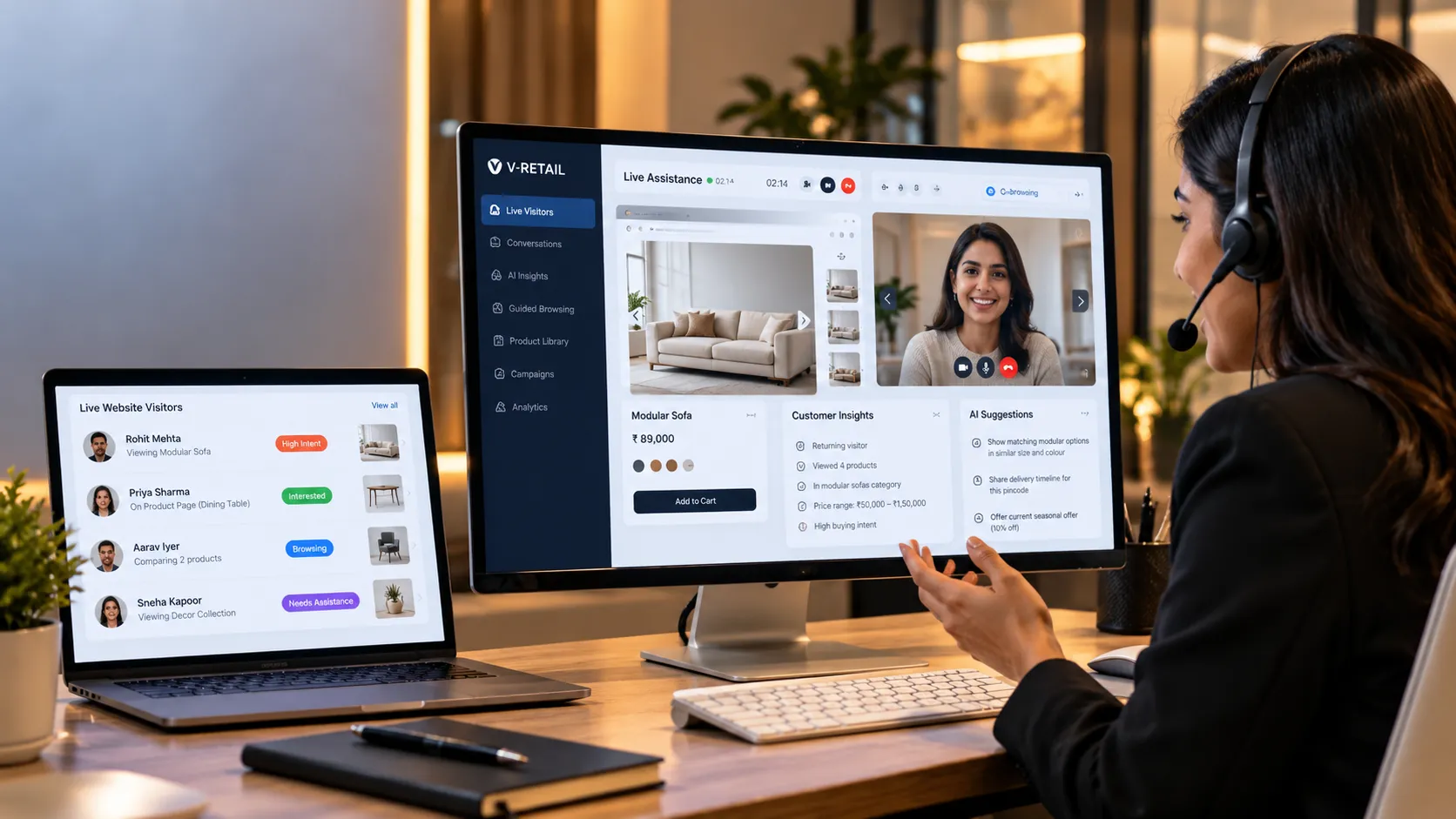
V-Retail approaches the problem from the website. It is a sales enablement platform that lets a representative open a live chat, voice or video conversation with a visitor who is actively reading, and then use remote assistance to guide them through the site.
For a high-tech buyer, this looks like a short, specific sequence:
- The platform shows the team which pages the visitor has been reading and where they seem to be stuck.
- A representative opens a conversation and asks what the visitor is trying to achieve.
- Rather than sending a list of links, the representative walks them to the exact comparison page, specification sheet or service option that applies.
- If the question needs depth, the call moves to voice or video, where a short explanation often replaces ten emails.
It recreates part of what happens at a trade-show stand or a customer visit, without anyone travelling. The visitor gets an answer about their rack, their load or their environment, and the salesperson learns what the buyer really needs. You can see the capabilities laid out on the V-Retail product page.
A Guided Selling System That Learns What Buyers Ask
Technical sales teams often hold valuable knowledge in individual heads. One senior engineer knows the awkward compatibility cases, and the rest of the team does not. Every live conversation is a chance to capture that.
V-Retail’s conversational analytics look for patterns across interactions. They are designed to surface things like:
- Customer requirements that keep appearing
- Concerns raised again and again
- Products and services attracting stronger interest
- Points in the website journey where prospects drop away
- Gaps in product knowledge among representatives
The practical payoff is easy to picture. If the same compatibility question comes up weekly, it belongs on the product page, and in the next round of rep training. Documentation improves because buyers have shown, in their own words, where the current version falls short.
The Honest Limits
A platform does not make a thin sales process thick. A guided selling system works best when the team already agrees on what a good conversation looks like, and when the people answering are technically capable. A prompt on screen helps a competent representative, and it cannot rescue one who does not understand the product.
Staffing matters too. Live conversations only help if someone answers promptly during the hours buyers browse. And if your site draws very few visitors, fix discovery first, because engagement tools work on the demand that already exists.
A Short Checklist for Technology Sellers
Before choosing any tool, test your situation against these points:
- Do buyers need to talk to someone before they commit?
- Is your catalogue hard to explore without help?
- Can a representative explain an option clearly, in the buyer’s language?
- Do you record what buyers ask, or does it vanish after each call?
- Does your team have a defined way of handling a technical objection?
If most answers lean yes, the fit is promising. If several lean no, you have found the work to do first.
Give Your Buyers a Translator
Your product may be excellent and still be hard to buy. The fix is often a person, available at the right moment, who can turn a buyer’s problem into the right option. Book a V-Retail demo and see how live, guided conversations could work across your own product pages.





















Sign in to leave a comment.