
Artificial intelligence is changing the conversation around India’s IT services industry. Instead of asking only whether software companies can protect traditional outsourcing revenue, investors are increasingly looking at whether they can turn AI adoption into profitable, recurring business.
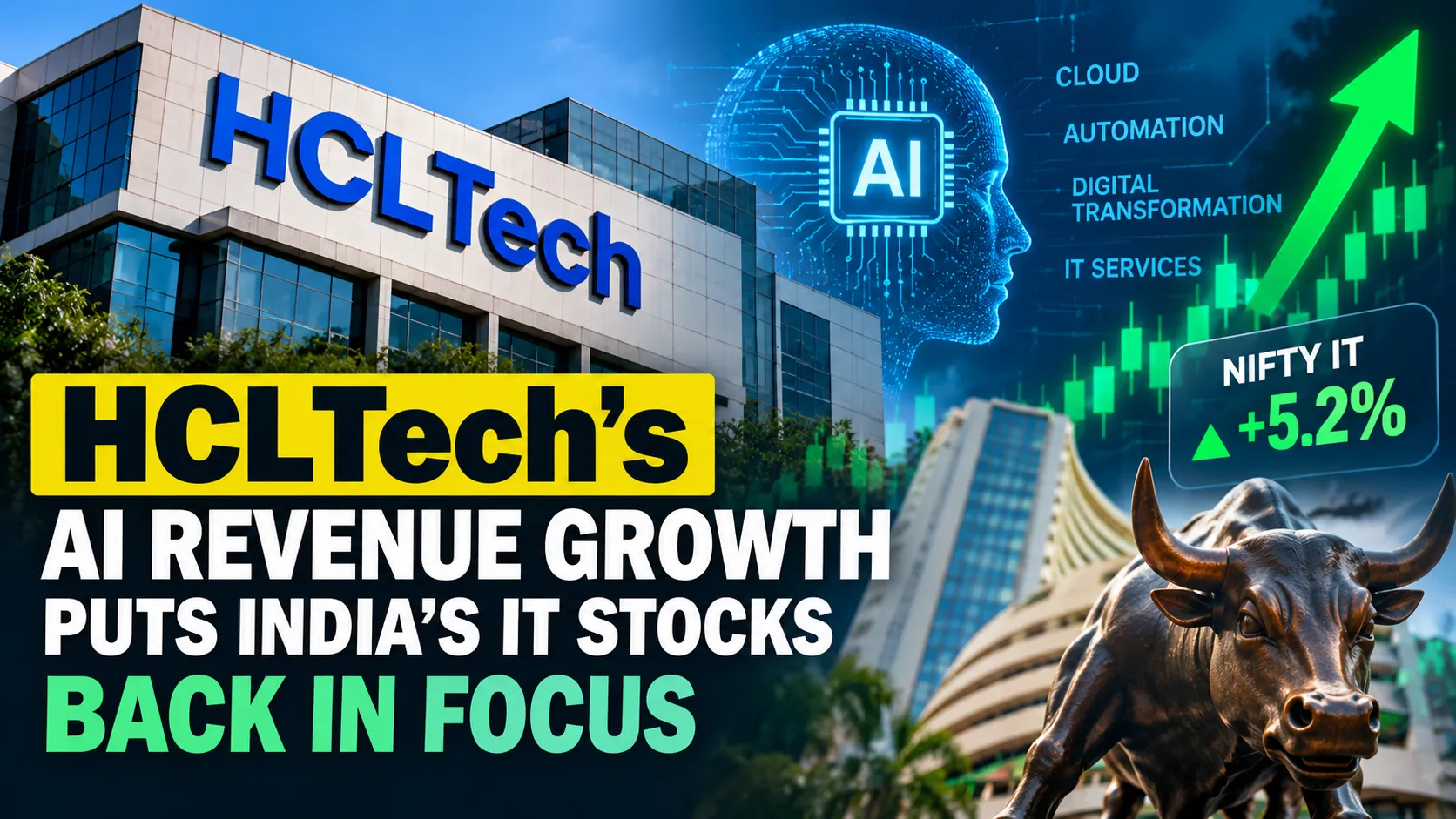
HCLTech provided a fresh example on October 13, 2026, when its shares jumped 8.4% after the company reported stronger-than-expected second-quarter profit and operating margins. The rally also helped lift the broader Nifty IT index by 5.2%, its biggest single-day gain in approximately 17 months, according to Reuters.
The results were encouraging, but they also highlighted an important distinction: AI-related growth is valuable only when companies can convert it into sustainable revenue and earnings.
What Made HCLTech’s Results Stand Out?
HCLTech reported consolidated net profit of ₹5,132 crore for the September quarter, an increase of 21.2% year over year. Revenue rose 11.5% to ₹35,620 crore, although it came in slightly below the average analyst estimate reported by Reuters.
The more notable development was the company’s annualised advanced AI revenue, which increased to $219 million from $171 million in the preceding quarter. Its earnings before interest and tax margin reached 18.2%, supported by operating leverage, AI-related efficiencies and a stronger mix of advanced AI services.
These figures suggest that AI is becoming more than a technology investment for some IT service providers. It is also creating opportunities to sell specialised services, improve delivery efficiency and expand existing client relationships.
However, one quarter cannot establish a long-term trend. Investors still need to assess whether new AI contracts translate into recognised revenue, whether demand remains durable and whether the benefits are large enough to offset pressure on conventional software services.
Why AI Matters to India’s IT Services Industry
Indian IT companies have traditionally generated substantial revenue by helping global businesses manage software development, infrastructure, consulting and business processes.
Generative AI introduces both an opportunity and a challenge to this model.
On one side, businesses need assistance with AI implementation, data management, cybersecurity, cloud infrastructure and the integration of new systems into existing operations. IT service providers with relevant expertise can compete for this work.
On the other side, AI tools may automate tasks that were previously billed by the hour or required large teams. If clients need fewer people to complete the same amount of work, traditional billing models could come under pressure.
The outcome will depend on how quickly service providers adapt their offerings, pricing structures and workforce capabilities. Strong AI revenue growth is encouraging, but it does not automatically eliminate the risks posed by automation or weaker global technology spending.
What Investors Should Examine Beyond the Headline Numbers
HCLTech’s rally offers a useful reminder that quarterly results need to be assessed in context.
Revenue quality: Examine whether growth comes from repeat business, new contracts or one-off contributions. Also compare reported growth with constant-currency growth, which helps separate operating performance from currency movements.
Operating margins: Higher margins can indicate better cost control, improved utilisation or a more profitable service mix. Investors should determine whether these improvements are sustainable rather than assuming one quarter will set the pattern for the entire year.
Deal wins and future demand: New contracts and a healthy pipeline can support future growth, but announced deal values do not necessarily become revenue immediately. The timing of project execution matters.
Valuation: Even strong results can disappoint shareholders if expectations are already too high. Compare valuation multiples, earnings growth and business risks with those of relevant listed peers.
For readers researching individual IT companies, StockManiacs offers a stock technical analysis and share-price directory that brings together share-price information, technical indicators and company-related analysis. Such tools can complement fundamental research, but chart signals alone cannot establish whether a company’s valuation is justified.
Does One Strong Quarter Mean an IT Sector Recovery?
Not necessarily. HCLTech’s results improved sentiment, but the wider industry still faces questions about technology budgets, AI-driven disruption and the pace of global demand.
Investors should compare subsequent results across major IT companies rather than assuming that one company’s performance will be replicated throughout the sector. Differences in client exposure, service offerings, margins and AI capabilities can produce very different outcomes.
The most useful takeaway from HCLTech’s latest results is that the market is paying close attention to evidence of profitable AI adoption. Companies that can demonstrate sustained demand, disciplined execution and healthy margins may be better positioned to navigate the industry’s transition.
For investors, the task is to distinguish measurable business progress from excitement surrounding a fast-changing technology. Earnings, cash generation, contract conversion and valuation remain essential parts of that assessment.
Disclaimer: This article is for educational and informational purposes only. It is not personalised investment advice or a recommendation to buy or sell any security.




















Sign in to leave a comment.