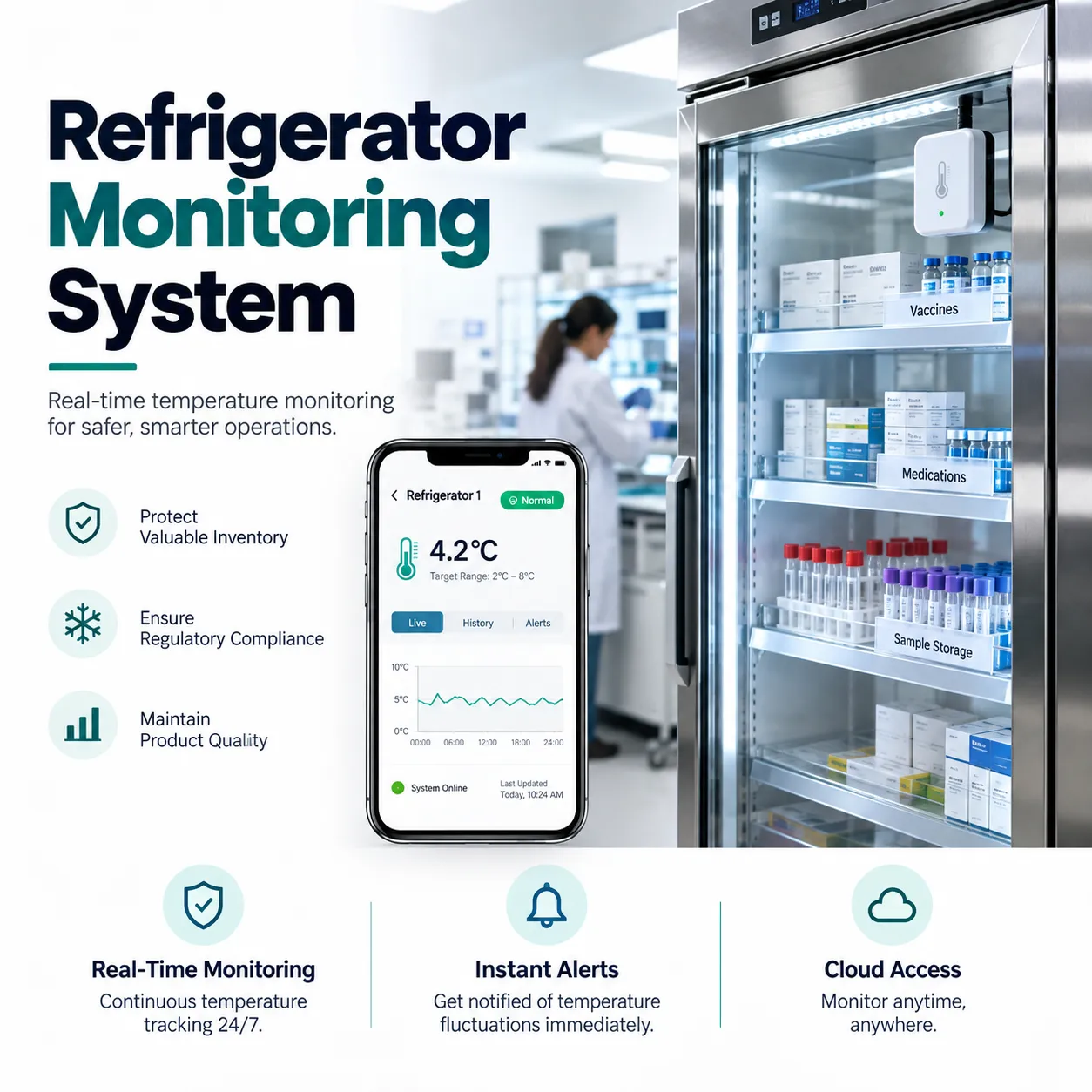

Healthcare facilities in Saudi Arabia depend on refrigerators and cold-storage units to protect vaccines, medicines, blood products, laboratory samples, and other temperature-sensitive materials. A Healthcare Refrigerator Monitoring System provides continuous visibility into storage conditions and helps medical organizations respond quickly when temperatures move outside acceptable ranges.
In hospitals, clinics, pharmacies, laboratories, vaccination centers, and medical warehouses, maintaining the required temperature is an essential part of protecting product quality. A modern Refrigerator Monitoring System in KSA combines temperature sensors, wireless connectivity, cloud-based monitoring, alerts, data logging, and reporting to create a more reliable cold-chain environment.
What Is a Healthcare Refrigerator Monitoring System?
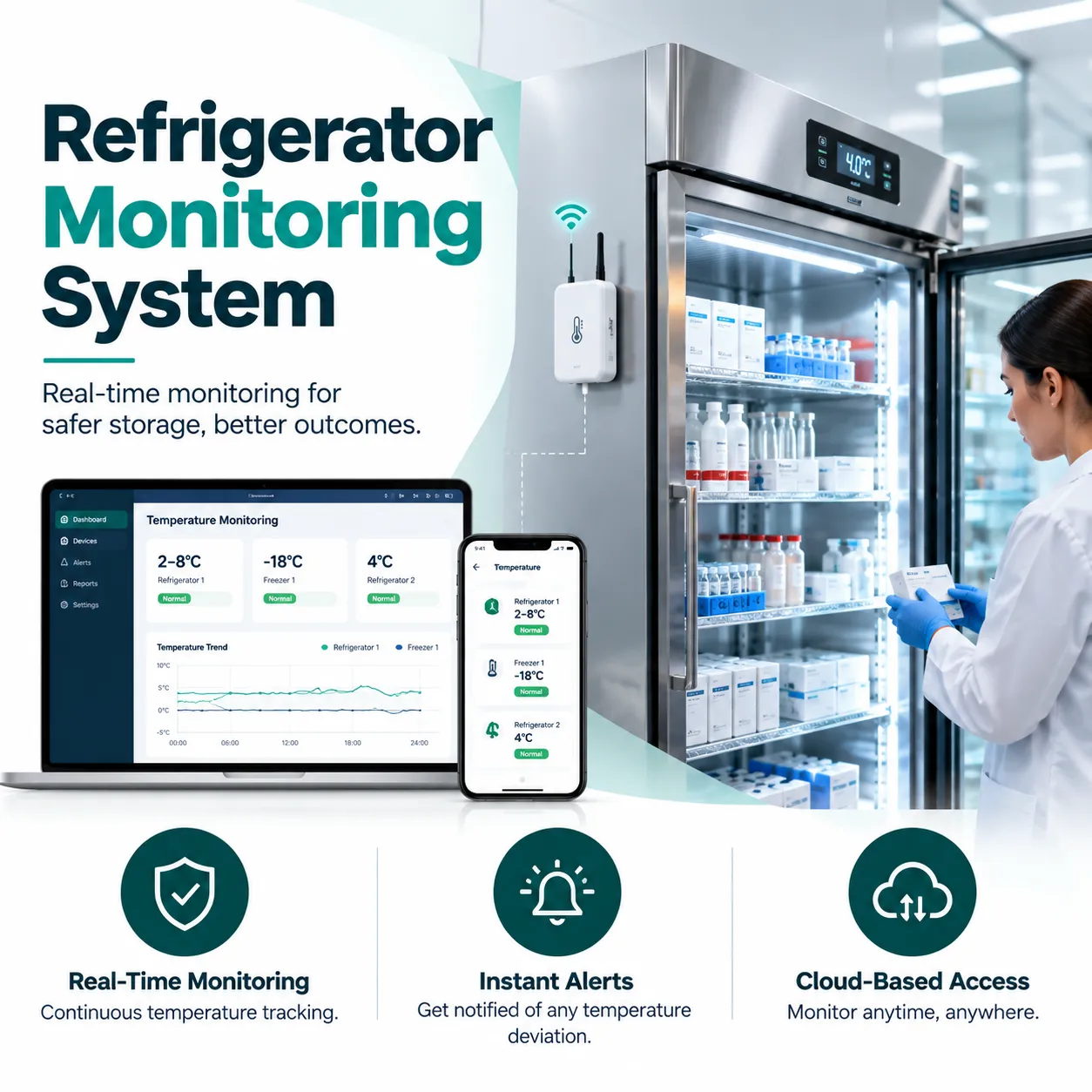
A Healthcare Refrigerator Monitoring System is a technology solution designed to continuously measure and record the temperature and other environmental conditions inside healthcare refrigerators and cold-storage equipment.
Unlike manual temperature checks, which are performed only at specific intervals, an automated monitoring solution can collect readings continuously. If the temperature reaches a configured threshold, the system can send an immediate alert to responsible personnel.
A typical system may include:
- IoT Temperature Sensors
- Wireless monitoring devices
- Centralized monitoring software
- Cloud-based dashboards
- SMS, email, or mobile alerts
- Temperature data loggers
- Historical reports
- Alarm management
- Multi-site monitoring capabilities
This approach allows healthcare organizations to monitor refrigeration equipment without depending entirely on manual inspections.
Why Refrigerator Temperature Monitoring Matters in Saudi Arabia
Saudi Arabia has a demanding climate, with high outdoor temperatures during much of the year. Healthcare facilities must therefore pay close attention to the performance of refrigeration equipment, particularly where temperature-sensitive products are stored.
A refrigeration failure can occur because of power interruptions, equipment malfunction, a door being left open, sensor problems, or other operational issues. Without continuous monitoring, a problem may remain unnoticed until significant product exposure has occurred.
A Healthcare Temperature Monitoring System can provide early visibility into abnormal conditions and help staff take corrective action.
For organizations managing multiple facilities, centralized monitoring can also make it easier to maintain consistent operational oversight.
Key Features of a Healthcare Refrigerator Monitoring System
1. Continuous Temperature Monitoring
One of the most important capabilities is continuous measurement of refrigerator temperature.
Temperature Sensors can collect readings at configured intervals and transmit the information to monitoring software. This provides healthcare teams with a continuous record rather than relying solely on manual readings.
The system can also display current temperature values through a centralized dashboard.
2. Real-Time Temperature Alerts
A Temperature Alarm System can notify designated personnel when the temperature exceeds predefined limits.
Depending on the system configuration, alerts may be delivered through:
- SMS
- Mobile notifications
- Dashboard alarms
- Audible notifications
Rapid alerts can help staff investigate the refrigerator and take appropriate corrective action.
3. Historical Data Logging
A Temperature Data Logger records refrigerator temperature readings over time.
Historical information can help organizations:
- Review temperature trends
- Investigate incidents
- Identify recurring fluctuations
- Support internal quality processes
- Generate temperature reports
- Maintain digital records
Digital records can also reduce the administrative burden associated with manually maintaining temperature logs.
4. Cloud-Based Monitoring
Modern IoT Refrigerator Monitoring solutions can connect refrigeration equipment to a secure cloud platform.
Authorized users can access temperature information remotely through computers, tablets, or mobile devices, depending on the system architecture.
This can be especially useful for healthcare organizations operating several locations across Saudi Arabia.
5. Door Status Monitoring
Refrigerator doors that remain open for extended periods can contribute to temperature fluctuations.
A monitoring solution can use door sensors to identify prolonged opening events and generate alerts. This provides an additional layer of operational visibility beyond temperature measurement alone.
6. Power Failure Alerts
Power interruptions can affect refrigeration equipment and may create a risk for temperature-sensitive products.
A Refrigerator Monitoring System can incorporate power-status monitoring and notify responsible personnel when a connected refrigerator experiences a power interruption.
This allows staff to investigate the situation promptly and follow their established contingency procedures.
7. Multi-Location Monitoring
Large healthcare organizations may operate hospitals, clinics, pharmacies, laboratories, warehouses, and vaccination centers across different locations.
A centralized monitoring platform can bring these sites into a single dashboard.
Instead of manually checking each refrigerator, authorized personnel can view the status of multiple devices from one monitoring interface.
Applications of Refrigerator Monitoring in KSA Healthcare
A Healthcare Refrigerator Monitoring System in Saudi Arabia can be applied across many healthcare environments.
Hospitals
Hospitals may use temperature monitoring for medical refrigerators, pharmacy storage, laboratories, blood banks, and specialized cold-storage areas.
Continuous monitoring can provide greater visibility into equipment performance and temperature conditions.
Pharmacies
Pharmacies may store temperature-sensitive medicines and biological products. Automated monitoring can help pharmacy teams maintain appropriate storage conditions and receive alerts when unusual temperature changes occur.
Vaccination Centers
Vaccines may require controlled storage conditions. A Vaccine Refrigerator Monitoring System can continuously monitor storage temperatures and provide alerts when readings move outside configured limits.
Medical Laboratories
Laboratories often use refrigerators and freezers to store samples, reagents, test materials, and other temperature-sensitive items.
Automated monitoring can provide a digital temperature history for each connected storage unit.
Blood Banks
Blood and blood components require carefully controlled storage environments. Temperature monitoring can help personnel maintain continuous oversight of refrigeration conditions and respond to alarms.
Pharmaceutical Warehouses
Large pharmaceutical and healthcare warehouses may operate numerous cold-storage units.
A centralized Cold Chain Monitoring System can help warehouse teams monitor multiple locations and identify abnormal conditions more quickly.
Benefits of a Healthcare Refrigerator Monitoring System
Improved Operational Visibility
Continuous monitoring gives healthcare personnel a clearer understanding of refrigerator conditions throughout the day and night.
Faster Response to Temperature Excursions
Automated alarms can alert responsible staff when temperature readings cross predefined thresholds, allowing them to investigate sooner.
Reduced Dependence on Manual Checks
Manual temperature recording can be time-consuming and may provide only periodic information. Automated monitoring creates a more consistent stream of data.
Better Record Management
Digital temperature histories can make it easier to review events and generate reports.
Centralized Management
Organizations with multiple refrigerators or facilities can monitor connected devices through a centralized platform.
Predictive Maintenance Opportunities
Temperature trends may help facility teams identify equipment that is showing unusual behavior. Repeated fluctuations can indicate that a refrigerator requires inspection or maintenance.
Greater Accountability
A digital system can provide records of temperature events, alarms, acknowledgments, and corrective actions, depending on the platform's capabilities.
How IoT Technology Improves Cold Storage Monitoring
The integration of IoT Sensors has transformed refrigerator monitoring from a periodic manual activity into a connected monitoring process.
Sensors can collect temperature information and transmit it to a gateway or cloud platform. The software can then analyze incoming data and display the refrigerator's current status.
For healthcare organizations, this architecture can provide several useful capabilities:
Sensor → Connectivity → Cloud Platform → Dashboard → Alert → Response
This connected approach can support remote monitoring and centralized management across different departments and facilities.
Choosing the Right Refrigerator Monitoring Solution in KSA
Healthcare organizations should consider several factors before implementing a monitoring solution.
Sensor Accuracy
Sensors should be appropriate for the required temperature range and application.
Alert Configuration
The platform should support configurable thresholds and appropriate notification mechanisms.
Data Storage
Organizations should consider how temperature data is stored, retained, accessed, and exported.
Connectivity
Wireless, Ethernet, cellular, or other connectivity options should be selected according to the facility's infrastructure.
Scalability
The system should be capable of supporting additional refrigerators and locations as the organization expands.
Dashboard and Reporting
A user-friendly dashboard can simplify monitoring, while reporting capabilities can support operational reviews and documentation.
Security
Healthcare organizations should evaluate access controls, user authentication, data protection, and the overall security architecture of the monitoring platform.
Healthcare Refrigerator Monitoring for Saudi Arabian Facilities
The growing adoption of connected healthcare technologies in Saudi Arabia is creating opportunities for healthcare organizations to improve facility operations through automation and IoT-based monitoring.
A Refrigerator Monitoring System KSA can be integrated into hospitals, pharmacies, laboratories, medical centers, pharmaceutical facilities, and other environments where controlled refrigeration is important.
Organizations can also combine refrigerator monitoring with broader Environmental Monitoring Systems, including humidity monitoring, room temperature monitoring, freezer monitoring, and equipment-status monitoring.
This creates a more comprehensive approach to healthcare facility management.
Best Practices for Implementing a Monitoring System
Before deployment, healthcare organizations should identify all refrigeration assets that require monitoring and determine the appropriate temperature limits for each application.
Other useful practices include:
- Install sensors in suitable locations inside refrigeration units.
- Configure temperature thresholds according to the intended application.
- Define personnel responsible for receiving and responding to alerts.
- Test notification mechanisms regularly.
- Review historical temperature data.
- Establish procedures for power failures and equipment faults.
- Periodically verify sensor performance.
- Maintain appropriate documentation and maintenance records.
- Monitor battery status for wireless devices where applicable.
- Review the system periodically as the number of monitored assets changes.
Technology is most effective when combined with clear operating procedures and trained personnel.
The Future of Healthcare Cold-Chain Monitoring in KSA
Healthcare monitoring is increasingly moving toward connected and data-driven infrastructure. IoT sensors, cloud platforms, mobile applications, analytics, and automated alerts can create a more integrated monitoring environment.
Future systems may provide more advanced analytics for identifying unusual temperature patterns, equipment behavior, and potential refrigeration issues.
Integration with facility-management platforms and enterprise healthcare systems can also provide organizations with a broader view of their operational infrastructure.
For Saudi Arabian healthcare providers, this shift toward connected monitoring can support more centralized, responsive, and data-driven cold-chain management.
Conclusion
A Healthcare Refrigerator Monitoring System in KSA provides healthcare organizations with continuous visibility into refrigeration conditions. By combining temperature sensors, IoT connectivity, real-time alerts, data logging, cloud monitoring, and reporting, organizations can create a more structured approach to managing temperature-sensitive storage.
From hospitals and pharmacies to laboratories, vaccination centers, blood banks, and pharmaceutical warehouses, automated monitoring can help personnel identify abnormal conditions quickly and maintain better digital records.
As healthcare facilities in Saudi Arabia continue adopting smart technologies, Refrigerator Temperature Monitoring, Cold Chain Monitoring, and IoT Environmental Monitoring can become important components of modern healthcare infrastructure.
Frequently Asked Questions
1. What is a Healthcare Refrigerator Monitoring System?
A Healthcare Refrigerator Monitoring System continuously measures and records refrigerator temperature and can send alerts when configured temperature limits are exceeded.
2. Why is temperature monitoring important for healthcare refrigerators?
Temperature monitoring helps healthcare personnel identify abnormal conditions quickly and maintain visibility over storage environments used for temperature-sensitive medicines, vaccines, samples, and other healthcare materials.
3. Can refrigerator monitoring be managed remotely?
Yes. Depending on the solution, cloud-connected monitoring platforms can allow authorized users to view temperature data and receive alerts remotely through dashboards or mobile devices.
4. Can one system monitor multiple refrigerators?
Yes. Many modern monitoring platforms support multiple sensors and refrigeration units, allowing organizations to manage several devices through a centralized dashboard.
5. What can cause a refrigerator temperature alarm?
Temperature alarms can be triggered by various conditions, including equipment malfunction, prolonged door opening, power interruption, inadequate cooling, or other temperature excursions. The appropriate response should follow the healthcare facility's established procedures.
























Sign in to leave a comment.