

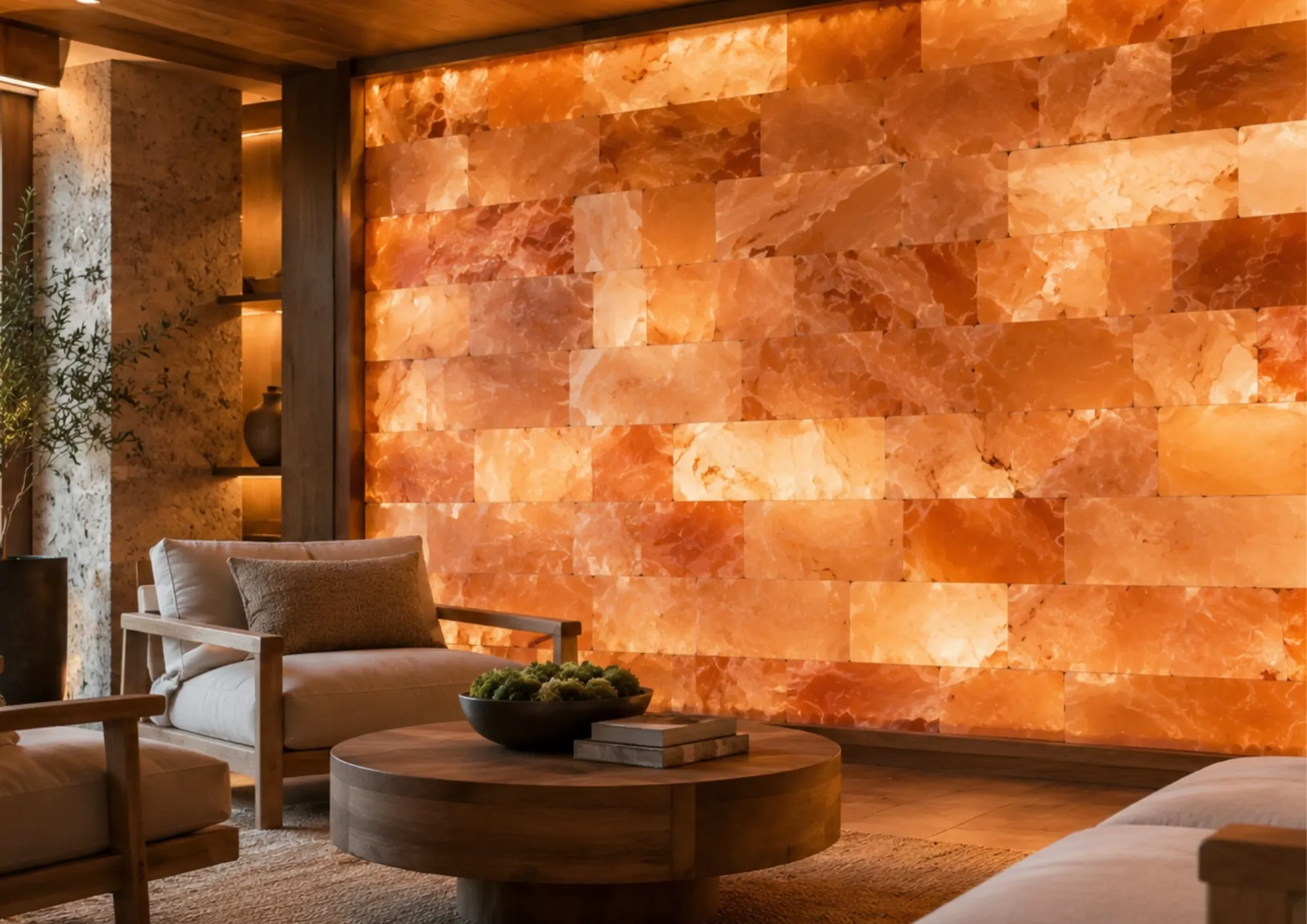
Himalayan salt brick walls are increasingly used as architectural features in homes, spas, saunas, wellness spaces, and hospitality interiors. Their natural pink and orange tones can create a warm visual effect, especially when combined with carefully planned lighting.
However, there is one factor that should always be considered before installing a salt wall: moisture.
- Himalayan salt is naturally soluble in water.
- That means a salt brick wall should not be planned or maintained in the same way as an ordinary brick, stone, or ceramic tile wall.
- Understanding how humidity, condensation, ventilation, and direct water exposure affect the material can help you make better decisions during design and installation.
Why Does Moisture Matter?
- Himalayan salt contains naturally occurring minerals and is primarily composed of salt.
- When exposed to water or persistent moisture, the salt can begin to dissolve.
- This does not mean salt bricks cannot be used in humid environments.
- It means the installation needs to account for the conditions surrounding the wall.
- The key distinction is between normal atmospheric humidity and direct or persistent water exposure.
- A wall in a controlled interior environment may experience occasional changes in humidity without the same level of exposure as a wall that regularly encounters condensation, splashing water, or steam.
Direct Water Exposure Is the Biggest Concern
The most important rule is simple:
Keep Himalayan salt bricks away from unnecessary direct water exposure.
For example, a salt wall beside a shower, bathtub, water feature, or frequently splashed area should be evaluated carefully.
Water can create localized areas where the salt surface becomes wet. Over time, repeated exposure may cause surface deterioration, texture changes, or material loss.
A salt wall is therefore better treated as a decorative architectural feature, rather than a waterproof wall surface.
Humidity in Saunas and Spas
Saunas and spas require additional planning because humidity and temperature conditions can vary considerably.
A salt bricks wall installed in a sauna or wellness environment should be designed around the specific operating conditions of that space.
Consider:
- Expected humidity levels
- Temperature fluctuations
- Ventilation
- Condensation
- Distance from water sources
- Cleaning procedures
- Placement of heating equipment
- Whether the wall will experience direct steam or splashing
The goal is not simply to choose salt bricks that look good. The surrounding environment needs to be suitable for the material.
Ventilation Makes a Difference
Good ventilation can help manage environmental moisture.
In a room where humidity regularly rises, proper air circulation can help reduce prolonged moisture accumulation on surfaces.
This is especially relevant in enclosed wellness spaces.
However, ventilation should not be viewed as a way to make salt bricks waterproof. It is simply one part of a properly planned environment.
If the room has persistent condensation or uncontrolled humidity, the underlying moisture problem should be addressed before installing a salt wall.
What About Condensation?
Condensation can occur when warm, moist air comes into contact with a cooler surface.
This can be particularly important in spaces with temperature fluctuations. Repeated condensation can create localized moisture exposure even when there is no direct water spray.
Before installation, consider where condensation is likely to occur and whether the proposed salt wall location is exposed to those conditions.
A professional installation plan should take the room's temperature, ventilation, and moisture behavior into account.
Protecting the Wall During Cleaning
- Cleaning is another area where moisture can become a problem.
- A Himalayan salt brick wall should not be cleaned like a conventional washable tile wall by repeatedly soaking the surface with water.
- Instead, routine maintenance should minimize unnecessary moisture exposure.
- The exact cleaning method should also account for the installation system and the environment in which the wall is located.
- If a wall is exposed to dust or other contaminants, use a maintenance approach appropriate for the salt material rather than introducing large amounts of water.
Choose the Wall Location Carefully
Location can have a major effect on the long-term condition of a salt wall.
A relatively dry interior feature wall may be easier to maintain than a wall positioned directly beside a source of water.
Before installation, look at the entire surrounding area.
Ask:
- Is there a shower nearby?
- Could water splash onto the wall?
- Does the room experience heavy steam?
- Where does condensation normally form?
- Is ventilation adequate?
- Will the wall need frequent cleaning?
- Are there heating or cooling sources nearby?
These questions can help identify potential moisture problems before the bricks are installed.
Bricks, Joints, and Moisture Planning
Moisture planning is not only about the salt itself. The complete wall assembly matters.
The installation method, joints, supporting surface, lighting system, and surrounding construction should all be considered together.
For larger installations, the wall should be designed so that moisture does not become trapped behind the salt material or around components of the installation.
This is one reason it is useful to finalize the wall design before ordering materials. Proper planning can account for openings, corners, lighting, ventilation, and environmental conditions at the same time.
Can Himalayan Salt Bricks Be Used in Humid Rooms?
They can be considered for humid environments, but humidity alone should not be treated as a guarantee of suitability.
The actual conditions matter.
A room with controlled humidity, good ventilation, and no direct water exposure is very different from an area exposed to constant steam or repeated splashing.
For projects involving saunas, spas, or other high-humidity environments, evaluate the specific conditions rather than assuming that every salt brick installation will perform the same way.
Final Thoughts
Moisture is one of the most important considerations when planning a Himalayan salt brick wall.
The material's natural solubility means that direct water exposure, persistent condensation, uncontrolled humidity, and improper cleaning can create problems over time. On the other hand, thoughtful placement, ventilation, environmental planning, and appropriate maintenance can help reduce unnecessary moisture exposure.
Before installing Himalayan salt bricks, Tiles & Blocks for wall applications, focus on the environment as much as the appearance.
A well-designed salt wall is not simply about choosing attractive bricks. It is about selecting the right location, understanding the room conditions, planning the installation properly, and protecting the material from unnecessary water exposure.





















Sign in to leave a comment.