
Introduction
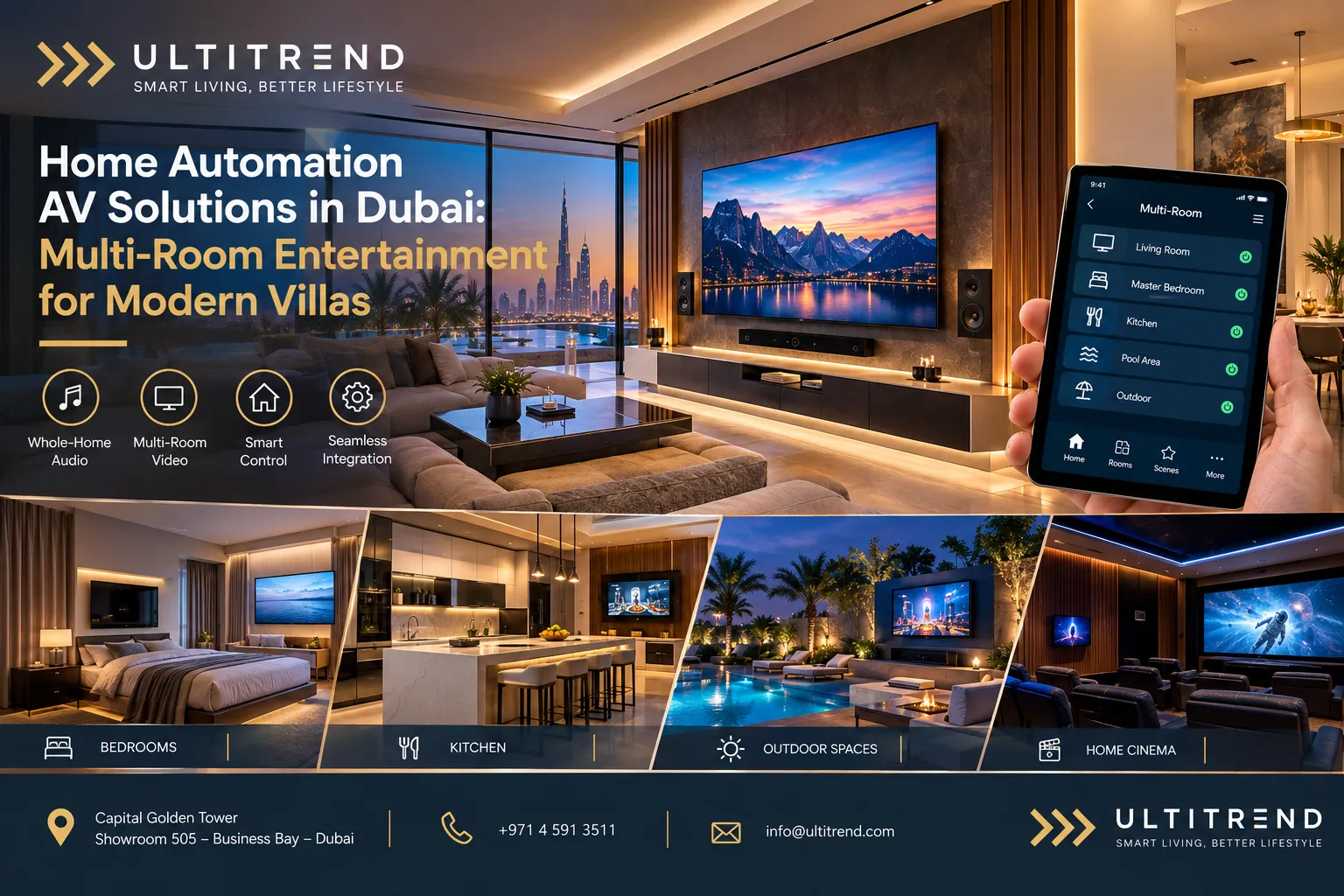
Picture a fairly ordinary evening in a modern villa: one family member wants to watch the football, another is streaming a show in their bedroom, and someone else wants background music by the pool. In a poorly planned setup, that means three separate remotes, three separate boxes, and probably a router struggling under the load. This is precisely the everyday scenario that well-designed home automation AV solutions in Dubai are built to solve.
Multi-room entertainment gets discussed often, but usually in terms of audio alone, a playlist following you from room to room. Modern villas typically need something more sophisticated than that, since video content, multiple simultaneous sources, and different household members with different preferences all need to coexist without constant conflict or confusion.
This article looks specifically at how multi-room entertainment works at the video and content-distribution level in a modern villa, beyond audio alone, and what makes the difference between a system that genuinely serves a busy household and one that quietly frustrates it.
Why Modern Villas Need More Than Multi-Room Audio
Multi-room audio solved a real problem, letting music follow occupants or play independently across zones. Video and mixed content introduce a considerably more complex challenge, since different rooms often need access to entirely different sources simultaneously, not just the same content played in different locations.
A modern villa might reasonably need a television in the majlis showing live sports, a projector in a media room playing a film, a bedroom television streaming something else entirely, and outdoor speakers playing background music, all running independently at the same time without interfering with each other or overwhelming the home network.
This is where the distinction between simple multi-room audio and genuine multi-room entertainment becomes important, since the latter requires considerably more thoughtful infrastructure to actually work reliably.
Understanding AV Distribution and Matrix Switching
The technical foundation supporting true multi-room video entertainment typically involves what is known as AV distribution, sometimes implemented through a matrix switcher, allowing multiple video and audio sources to be routed to multiple displays independently.
How Matrix Distribution Works
A matrix system essentially allows any connected source, a streaming device, a cable box, a gaming console, to be sent to any connected display, and crucially, different displays can show different sources simultaneously rather than being locked into mirroring the same content throughout the property.
Why This Matters for Villas Specifically
Larger properties with multiple entertainment zones benefit considerably from this flexibility, since a single household rarely wants identical content in every room at the same time. A properly configured matrix system allows genuine independence between zones while still centralizing source equipment in one location rather than duplicating hardware in every room.
Planning Entertainment Zones in a Modern Villa
Rather than treating every room identically, effective multi-room entertainment planning typically groups spaces into distinct zones based on how they are actually used.
- Primary entertaining areas, such as the majlis or main living room, which typically warrant the highest-quality display and audio setup, often serving as the default zone for hosting guests.
- Dedicated media or cinema rooms, built specifically for immersive viewing, usually isolated acoustically and visually from the rest of the home's daily activity.
- Bedrooms and private spaces, generally requiring simpler, independent setups that do not need to integrate with the wider household's viewing choices.
- Outdoor and semi-outdoor areas, including pools and terraces, where audio tends to matter more than video, though outdoor-rated displays are increasingly requested for evening gatherings.
Mapping these zones early, before selecting specific equipment, helps avoid the common mistake of over-investing in areas that see limited use while under-resourcing the spaces a household actually spends the most time in.
Centralized Source Equipment vs Distributed Hardware
One of the more meaningful decisions in planning modern villa entertainment involves where source equipment, streaming devices, cable boxes, and media servers, actually lives within the property.
The Case for Centralization
Keeping source equipment in a single, centralized location, often a dedicated equipment rack or closet, considerably simplifies maintenance and reduces visible clutter throughout the home, since only cabling rather than full devices needs to reach each room.
When Distributed Hardware Makes Sense
For smaller villas or households wanting greater independence between rooms, distributed hardware, meaning each room manages its own streaming device, may offer simpler troubleshooting, though at the cost of centralized control and the flexibility matrix distribution provides.
Most professionally planned modern villa systems favor centralization, since it typically provides more consistent performance and considerably easier long-term maintenance, particularly relevant for larger properties running several entertainment zones simultaneously.
Network Infrastructure for Multi-Source Entertainment
Genuine multi-room video entertainment places significant demand on a villa's network, considerably more than audio-only setups or single-television households.
Multiple simultaneous 4K streams require substantial bandwidth, and a network designed for basic browsing and a single streaming device will struggle noticeably once several zones are active at once. Wired connections, where feasible, generally outperform wireless for primary entertainment zones, since Wi-Fi congestion becomes a genuine risk in villas running numerous connected devices across lighting, climate, and smart home security systems in Dubai simultaneously. Dedicated network segments for entertainment traffic, separate from general household internet use, can help prevent streaming quality from being affected by other household activity happening at the same time.
If your villa is currently experiencing buffering or lag during simultaneous use across multiple rooms, this is frequently a network capacity issue rather than a problem with the AV equipment itself, worth investigating before assuming new hardware is required.
Universal Control Across Multiple Zones
Managing entertainment across several independent zones only works well if control remains simple, regardless of how sophisticated the underlying distribution system actually is.
A single app or touch panel interface allowing household members to select sources, adjust volume, and switch inputs for their specific zone, without needing to understand the underlying distribution infrastructure, is essential for genuine day-to-day usability. Voice control integration adds further convenience, particularly for quick adjustments that do not require navigating a full interface. Guest-friendly simplicity also matters considerably, since visitors unfamiliar with a household's specific setup should be able to operate at least the basics without detailed instructions.
This principle mirrors what tends to work well within broader smart home automation in Dubai generally, where the underlying technical complexity should remain invisible to the people actually using the system day to day.
Integrating Multi-Room Entertainment With the Rest of the Villa
Multi-room AV performs best when planned alongside the villa's broader automation rather than as a completely isolated system.
A few practical examples of this integration:
- Lighting scenes adjusting automatically based on which entertainment zone is active, dimming specifically in the room currently being used rather than affecting the entire property
- Climate settings adjusting slightly in an active media room shortly before or during use
- Outdoor audio and lighting activating together for evening entertaining without requiring separate manual adjustments for each system
This kind of coordination reinforces why AV planning tends to work best as part of a broader villa automation conversation from the outset, rather than treated as a completely separate purchase considered later.
Common Planning Mistakes in Villa-Scale Entertainment
A few recurring issues tend to undermine otherwise well-intentioned multi-room entertainment projects.
- Underestimating network demand, assuming a standard household router can handle multiple simultaneous 4K streams across several zones without noticeable performance issues.
- Treating every zone identically, investing heavily in bedrooms or secondary spaces while underfunding the primary entertaining areas that actually see the most use.
- Choosing distributed hardware without considering long-term maintenance, resulting in multiple separate devices across the property that each require individual troubleshooting and updates.
- Retrofitting distribution wiring after construction, significantly increasing both cost and disruption compared to planning cable runs during the build or a major renovation.
- Overcomplicating control, building an impressive but genuinely confusing system that household members and guests struggle to actually use comfortably.
Involving an experienced AV planner early in a villa's construction or renovation process tends to prevent most of these issues before they become expensive to correct later.
Conclusion
Multi-room entertainment in a modern villa involves considerably more than simply extending audio throughout the property. Genuine, well-planned home automation AV solutions in Dubai account for independent video sources, network capacity, centralised equipment, and control that remains simple regardless of how sophisticated the underlying distribution system actually is.
For villa owners planning a new build, renovation, or significant entertainment upgrade, thinking through zones, infrastructure, and control together from the outset tends to produce a system that genuinely serves a busy household rather than adding another layer of complexity to daily life.
Design Entertainment That Fits Your Whole Villa
If your household regularly juggles different entertainment needs across multiple rooms, our team can help design a properly distributed AV system that keeps every zone independent yet easy to control. Reach out to start planning your villa's entertainment setup.
Frequently Asked Questions
What is the difference between multi-room audio and multi-room video entertainment? Multi-room audio typically follows or plays the same content across zones, while multi-room video entertainment often requires different sources playing independently and simultaneously in different rooms.
What is a matrix switcher, and do I need one for my villa? A matrix switcher routes multiple video and audio sources to multiple displays independently, allowing different rooms to show different content at once. It is particularly useful for villas with several active entertainment zones.
Should source equipment be centralized or placed in each room? Centralizing source equipment in one location generally simplifies maintenance and reduces clutter, though distributed hardware can offer simpler troubleshooting for smaller properties or households wanting more independence.
Why does my villa experience buffering when multiple rooms stream at once? This is often a network capacity issue rather than an AV equipment problem, particularly common when several zones stream simultaneous high-resolution content over an underprepared network.
Can multi-room entertainment be integrated with lighting and climate control? Yes, integrated systems can adjust lighting and climate automatically based on which entertainment zone is active, coordinating with the rest of the villa's automation.
Is it better to plan multi-room entertainment during construction or after? Planning during construction or major renovation is significantly easier and more cost-effective, since cable distribution can be built into the structure rather than retrofitted later.




















Sign in to leave a comment.