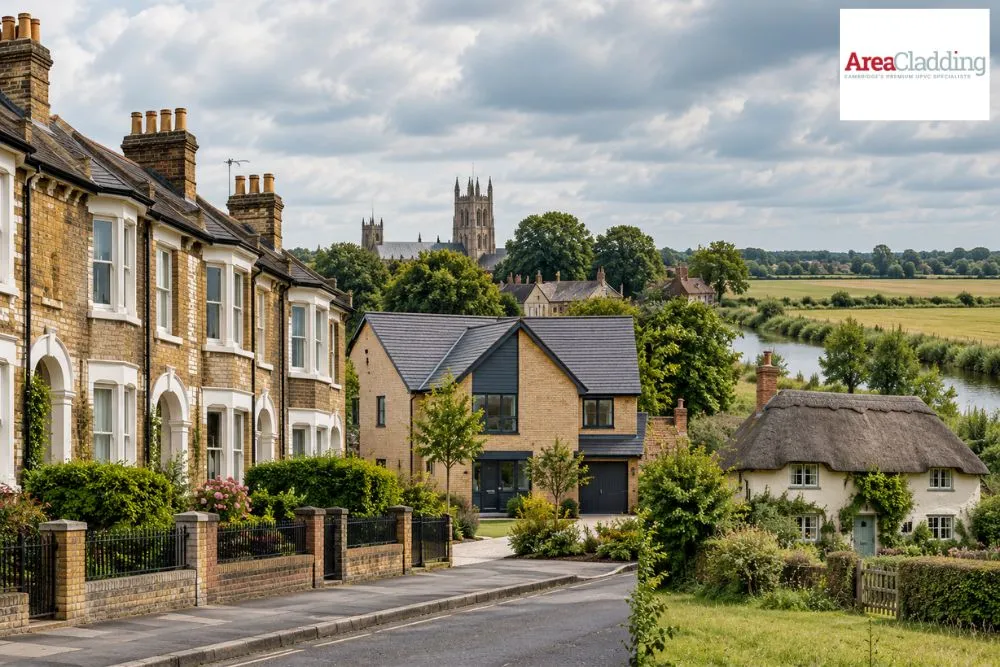

If you own a home in Cambridgeshire, you already know that "home improvement advice" written for a generic UK audience only gets you so far. A Victorian terrace in Cambridge behaves very differently from a 1970s bungalow in Wisbech or a barn conversion out near Ely. Soil type, flood risk, conservation rules, and even the age profile of local housing stock all shape what "improving your home" actually involves here.
This guide pulls those local realities together. It's written for homeowners who want to make sensible, well-planned improvements — whether that's a loft conversion in Cambridge, damp-proofing a Fenland cottage, or simply working out which upgrades are worth the money before you sell. Rather than repeating generic checklists, it focuses on what genuinely matters for Cambridgeshire properties: planning constraints, ground conditions, energy efficiency in older housing stock, and the trade-offs homeowners in this county tend to face in practice.
Why Cambridgeshire Homes Need a Slightly Different Approach
Cambridgeshire isn't one uniform housing market. Broadly, you're dealing with three very different property types:
- Cambridge city and surrounding market towns (Cambridge, Ely, Huntingdon, St Ives) — a mix of Victorian and Edwardian terraces, 1930s semis, and newer developments, many within conservation areas.
- Fenland and rural areas (March, Wisbech, Chatteris, Whittlesey) — often older cottages and farmhouses on low-lying, peat or clay-based ground, with a higher proportion of solid-wall construction and higher flood risk.
- New-build estates across the county, particularly around Cambridge's growth corridors, where the challenges are less about structural age and more about snagging, warranty terms, and making generic layouts feel more personal.
Each of these brings different priorities. A homeowner in a Fenland cottage is usually more concerned with damp, drainage, and insulating a solid-wall property without trapping moisture. Someone in central Cambridge is more likely to be navigating listed building consent or conservation area restrictions. Recognising which category your property falls into is the first real step in planning any improvement — it changes your budget, your timeline, and sometimes whether a project is even possible without permission.
Planning Permission and Conservation Rules in Cambridgeshire
This is the area where Cambridgeshire homeowners most often get caught out, because assumptions from other parts of the country don't always transfer.

Conservation Areas and Listed Buildings
Cambridge City Council maintains numerous conservation areas covering large parts of the historic centre, and many surrounding villages (particularly along the Cam and in areas like Grantchester) have their own designations. If your property sits within one of these, permitted development rights are usually reduced — meaning changes that would be automatically allowed elsewhere (like certain extensions, roof alterations, or even replacing windows) may require planning permission.
Listed buildings are a further step up in restriction. Cambridgeshire has a meaningful number of Grade I, Grade II* and Grade II listed properties, and any changes affecting the character of a listed building — internal or external — typically need listed building consent, separate from standard planning permission. This applies even to things homeowners often assume are minor, such as changing window frames or repointing with the wrong mortar mix.
Practical takeaway: Before committing to design ideas, check your property's status directly with the relevant local planning authority (Cambridge City Council, South Cambridgeshire District Council, East Cambridgeshire District Council, Huntingdonshire District Council, or Fenland District Council, depending on location). A five-minute check can save months of wasted design work.
Flood Risk and Building Control in the Fens
Large parts of Fenland sit below sea level and are managed through an extensive drainage system. If you're extending a property or adding a new structure in these areas, building control will often require specific consideration of flood resilience — this can include raised electrical sockets, flood-resistant materials at ground level, or drainage assessments as part of the planning process. It's worth budgeting for this from the outset rather than treating it as an unexpected add-on cost partway through a project.
Insulating and Heating Older Cambridgeshire Homes
A significant proportion of Cambridgeshire's housing stock predates cavity wall construction, which changes the entire approach to energy efficiency improvements.
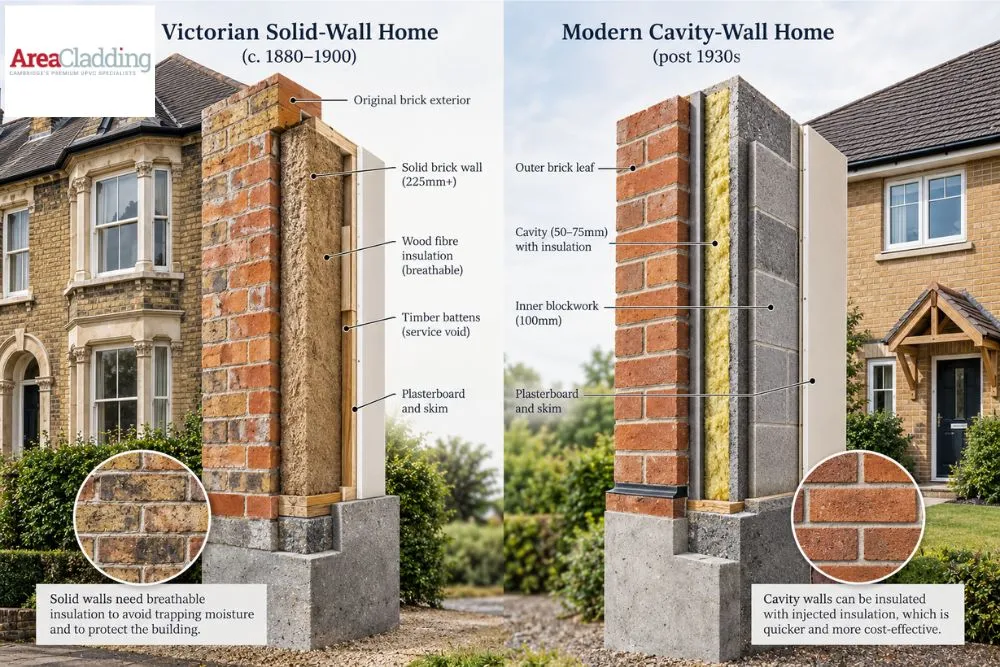
Solid Wall vs Cavity Wall Properties
| Consideration | Solid Wall (pre-1930s, common in Fens & Cambridge terraces) | Cavity Wall (1930s onwards, common in newer estates) |
|---|---|---|
| Typical insulation method | Internal or external wall insulation | Cavity wall injection insulation |
| Relative cost | Higher — especially external insulation | Lower, often quicker to install |
| Risk if done poorly | Trapped moisture, damp, timber decay | Cold bridging if gaps are missed |
| Planning impact | External insulation may need consent in conservation areas | Rarely requires planning permission |
| Best suited to | Homeowners planning to stay long-term | Most standard semi-detached and detached homes |
For solid-wall Cambridgeshire cottages, especially those with lime mortar or timber frames, it's worth being cautious about modern, vapour-tight insulation systems. Older buildings were designed to "breathe," and sealing them with the wrong materials can cause damp problems that are more expensive to fix than the original energy inefficiency. Traditional, breathable insulation approaches (lime-based renders, wood fibre boards) tend to hold up better in these properties, even though they cost more upfront.
Heating Considerations
Rural Cambridgeshire properties are more likely to be off the mains gas grid, particularly in villages around the Fens. For these homes, improvements often centre on:
- Air source heat pumps, which work well with good insulation but need realistic sizing for older, less airtight buildings
- Oil or LPG boiler replacements, where efficiency gains can still be substantial
- Improving airtightness gradually, rather than in one disruptive phase, to avoid overwhelming an older heating system
Extensions and Loft Conversions: What Actually Adds Value Locally
Cambridge's housing market is unusually space-constrained relative to demand, which shifts the value calculation for certain improvements compared with the national average.

Loft conversions tend to perform particularly well in Cambridge and Cambourne-style family housing, where an extra bedroom can make a meaningful difference to what a property can achieve, given how tightly priced family homes are in the city. In more rural Fenland towns, where land and existing floor space are less constrained, the same conversion may add proportionally less value simply because buyers have more affordable alternatives with more space already.
Kitchen extensions and open-plan reconfigurations remain popular across the county, but in conservation areas, rear extensions are usually easier to get approved than side or front extensions, since they're less visible from the street and have less impact on a property's historic character.
Garden rooms and outbuildings have grown in popularity, partly driven by remote working patterns from Cambridge's large tech and academic workforce. These are often achievable under permitted development, but size limits and proximity to boundaries still apply, and flood zone restrictions can affect foundations in Fenland gardens.
Finding and Vetting Local Tradespeople
Cambridgeshire's building trade has real specialists worth seeking out rather than defaulting to whoever's available fastest:

- For listed buildings and conservation work, look specifically for tradespeople with documented heritage or conservation experience — general contractors without this background can unintentionally use inappropriate materials or methods.
- For Fenland properties, ask directly about experience with solid-wall insulation and drainage — this isn't universal experience even among competent general builders.
- Always check that any structural work involving flood zones has been signed off by building control with flood risk in mind, not just standard building regulations.
A useful practical step: ask any quote-giving tradesperson what they'd flag as the main risk specific to your property type, not just the job itself. Their answer tells you quickly whether they understand the property or are treating it as a standard job.
Key Takeaways
- Cambridgeshire property types vary enormously — Cambridge terraces, Fenland cottages, and new-build estates each need a different improvement approach.
- Always check conservation area and listed building status before finalising design plans; restrictions here are more common than many homeowners expect.
- Flood risk in Fenland areas can affect both planning requirements and construction methods, so factor this in early.
- Solid-wall properties need breathable insulation approaches to avoid trapping moisture — cheaper cavity-wall solutions aren't interchangeable.
- Loft conversions tend to add the most value in space-constrained areas like Cambridge city, while rural areas see different value dynamics.
- Vetting tradespeople for property-specific experience (heritage, flood zones, solid walls) matters more here than in many other parts of the UK.
Frequently Asked Questions
Q: Do I need planning permission for a loft conversion in Cambridge?
A: Often not, if it falls within permitted development limits — but this changes if your property is in a conservation area, is listed, or if the conversion involves significant roof alterations visible from the street. Always confirm with your local planning authority before starting design work.
Q: Is my Cambridgeshire property likely to be in a flood zone?
A: Much of Fenland and low-lying areas near the River Great Ouse carry some level of flood risk. The Environment Agency's flood risk maps let you check a specific address, and this should be one of the first things you look at before planning ground-floor extensions.
Q: Can I insulate a solid-wall Victorian terrace in Cambridge myself?
A: Some elements, like loft insulation, are straightforward DIY jobs. Wall insulation for solid-wall properties, however, is best left to specialists familiar with breathable materials — poor installation can cause long-term damp issues that are costlier to fix than the original problem.
Q: Are heat pumps a realistic option for older rural Cambridgeshire homes?
A: Yes, but they perform best once a property has reasonable insulation and airtightness. For older, less insulated rural properties, it's often worth improving the building fabric first, or planning insulation and heating upgrades together, rather than fitting a heat pump into a very draughty house.
Q: How do I check if my house is listed or in a conservation area?
A: Your local district or city council's planning department maintains publicly searchable conservation area maps and listed building registers, and Historic England's National Heritage List for England is also searchable by address.

























Sign in to leave a comment.