
"Hospital-grade" is a marketing phrase, not a legal standard. No government agency in the U.S. defines it or tests for it. Any brand can print it on a box.
That doesn't mean every product with the label is bad. It means the words alone tell you very little. If you're shopping for an indoor air purifier, you need to look at the numbers behind the claim.
This guide explains where the term came from, what real hospitals use, and which specs matter for your home or office.
Where the "Hospital Grade" Label Comes From
Hospitals do clean their air. They use HEPA filters, and they control how air moves between rooms. Marketers borrowed that image because it sounds safe and serious.
But a hospital's air system is not a portable box. It is a whole building system with ducts, fans, pressure controls, and trained staff. A small unit on your floor can't copy all of that.
So, when you see a hospital-grade air purifier for sale, treat it as a starting point for questions, not an answer.
What "HEPA" Actually Means
HEPA stands for High-Efficiency Particulate Air. The U.S. Department of Energy standard says a true HEPA filter must capture at least 99.97% of particles that are 0.3 microns in size.
That size is the hardest to catch. Bigger and smaller particles are usually trapped even more easily. So, a true HEPA filter is very good at removing dust, pollen, pet dander, mold spores, and smoke particles.
Watch out for look-alike terms:
- "HEPA-type" or "HEPA-like": These are not held to the true HEPA standard.
- "99% HEPA": This is not the same as 99.97% at 0.3 microns.
- "Medical-grade HEPA": This is another phrase with no official definition.
In Europe, filters are graded under a standard called EN 1822. H13 filters capture at least 99.95% of the toughest particles, and H14 filters capture at least 99.995%. If a brand lists H13 or H14, that is a useful, specific claim.
What Real Hospitals Do Differently
This is the part most product pages skip. Hospitals rely on more than filters.
They use air changes per hour (ACH), which is how many times the air in a room is fully replaced each hour. The CDC recommends at least 12 air changes per hour for airborne infection isolation rooms in new construction. Ordinary patient rooms need far fewer.
They also control airflow direction. Some rooms are kept at negative pressure so air flows in, not out. Others are kept at positive pressure to protect vulnerable patients.
Portable units can support cleaner air in a room, and some are even used in healthcare settings as a backup. But your home unit is not a copy of a hospital ventilation system. Knowing that helps you set realistic goals.
Are Commercial Air Purifiers the Same Thing?
Not exactly. Commercial air purifiers are built for larger, busier spaces like offices, clinics, gyms, and classrooms. They usually move more air, run longer, and have stronger motors.
Some commercial models do use true HEPA filters. But "commercial" is also just a label. It tells you the unit is designed for bigger spaces or heavier use, not that it's medically superior.
That said, commercial air purifiers can make sense for a big open-plan living area, a home office with heavy use, or a small business. The key is the same as before: check the specs, not the name.
What to Check Instead: Six Things That Matter
Here are the details that actually predict how well a unit will work.
1. True HEPA Filtration
Look for the words "true HEPA" and the 99.97% at 0.3 microns claim. If a product lists H13 or H14, that's a good sign too.
2. CADR (Clean Air Delivery Rate)
CADR is a rating from the Association of Home Appliance Manufacturers (AHAM). It measures how much filtered air a unit delivers for smoke, dust, and pollen. Higher numbers mean faster cleaning.
A common rule from AHAM: your unit's smoke CADR should be at least two-thirds of your room's floor area, assuming an 8-foot ceiling. For example, a 300-square-foot room needs a smoke CADR of about 200.
3. Room Size and Air Changes
Pick a unit that can clean your room's air at least four to five times an hour. Sellers often list "recommended room size," but check that it is based on CADR, not just a guess.
4. Ozone Safety
Some devices, like ozone generators and certain ionizers, can release ozone. Ozone is a lung irritant. The EPA warns against using ozone generators in occupied spaces.
In California, air cleaners must meet strict ozone limits of 0.050 parts per million, and units that pass are listed as CARB-certified. That certification is a good safety check no matter where you live.
5. Noise Level
A loud purifier gets turned off. Check the decibel rating at low, medium, and high speeds. For bedrooms, look for a unit that stays quiet on its lowest setting.
6. Filter Costs and Maintenance
Replacement filters are the real long-term cost. Before you buy, find out how often filters need changing and what they cost. A cheap unit with expensive filters is not a bargain.
A Note on UV Light, Ionizers, and Add-Ons
Some products add UV-C lamps, ionizers, or "plasma" features and use them to justify a "hospital-grade" price tag. These add-ons deserve caution.
UV-C light can work in specific, controlled settings, but in a home purifier, the air moves past the lamp very quickly. That limits its effect. Ionizers may create small amounts of ozone.
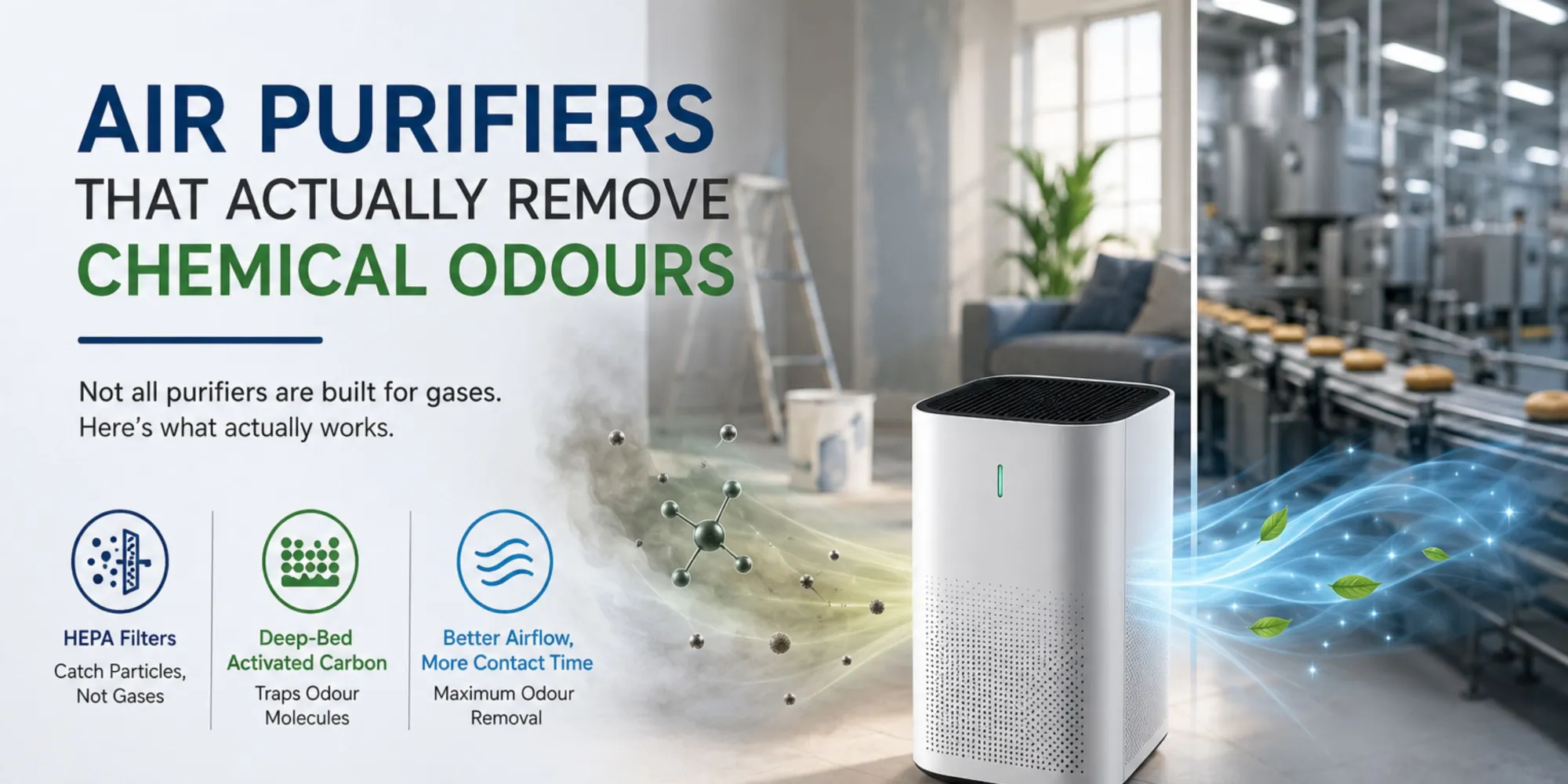
If you want the simplest, most proven design, choose a unit with a true HEPA filter and, if you like, an activated carbon layer for odors and gases. HEPA filters catch particles, but they don't remove gases like cooking fumes or paint vapors. Carbon helps with those.
Is a Medical Device Different?
Sometimes, yes. In the U.S., the FDA regulates certain air purifiers as medical devices when the maker claims they treat or prevent a health condition. These products must meet extra requirements.
That is a formal category. It is very different from a casual "hospital grade" sticker. If a company makes serious health claims, ask whether the product is actually FDA-cleared, and look for proof.
How to Spot an Honest Product Page
A trustworthy seller makes it easy to find facts. Look for:
- A stated CADR for smoke, dust, and pollen
- Clear proof of true HEPA filtration
- AHAM Verified or CARB certification
- Filter cost and replacement schedule
- Honest limits, such as "reduces particles" instead of "eliminates all germs"
If a page promises to kill all viruses or cure allergies, walk away. No air cleaner can promise that.
Read the Specs, Not the Sticker
The phrase "hospital grade" sounds impressive, but it is only a label. What protects your air is real performance: true HEPA filtration, a strong CADR for your room size, safe ozone levels, and filters you can afford to replace.
Before you buy any indoor air purifier, ignore the slogan and check the numbers. Compare a hospital-grade air purifier claim against CADR ratings and certifications. Do the same for commercial air purifiers. The product that shows its proof is the one worth trusting, and the right indoor air purifier is the one that fits your room and your budget.


























Sign in to leave a comment.