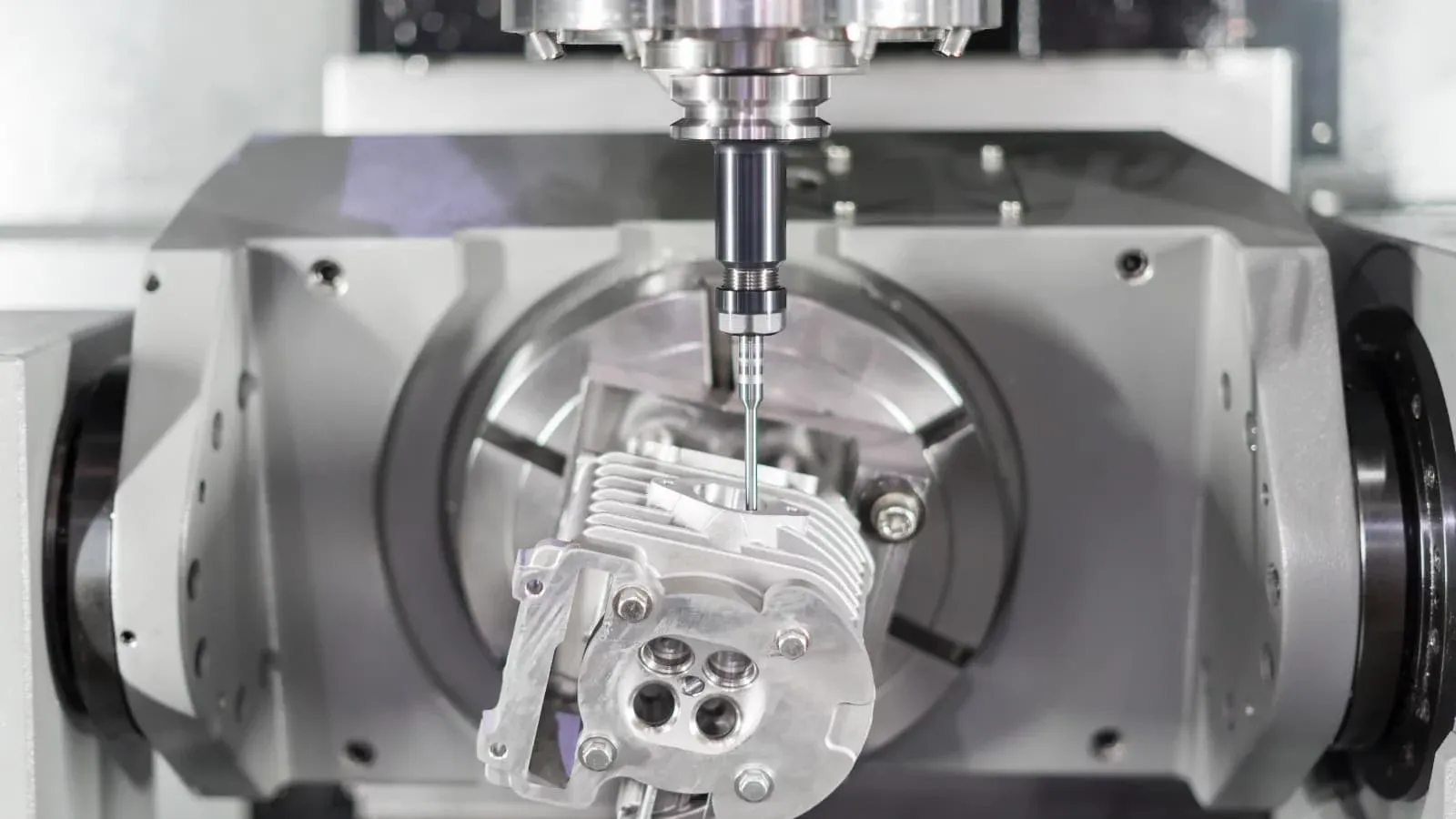

Ever held a metal part and wondered how it was made with so many curves, angles, and tiny holes?
Most of the time, the answer is a multi axis CNC milling machine.
A part like that used to need three or four separate machines and a lot of hand work. Every time a worker moved the part, small errors crept in. Today, one machine can do most of the job in a single setup.
In this guide, I'll explain how it works, where it's used, and how to avoid the mistakes that cost buyers time and money.
What Is a Multi Axis CNC Milling Machine?
A CNC milling machine uses a spinning cutting tool to remove material from a solid block. A computer controls every move.
A basic machine moves along three lines: left and right (X), front and back (Y), and up and down (Z). That's a 3-axis machine.
A multi axis CNC milling machine adds more movement. It tilts or rotates the part, the tool, or both. That lets the tool reach the part from many angles without stopping to reposition it.
The Main Types
- 3-axis: Good for flat parts, slots, holes, and simple shapes.
- 4-axis: Adds rotation, so the tool can reach the sides of a part.
- 5-axis: Adds a second rotation, so the tool can reach almost any surface. It's the best choice for complex shapes.
How Multi Axis CNC Milling Works: Step by Step
Here is the process, the way it usually runs in a real shop.
- Start with a design. The customer sends a 3D model or a drawing with dimensions, tolerances, and material.
- Review for manufacturability. An experienced machinist checks the design. If a wall is too thin or a tolerance is unrealistic, a good shop says so before cutting any metal.
- Program the toolpath. CAM software plans the tool's route. It then turns that plan into G-code, the language the machine reads.
- Choose the material and tools. Aluminum, stainless steel, and titanium all cut differently. Each needs its own speeds, feeds, coolant, and cutting tools.
- Set up the part. The block of material is clamped in a fixture. With multi axis machines, this often happens just once.
- Run the machine. The tool cuts while the part or head tilts and rotates to reach each surface.
- Inspect the part. Precision measuring tools confirm every critical dimension.
- Finish and ship. The part gets any needed finishing, such as anodizing or passivation, and then goes out the door.
The big idea is step 5. Fewer setups mean fewer chances for error. That's why multi axis work is so accurate.
Real World Examples
Multi axis machining shows up in more places than most people expect.
Aerospace
Aircraft parts often have curved surfaces, deep pockets, and tight tolerances. Brackets, housings, and small structural pieces are common jobs. In this industry, one bad part can hold up a whole program.
Medical
Surgical tools and device housings need smooth surfaces and exact sizes. A multi axis machine can cut them from stainless steel or titanium with very little hand finishing.
Automotive
Engine parts, custom housings, and prototype components are all good fits. Designers can test a new part in days instead of weeks.
Defense and Marine
These parts must hold up in harsh conditions. Tough alloys and tight tolerances are normal here.
A Quick Story From the Shop Floor
Picture a small housing with angled holes on three different faces. On a 3-axis machine, you'd need three setups. Each one adds time and a little error. On a 5-axis machine, it's one setup. The holes line up better, the part costs less to make, and it ships sooner.
Key Benefits of Multi Axis CNC Milling
Here's why so many engineers ask for it.
- Higher accuracy. Fewer setups mean features stay lined up. CNC milling can hold tolerances as tight as 0.0005 inches.
- Faster turnaround. One setup instead of several saves hours or days.
- Complex shapes made simple. Curves, undercuts, and angled features are within reach.
- Better surface finish. The tool stays at a good angle to the part, which leaves a smoother surface.
- Lower total cost. Even if the hourly rate is higher, less handling and less scrap often make the finished part cheaper.
- Longer tool life. Better tool angles reduce wear.
Common Mistakes to Avoid
I've seen these many times. Most are easy to prevent.
1. Ordering 5-axis when you don't need it.
If your part is flat and simple, 3-axis may be all you need. Match the machine to the part.
2. Over-tightening tolerances.
Not every dimension needs to be perfect. Tight tolerances everywhere raise the cost fast. Save them for the features that really matter.
3. Ignoring material choice.
Some materials are harder to cut and cost more to machine. Ask your shop for advice early.
4. Skipping the design review.
Thin walls, deep narrow pockets, and sharp inside corners cause trouble. A quick review can save a costly redesign.
5. Picking a shop on price alone.
The cheapest quote can turn into the most expensive job if parts arrive late or fail inspection.
6. Not asking about certifications.
For aerospace, medical, or defense work, the right certifications are a must, not a bonus.
Professional Tips
These tips come from how good shops work every day.
- Share your full drawing. Include the material, finish, quantity, and deadline. Missing details slow down quoting.
- Talk to the machinist early. A five-minute call can prevent a week of delay.
- Add radii to inside corners. Round tools can't cut perfectly sharp inside corners. Designing for that saves money.
- Group features on fewer faces when possible. It speeds up even multi axis jobs.
- Test with a prototype first. Prove the design, then order in larger numbers.
- Ask how the part will be inspected. A good shop can tell you exactly how it checks each critical feature.
Why Choose EGM Manufacturing for Multi Axis CNC Milling Services?
Finding the right partner matters as much as the machine. Here is what EGM offers (please confirm these details against your live site):
- A full range of machines. 3-, 4-, and 5-axis milling machines, plus CNC turning and precision inspection equipment, all under one roof in Sunrise, Florida.
- Serving customers since 2005. The team brings 50+ years of combined machining experience.
- Trusted certifications. AS9100, ISO 9001:2015, ITAR registration, and JCP (DD2345) certification.
- Fast lead times. Many parts are completed in a single operation, with turnaround as short as 1 to 3 days, even on complex shapes.
- No volume minimums. One prototype or a short production run, both are welcome.
- A wide range of materials. Aluminum, stainless steel, mild and alloy steel, tool steel, brass, titanium, and other exotic metals.
- Honest feedback. The team will tell you early if a tolerance or wall thickness could cause problems.
- Industries served. Aerospace, medical, defense, marine, automotive, and commercial.
If you need multi axis cnc milling services from a shop that treats your deadline like its own, EGM is built for that.
Conclusion
A multi axis CNC milling machine helps you make complex parts more accurately, more quickly, and often for less money. It works because it cuts down on setups, and fewer setups mean fewer mistakes.
The best results come from three things: a smart design, the right machine for the job, and a shop that talks to you honestly before cutting. Get those right, and your parts will arrive on time and on spec.
Ready to Get Your Parts Made?
Have a drawing or a 3D model? Send it to EGM Manufacturing today and get a fast, clear quote. Whether you need one prototype or a short production run, our team will review your design and suggest the best way to make it.
Contact EGM Manufacturing now to start your project.
Frequently Asked Questions (FAQs)
1. What is a multi axis CNC milling machine?
It's a computer-controlled machine that cuts material using more than three axes of movement. The extra axes let the tool reach a part from many angles in one setup. That makes it well suited to complex, high-precision parts.
2. What is the difference between 3-axis, 4-axis, and 5-axis milling?
A 3-axis machine moves in three straight directions. A 4-axis machine adds one rotation. A 5-axis machine adds two, so it can reach almost every surface of a part without repositioning it.
3. When should I choose multi axis CNC milling services?
Choose them when your part has curves, angled holes, or features on several sides. They also help when you need tight tolerances or fast delivery. For flat, simple parts, 3-axis is often enough.
4. Is multi axis machining more expensive?
The hourly machine rate can be higher. But the total cost is often lower because there are fewer setups, less handling, and less scrap. The right choice depends on your part.
5. What information do I need to request a quote?
Send a 3D model or drawing, the material, the quantity, tolerances, finish requirements, and your deadline. The more detail you share, the faster and more accurate your quote will be.





















Sign in to leave a comment.