
India crossed 51 GW of installed wind capacity in early 2025. That number hides a lot of quiet engineering.
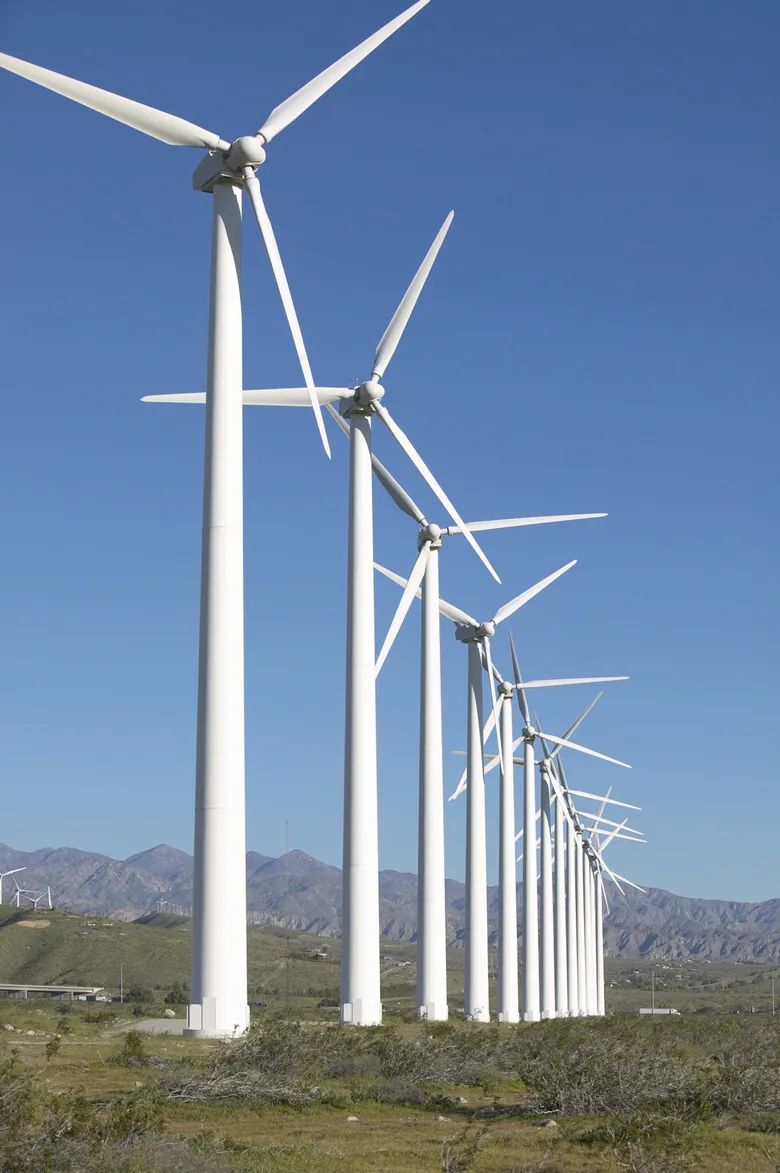
A wind plant isn't one machine. It's a fleet - dozens, sometimes hundreds of turbines strung across a ridgeline or coastal plain, each feeding a shared substation. What makes them count toward national production isn't just spinning blades. It's how well that fleet behaves as a single, predictable unit on the grid.
Let me explain what actually happens.
Take a site in Gujarat's Kutch belt. Wind there is seasonal- strong from June through September, thinner the rest of the year. So a plant's real contribution gets decided long before any foundation is poured. Engineers spend a year, sometimes longer, reading met-mast data before they commit to a layout. Space the turbines wrong and they steal wind from each other. Wake losses can quietly shave 10-15% off annual output. Not a rounding error.
Once it's built, the job becomes consistency.
Each turbine puts out electricity at 690 volts, a transformer steps it up into the collector system, and from there it climbs to 33 kV- sometimes 220 kV at the pooling substation, before it ever touches the state grid. Every stage either loses you energy or buys you reliability, depending on how carefully it was designed.
This is where good operators separate from the rest.
Modern plants run SCADA systems tracking each turbine live: pitch angle, gearbox temperature, yaw error. When a machine slips, you know in minutes, not at month-end. A turbine available 97% of the year simply produces more than one sitting idle, waiting on a spare part to ship from Europe.
Renewable Energy Companies in India learned this the hard way. Plenty of early-2000s farms got built and then more or less forgotten, and they delivered far below their rated numbers. The industry grew up. The gap between a well-run plant and a neglected one can now be 20 points of capacity factor- same wind, wildly different output.
KP Group's wind footprint in Gujarat leans on the newer thinking: sites picked for wind quality rather than cheap land, monitoring wired in from day one. A Renewable Energy Development Company that takes operations as seriously as it takes construction tends to keep its plants near the top of the merit order.
Integration into the grid is the final step. Frankly speaking, the most difficult one.
Wind is intermittent; the grid needs constant supply. The plant itself helps solve this problem through accurate prediction of the energy it can produce the following day, which allows organizing other sources in view of this plant. Predict correctly, and you avoid penalties and cutting back. Predict poorly, and you just waste the green energy because it wasn’t planned for.
Then, how does one plant contribute to India’s wind story? Through constant generation, honest prediction and availability. Apply all this to several hundred plants, and you’ll have something to quote nationally.
The blades themselves are not the issue. The hard work is behind them.




























Sign in to leave a comment.