

The way businesses communicate with customers has changed significantly in recent years. People now expect quick answers, simple buying experiences, helpful support, and communication on the channels they already use. This is where AI customer engagement platforms are becoming useful for modern businesses. Instead of managing marketing, sales, commerce, and customer support through completely separate systems, businesses can use AI to connect different parts of the customer journey and provide a more consistent experience.
Why Customer Engagement Has Become More Important
Customer engagement is no longer limited to answering support questions or sending promotional emails. A customer may first discover a brand through an advertisement, visit its website, ask a question on WhatsApp, compare products, make a purchase, contact support, and later return for another purchase.
Each of these interactions is part of the same customer relationship.
The problem is that many businesses still manage these interactions through different tools. Marketing may have one system, sales another, customer support another, and ecommerce another. When these systems do not communicate properly, customers may have to repeat information several times.
For example, imagine a customer who receives an offer through email and then contacts the company on WhatsApp. If the support team cannot see the customer's previous interaction, they may not know which product the customer was interested in or which offer they received.
This creates unnecessary friction.
A connected AI platform can help businesses maintain customer context across different interactions. The goal is not simply to add another chatbot. It is to make customer conversations more useful and connected.
What Is an AI Customer Engagement Platform?
An AI customer engagement platform uses artificial intelligence to help businesses communicate with customers, automate routine work, and manage different stages of the customer journey.
Depending on the business, AI can help with:
- Answering customer questions
- Qualifying sales leads
- Recovering abandoned shopping carts
- Helping customers find products
- Supporting order-related questions
- Managing reservations
- Sending personalized messages
- Supporting customers after a purchase
- Identifying opportunities for upselling
- Re-engaging inactive customers
- Handling routine service requests
The biggest advantage is that these activities do not have to exist as completely separate experiences.
A customer can begin with marketing and eventually move into sales, purchasing, support, and retention without the business losing important context.
AI Can Support More Than Customer Service
One common misunderstanding is that AI in business is mainly about chatbots.
Modern AI agents can be used for much more than answering frequently asked questions.
For example, an ecommerce business can use AI to identify an abandoned cart and contact the shopper with a helpful message. If the shopper asks about size, product availability, shipping, or another question, the AI can continue the conversation instead of simply sending a generic reminder.
Similarly, a hotel can use AI to respond to guest requests, help with reservations, provide information about services, and support upselling opportunities.
For a SaaS company, an AI agent can engage trial users, identify potential buying intent, answer product questions, and help move qualified prospects toward a sales conversation.
This makes AI more useful when it is connected to actual business workflows rather than being treated as a simple chat window.
Ecommerce Businesses Can Benefit from AI Automation
Ecommerce is one of the areas where customer engagement automation can have a direct impact on revenue.
Online stores receive large numbers of customer questions every day. Customers may want to know about product features, sizes, delivery times, returns, payment options, or order status.
At the same time, businesses need to deal with abandoned carts and customers who show interest but do not complete their purchases.
AI agents can help address these problems.
For example, when a shopper leaves a product in their cart, an AI-powered cart recovery system can send a relevant message through a supported channel. If the shopper responds with a question, the conversation can continue naturally.
This is more useful than sending the same reminder to every customer.
Ephanti's ecommerce solution focuses on areas such as cart recovery, conversational shopping, and order support. Its homepage also highlights integrations with Shopify, WooCommerce, and BigCommerce.
The idea is simple: help shoppers get answers faster and reduce the number of customers who leave before completing their purchase.
Conversational Commerce Is Becoming More Useful
Traditional online shopping often requires customers to search through product pages, read descriptions, compare options, and then complete checkout.
Conversational commerce adds another way to shop.
Instead of searching through several pages, customers can ask questions in a conversation.
They might say:
“I need running shoes for daily use.”
The system can ask about size, preferences, budget, or usage and then guide the customer toward suitable products.
This can make online shopping feel more personal.
For businesses, conversational commerce can also reduce the distance between customer interest and purchase. Instead of moving through several disconnected steps, a shopper can receive information and assistance within the same conversation.
As customers become more comfortable communicating through messaging apps, this type of shopping experience is likely to become increasingly important.
AI in the Hospitality Industry
Hotels and hospitality businesses have another strong use case for AI customer engagement.
Hotel guests may ask questions at any time of day. They may want information about check-in, room service, restaurants, spa services, transportation, late checkout, or local attractions.
Staff cannot always respond immediately, especially during busy periods or overnight.
An AI agent can handle many routine questions and requests while allowing human employees to focus on situations that genuinely require personal attention.
Ephanti's hospitality solution includes reservation and revenue support, in-stay concierge services, and guest support. The platform also lists integrations with systems such as Opera PMS, Cloudbeds, Mews, and Guesty.
This type of automation can be especially useful for hotels that want to provide support around the clock without increasing the workload of their front-desk teams.
AI Can Help Increase Direct Bookings
Direct bookings are important for hotels because they can reduce dependence on third-party booking channels.
AI can support this process by answering guest questions, helping visitors understand available options, and guiding them toward booking.
For example, a potential guest may ask about room availability, breakfast, cancellation policies, or nearby facilities. Instead of waiting for a staff member to respond, an AI agent can provide information and help move the conversation toward a booking.
The same conversation can also create opportunities for additional revenue.
A guest booking a room may be interested in airport transfers, breakfast, spa treatments, room upgrades, or other services.
When the right information is available at the right moment, businesses have more opportunities to provide useful recommendations.
B2B SaaS Companies Can Use AI for Customer Growth
Software companies have a different customer journey.
A potential customer may start with a free trial, explore the product, become stuck on a feature, and eventually stop using the software.
This is where AI can help.
An AI agent can identify certain signals that suggest a user needs help. It can provide guidance, answer questions, recommend relevant features, or connect the user with a sales representative when human involvement is appropriate.
Ephanti describes use cases around trial-to-paid conversion, conversational discovery, and customer success for B2B SaaS companies. Its homepage also references integrations with Salesforce, HubSpot, and Slack.
Instead of treating every trial user in exactly the same way, businesses can create more relevant interactions based on customer behavior.
Nonprofits Can Also Benefit From AI
AI customer engagement is not limited to commercial businesses.
Nonprofit organizations communicate with donors, volunteers, supporters, and community members. Managing these relationships can require significant administrative work.
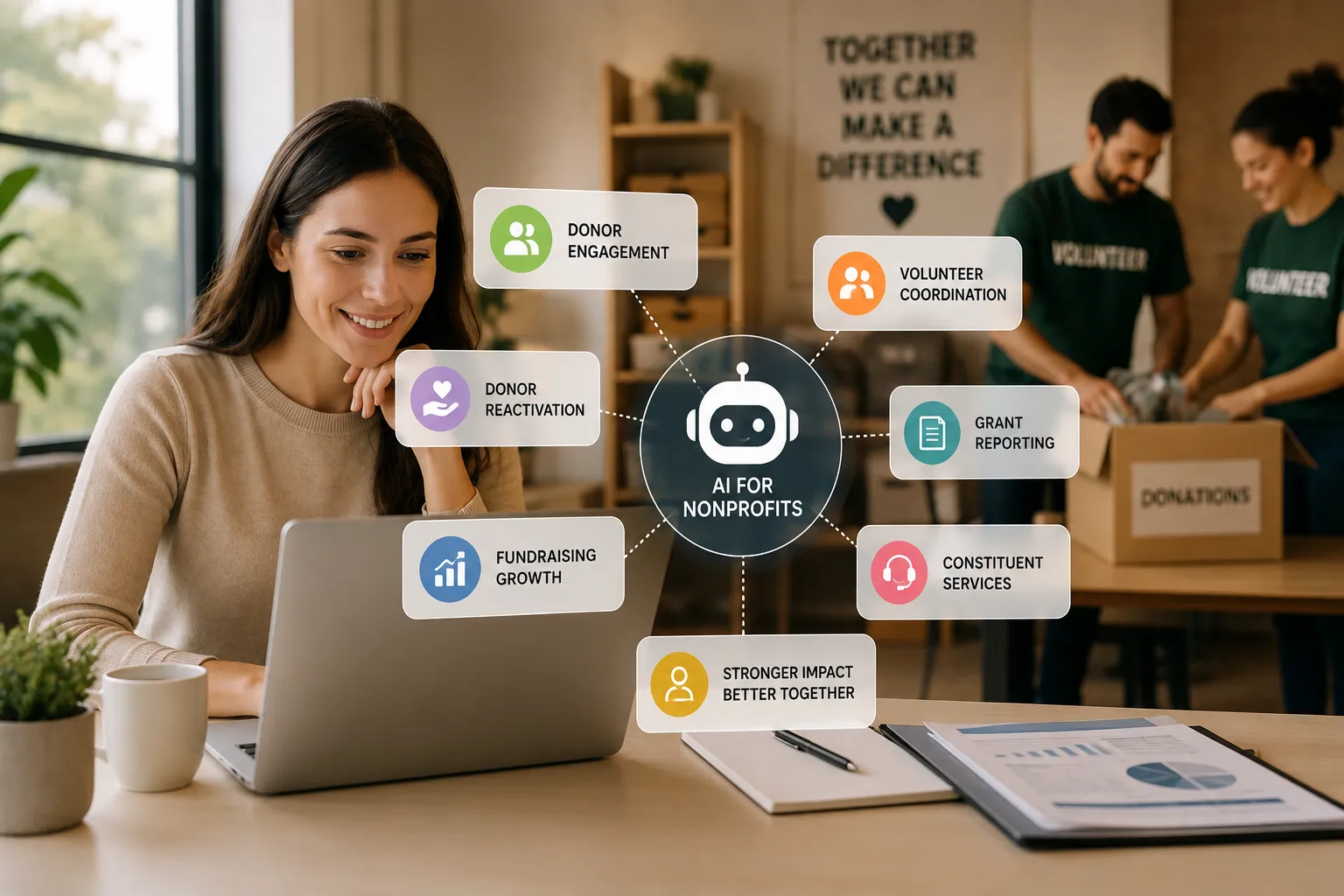
AI can help nonprofits with activities such as donor reactivation, volunteer coordination, constituent support, and routine communication.
For example, an organization may have donors who contributed in the past but have not interacted with the organization recently. An AI system can help identify these inactive relationships and support personalized re-engagement campaigns.
Ephanti's nonprofit solution includes donor reactivation, volunteer coordination, grant reporting, and constituent services.
This allows nonprofit teams to spend more time on their mission while reducing repetitive administrative tasks.
The Importance of Customer Context
One of the biggest challenges with multiple business tools is fragmented customer information.
A customer may have a purchase history in one system, email interactions in another, support conversations somewhere else, and marketing activity in another platform.
When these systems operate independently, employees may not have the complete picture.
AI becomes more useful when it can work with relevant customer information.
For example, a support agent should ideally know what the customer purchased before answering an order question. A sales agent may benefit from knowing which products or services a prospect has already explored.
Ephanti describes its approach around a unified customer record where information from CRM, commerce, support, and product systems can be used during customer interactions.
This can make conversations more relevant and reduce the need for customers to repeat their information.
AI Does Not Have to Replace Human Employees
Another important point is that AI automation does not necessarily mean removing people from the customer experience.
In many situations, the best approach is a combination of AI and human employees.
AI can handle repetitive and predictable tasks.
Humans can handle complex problems, sensitive conversations, unusual requests, and decisions that require judgment.
This creates a practical division of work.
For example, an AI agent may answer a common question about an order. If the customer has a complicated complaint, the conversation can be transferred to a human employee with the relevant context already available.
This can save time for employees while giving customers access to human support when they actually need it.
Businesses Need AI That Works with Existing Systems
Technology adoption becomes difficult when companies are required to replace all their existing software.
Most businesses already have systems for CRM, ecommerce, customer support, payments, marketing, or hospitality management.
A useful AI platform should therefore work with the tools businesses already use.
Ephanti highlights integrations across ecommerce, CRM, hospitality, ERP, and other business systems, with examples including Shopify, Salesforce, HubSpot, Opera, Cloudbeds, Mews, Zendesk, and Stripe.
This approach can make AI adoption easier because businesses can add automation without completely rebuilding their technology stack.
Why AI Agents Are Different from Basic Chatbots
A basic chatbot may answer questions from a fixed set of information.
AI agents can go further when they are connected to business systems and workflows.
For example, an agent could potentially retrieve information, start a process, update a customer record, or route a request to the right team.
The difference is important.
A customer does not always need an answer. Sometimes they need something to happen.
A hotel guest may need a reservation changed.
An ecommerce customer may need help with a return.
A SaaS prospect may need a sales appointment.
A nonprofit donor may need information about their contribution.
The real value of AI comes when conversations can lead to useful actions rather than ending with an answer.
Security and Control Still Matter
As businesses use AI for real customer interactions, security and accountability become important.
Companies need to understand what an AI system can access, what actions it can perform, and when humans can intervene.
Ephanti highlights features including SOC 2, GDPR, encryption, SSO, human approval, audit trails, and reversible AI decisions on its platform.
These controls matter because customer-facing AI should not operate without appropriate boundaries.
Businesses need confidence that automated systems are working within defined rules and that employees can step in when necessary.
Choosing the Right AI Customer Engagement Solution
Businesses considering AI should start with their actual customer problems rather than choosing technology simply because it is popular.
A good starting point is to identify repetitive customer interactions.
Ask questions such as:
Which questions do customers ask most often?
Where do customers leave the buying journey?
Which support tasks take the most employee time?
Where are customers forced to repeat information?
Which opportunities are being missed after a purchase?
Which channels do customers prefer to use?
The answers can help identify where AI automation will have the greatest practical value.
It is also important to consider integrations, security, human oversight, scalability, reporting, and ease of deployment.
The Future of Customer Engagement
Customer expectations will continue to change.
People are becoming more comfortable communicating with businesses through messaging apps, websites, social platforms, and voice. They also expect faster and more personalized responses.
Businesses that continue to manage every interaction through disconnected systems may find it harder to provide a consistent customer experience.
AI offers a way to connect different parts of the journey.
The most valuable systems will not simply produce impressive conversations. They will understand customer context, work with business data, complete useful tasks, and know when a human should take over.
That is the direction in which customer engagement is moving.
Conclusion
AI is changing customer engagement from a collection of separate activities into a more connected experience. Marketing, sales, ecommerce, customer support, and retention can work together when businesses have the right technology and customer information. For companies looking to automate repetitive work while keeping customer interactions useful and personal, Ephanti AI solutions provide an approach built around AI agents, industry-specific workflows, and connected customer journeys.























Sign in to leave a comment.