

Invoices, bank statements, insurance claims, and loan files contain the data behind payments, reconciliations, coverage decisions, and credit assessments. Yet processing these documents manually means dealing with changing layouts, large tables, scanned pages, missing records, and information spread across several files.
As document volumes rise, repetitive entry and review can slow operations while increasing the chance of errors. Reading the text is also only part of the job. The information must be classified, interpreted, checked, and connected to the right business record.
AI document processing addresses these stages together. This article explains how AI processes four major document categories, what changes between them, how validation works, and where human review still matters.
Why These Business Documents Are Difficult to Process Manually
These documents contain different structures and relationships, so a single fixed processing method rarely works equally well across them.
High Document Volumes Create Repetitive Data Entry and Review Work
Employees may spend hours opening files, locating fields, entering values, comparing records, and checking the same information again before it can be used.
Different Formats, Layouts, and File Types Make Fixed Processing Rules Less Reliable
Invoices differ by supplier, bank statements vary by institution, claims include many supporting records, and loan files combine several document types. Fixed coordinates and templates can fail as layouts change.
Business Decisions Depend on Context, Relationships, and Validation, Not Extraction Alone
A correctly captured number has limited value unless AI determines what it represents, which entity it belongs to, and whether related records support it.
How AI Processes Business Documents From Intake to Usable Data
AI document processing usually combines several stages that take a file from receipt to structured information.
Document Classification Identifies What Each File Represents
AI can distinguish invoices, statements, claims forms, policies, applications, tax records, and other supporting files so each follows the correct processing path.
OCR and Visual Analysis Capture Text, Tables, and Page Structure
OCR reads characters while visual analysis identifies tables, sections, columns, labels, and positional relationships.
Context-Aware Extraction Identifies Fields, Entities, and Line-Level Data
AI associates values with their meaning, such as supplier name, transaction amount, borrower income, policy number, or claim date.
Validation Checks Extracted Information Against Rules and Related Records
Values can be tested against required formats, thresholds, source records, and related documents.
Confidence-Based Review Separates Routine Documents From Cases Requiring Human Attention
Higher-confidence cases can proceed automatically while uncertain or material cases are sent for review.
Structured Data Can Be Passed Into Finance, Claims, Lending, and Accounting Systems
Validated information can then enter the business applications where payments, reconciliations, claims reviews, and credit decisions occur.
How AI Processes Invoices
Invoice processing depends heavily on extracting line-level information and verifying it against purchasing records.
AI Identifies Supplier, Invoice, PO, Tax, Amount, and Payment Information
AI can identify vendor names, invoice numbers, dates, purchase order references, taxes, totals, and payment terms.
Line-Item Extraction Preserves Quantity, Price, Description, and Tax Relationships
Instead of treating table values separately, AI can retain the relationship between each item, its quantity, unit price, description, and applicable tax.
Invoice Data Can Be Compared With Purchase Orders and Receipts
Extracted invoice information can be matched against purchasing and receiving records before payment approval.
Duplicate and Inconsistent Invoice Information Can Be Flagged Before Payment
Repeated invoice numbers, conflicting totals, or unexpected supplier information can be identified for investigation.
Exceptions Can Be Routed According to Amount, Confidence, and Validation Results
A missing field may require a different review path from a large value mismatch or supplier discrepancy.
How AI Processes Bank Statements
Bank statements require accurate preservation of transaction sequence, balances, and account information.
AI Extracts Account Details, Statement Periods, Transactions, and Balances
Account numbers, statement dates, opening balances, closing balances, transaction dates, descriptions, credits, and debits can be captured automatically.
Transaction Tables Are Converted Into Structured Rows Without Losing Debit and Credit Relationships
AI can preserve the relationship between dates, descriptions, amounts, transaction types, and running balances.
Transaction Descriptions Can Be Normalized for Consistent Analysis
Different wording for similar transaction types can be standardized so records are easier to compare.
Extracted Transactions Can Be Matched With General Ledger and Accounting Records
This is particularly useful in document management in banking, where statement data often needs to connect with internal transaction and accounting records.
Balance and Transaction Checks Help Identify Missing or Inconsistent Statement Data
Opening balances, closing balances, and transaction totals can be checked for inconsistencies before further processing.
How AI Processes Insurance Claims Documents
Insurance processing differs because a claim may depend on evidence spread across policies, reports, invoices, and supporting files.
AI Classifies Claim Forms, Policies, Bills, Reports, and Supporting Evidence
Each file can be identified before extraction so information is interpreted within the correct document type.
Claimant, Policy, Incident, Date, Amount, and Loss Information Can Be Extracted
AI can capture claimant details, policy numbers, incident information, dates, claimed amounts, and loss descriptions.
Document Completeness Checks Identify Missing Claim Evidence
The system can flag missing reports, invoices, forms, or supporting records required for review.
Claim Information Can Be Compared With Policy Terms and Coverage Records
This comparison helps determine whether extracted claim information aligns with the relevant policy and coverage conditions.
Conflicting Values and Unusual Claim Information Can Be Sent for Review
These capabilities are central to intelligent document processing for insurance, where claim decisions frequently depend on multiple related records.
How AI Processes Loan Documents
Loan document processing requires information to remain consistent across an entire borrower file.
AI Classifies Applications, Bank Statements, Tax Records, Financial Statements, and Supporting Files
Document classification helps separate borrower records into categories before analysis begins.
Borrower, Income, Asset, Liability, and Loan Information Can Be Extracted
AI can identify borrower details, earnings, assets, debts, requested loan amounts, and financial information.
Financial Data Can Be Standardized Across Different Source Documents
Information appearing under different labels or structures can be organized into consistent fields for analysis.
Borrower Information Can Be Compared Across Applications and Supporting Records
Income, assets, liabilities, addresses, and other details can be checked across related documents for inconsistencies.
Validated Document Data Can Support Credit Analysis and Underwriting
Once structured and checked, borrower information can support analyst review and downstream lending processes.
What Changes Across Invoices, Bank Statements, Claims, and Loan Documents
The processing stages may be similar, but the relationships that matter vary significantly by document type.
Invoices Depend Heavily on Transaction and Purchase Relationships
Invoice validity often depends on purchase orders, receipts, supplier records, quantities, and prices.
Bank Statements Require Accurate Transaction Sequence and Balance Structure
A misplaced transaction or broken debit and credit relationship can affect reconciliation results.
Claims Depend on Evidence Across Multiple Document Types
Policy terms, claim forms, reports, bills, and supporting records may all influence the case.
Loan Files Require Financial Information to Be Connected Across the Borrower Record
Borrower information must remain consistent across applications, statements, tax documents, and financial records.
The Same Extraction Method Cannot Be Applied Identically to Every Document Type
Each category requires different fields, validation logic, relationships, and review conditions.
Why Multi-Document Understanding Matters in AI Document Processing
Many business processes involve a collection of related documents rather than a single file.
A Single Business Case Often Contains Information Spread Across Several Files
A loan, claim, or invoice transaction may rely on information located in separate records.
Related Documents Need to Be Grouped Before Their Data Can Be Compared
AI must determine which files belong to the same supplier, borrower, claim, or transaction.
Cross-Document Validation Can Identify Missing, Duplicate, or Conflicting Information
Comparing related files can expose values or documents that do not agree.
AI Must Preserve Entity, Date, Amount, and Reference Relationships Across Files
These relationships help ensure that extracted data remains attached to the correct business case.
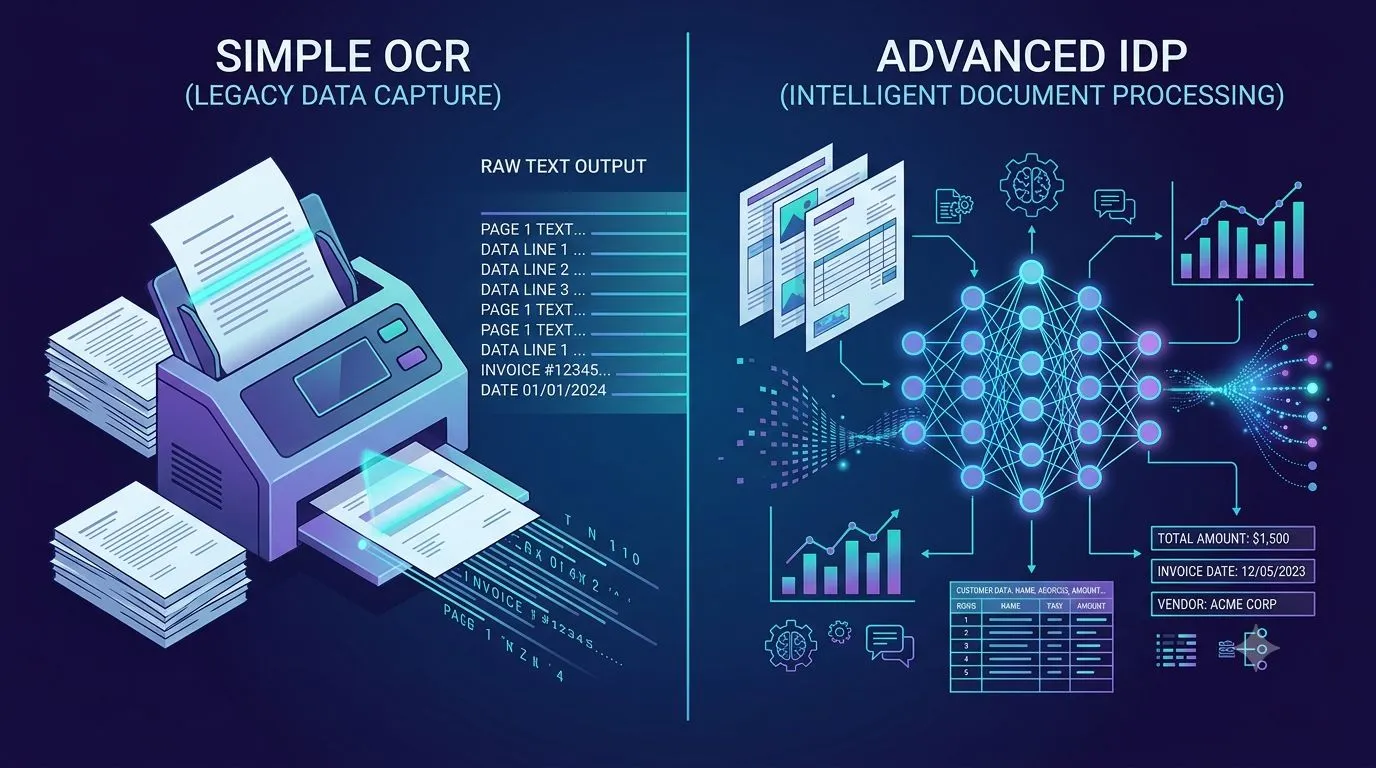
Where OCR Ends and AI-Based Document Processing Begins
OCR supplies readable text, but further interpretation is needed before that text becomes dependable business data.
OCR Converts Document Images Into Machine-Readable Text
This makes scanned content available for search and further processing.
AI Determines What Extracted Information Represents in Business Context
AI can determine whether a number represents an invoice total, bank balance, claim amount, or borrower liability.
Layout Understanding Preserves Tables, Sections, and Spatial Relationships
Document structure provides meaning that plain text may lose.
Semantic Interpretation Connects Values With the Correct Fields and Entities
Labels, surrounding content, and document type help determine what each extracted value represents.
Validation Determines Whether Extracted Information Is Ready for Business Use
Data can be checked before it enters another system or supports a business action.
How AI Handles Document Variations and Difficult Input
Real documents often contain irregular layouts and imperfect source quality.
Different Layouts Can Be Processed Without a Separate Fixed Template for Every Format
Context-based extraction can locate information even when its position changes.
Scanned PDFs and Image-Based Documents Require Recognition Before Interpretation
Text must first be captured from the image before meaning and relationships can be analyzed.
Tables, Multi-Column Pages, and Multi-Page Records Require Structural Analysis
AI needs to preserve reading order and table relationships across complex page designs.
Low-Confidence Information Can Be Isolated Instead of Sending the Entire Document for Review
Reviewers can focus on specific uncertain values rather than rechecking every extracted field.
Why Validation Matters Before Extracted Document Data Reaches Business Systems
Validation prevents correctly read but incorrect business information from moving downstream.
Field-Level Checks Confirm Required Information and Expected Formats
Individual values can be checked for presence, data type, format, or acceptable range.
Cross-Field Checks Test Relationships Within the Same Document
Dates, totals, taxes, balances, and other related values can be compared.
Cross-Document Checks Compare Related Business Records
An invoice can be checked against a PO, while borrower or claim data can be checked across supporting files.
Reference Data Checks Compare Extracted Information With Approved System Records
Supplier, customer, policy, account, or borrower data can be compared with trusted records.
Business Rules Determine Whether Data Can Proceed or Requires Review
Transactions that fail defined conditions can be held for investigation.
Where Human Review Still Fits Into AI Document Processing
Human review remains part of processes where uncertainty or business impact requires judgment.
Uncertain Extraction Requires Verification Before Acceptance
Low-confidence information should be checked before it enters downstream processes.
Conflicting Documents May Require Business Judgment
AI can identify disagreement, but deciding which source should prevail may require human assessment.
High-Impact Financial or Policy Decisions Can Require Approval Regardless of Confidence
Large payments, lending decisions, and sensitive claims may require approval even when extraction confidence is high.
Human Attention Can Focus on Exceptions Rather Than Every Document
This allows reviewers to spend more time on cases that carry higher uncertainty or business impact.
How Source Traceability Supports Reliable AI Document Processing
Processed data becomes easier to trust when users can verify its origin.
Extracted Values Should Remain Connected to Their Source Page, Table, or Field
Users should be able to locate the exact evidence supporting a value.
Reviewers Need to See the Evidence Behind Flagged Information
Source references reduce the time required to investigate exceptions.
Corrections and Approvals Should Remain Connected to the Original Record
This preserves the processing history for future review.
Traceability Helps Downstream Teams Verify Document Data Without Repeating the Full Review
Finance, lending, and claims teams can inspect specific evidence instead of reopening and rereading every file.
How Should Businesses Measure AI Document Processing Performance?
Performance should be measured beyond extraction speed alone.
Field and Document-Level Extraction Accuracy
Track whether required fields and documents are captured correctly.
Validation Pass and Failure Rates
Measure how often extracted information satisfies defined checks.
Manual Review and Correction Rates
Track how frequently employees need to verify or change results.
Exception Resolution Time
Measure how long flagged cases remain unresolved.
Straight-Through Processing Rate
Track the percentage of cases that complete processing without human intervention.
Source Traceability Coverage
Measure how consistently extracted values remain connected to supporting evidence.
Processing Time From Document Receipt to Usable Data
This shows the true end-to-end processing time rather than extraction time alone.
From Document Extraction to Business-Ready Information
The final objective is to produce information that downstream teams can use confidently.
Invoices Become Validated Transaction Data for Accounts Payable
Extracted invoice fields gain value once they are checked against related purchasing information.
Bank Statements Become Structured Financial Data for Reconciliation and Analysis
Transaction information can be organized into consistent records for comparison with accounting data.
Claims Documents Become Connected Evidence for Claims Review
Information from policies, forms, reports, and supporting files can be assessed as one case.
Loan Documents Become Structured Borrower Data for Credit Analysis
Financial and borrower information can be organized and checked before analyst review.
The Value of AI Comes From Making Document Data Usable, Verifiable, and Connected
Reading the document is only the starting point. Business value appears when extracted information retains its context, passes validation, and reaches the correct process.
Conclusion: AI Document Processing Is About Understanding What the Data Means and Where It Belongs
AI can process invoices, bank statements, insurance claims, and loan documents using many of the same underlying stages, but each document category presents different relationships and validation requirements.
Invoices depend on purchase and supplier data. Bank statements depend on transaction order and balance structure. Claims require evidence across policies and supporting records. Loan files depend on information remaining consistent across the borrower record.
This is why effective AI document processing goes beyond OCR or field extraction. Classification, contextual interpretation, cross-document validation, confidence-based review, and source traceability determine whether information is ready for business use.
The result is not simply digitized text. It is structured information that finance, insurance, lending, and accounting teams can review, verify, and use with greater consistency.
Frequently Asked Questions About AI Document Processing
These questions address the most common distinctions between OCR, AI extraction, validation, and human review.
How Does AI Process Business Documents?
AI can classify documents, capture text and structure, extract relevant information, apply validation checks, route exceptions, and produce structured data for downstream systems.
How Does AI Extract Data From Invoices?
AI identifies invoice fields and line items using text, layout, labels, and surrounding context, then associates values with supplier, PO, tax, payment, and transaction information.
How Does AI Process Bank Statements?
AI extracts account information, statement periods, balances, and transaction tables while preserving relationships between dates, descriptions, credits, debits, and balances.
How Is AI Used in Insurance Claims Processing?
AI can classify claim documents, extract incident and policy information, identify missing evidence, compare claims with coverage records, and flag inconsistent cases for review.
How Does AI Process Loan Documents?
AI classifies borrower records, extracts financial information, standardizes data across sources, and compares details across applications and supporting documents.
Can AI Process Different Document Formats Without Fixed Templates?
Yes. Context-aware document processing can identify information from different layouts without depending entirely on fixed field coordinates.
How Is AI Document Processing Different From OCR?
OCR primarily converts images into machine-readable text. AI document processing also interprets structure and context, associates values with business meaning, validates information, and supports downstream processing.
Does AI Document Processing Still Require Human Review?
Yes. Human review remains appropriate for uncertain extraction, conflicting evidence, unusual cases, and decisions with significant financial, credit, or policy impact.




























Sign in to leave a comment.