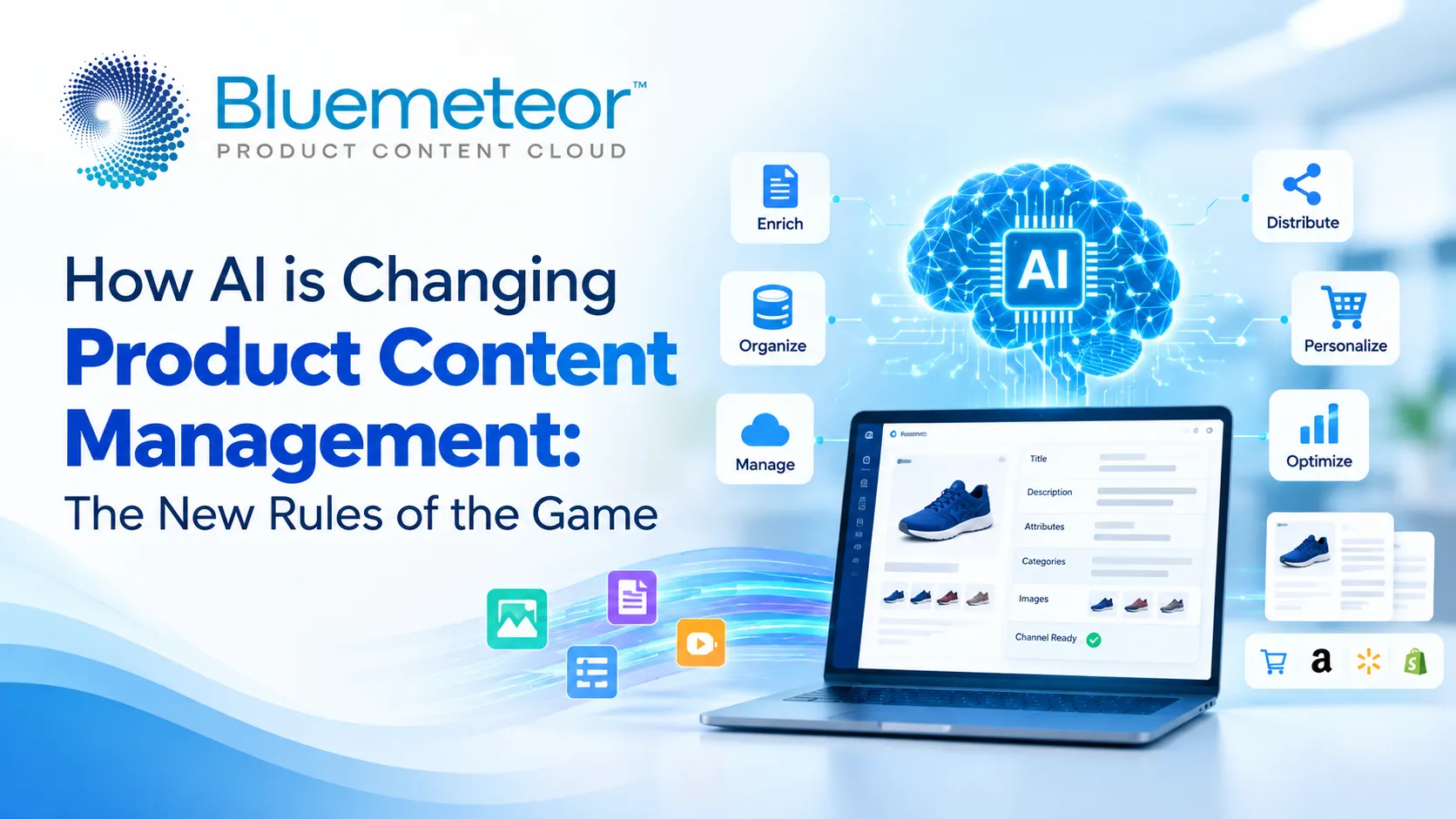

Picture this: a distributor with 200,000 SKUs, a dozen sales channels, and a content team stretched razor-thin trying to keep every product description, image, and spec sheet accurate. A few years ago, that team would have been buried in spreadsheets. Today, artificial intelligence is quietly rewriting the rulebook.
Product information management has always been about one core promise — giving every team, channel, and customer the same accurate, up-to-date product data. But the way that promise gets delivered is changing fast. AI is no longer a "nice to have" bolted onto legacy systems; it's becoming the engine that decides how content is created, enriched, governed, and pushed out to the world.
In this post, we'll break down exactly how AI is reshaping product content workflows, why an ai pim approach is quickly becoming the industry standard, and what it means for manufacturers, distributors, and retailers trying to scale without scaling their headcount.
What Is Product Information Management, and Why Does It Matter More Than Ever
At its core, product information management is the discipline — and the software category — built around collecting, organizing, and distributing accurate product data across every touchpoint: your website, marketplaces, distributor catalogs, ERP systems, and print materials.
Without a centralized system, product data tends to live in silos: one version in a spreadsheet, another in the ERP, a third on the e-commerce platform. The result is inconsistent pricing, missing attributes, broken search filters, and customers who bounce because they can't find the specs they need.
A few numbers make the stakes clear:
- Poor product data quality is consistently cited by retailers and distributors as a top driver of returns and abandoned carts.
- Incomplete or inconsistent listings can reduce conversion rates by double digits on marketplaces like Amazon and Grainger.
- Manual data entry across multiple channels can consume dozens of hours per week for mid-sized catalogs.
This is exactly the gap that traditional PIM systems were built to close. But traditional PIM still relies heavily on human effort to classify products, write descriptions, and map attributes — which is where AI changes everything.
How AI Is Transforming Product Content Management
1. Automated Data Enrichment
One of the most tedious parts of managing a product catalog is filling in the gaps — missing attributes, incomplete specs, inconsistent naming conventions. AI models can now scan raw supplier feeds, extract structured attributes, and auto-populate missing fields in a fraction of the time it would take a human team.
Instead of an analyst manually typing in "wattage," "material," or "dimensions" for thousands of SKUs, AI-driven enrichment tools can:
- Extract attributes directly from spec sheets, PDFs, or supplier data
- Standardize units, naming, and formatting automatically
- Flag anomalies or missing values before they ever reach a live channel
2. Smarter, Faster Content Generation
Writing unique, SEO-friendly product descriptions for thousands of SKUs used to be a full-time job for entire content teams. Generative AI can now draft compelling, on-brand copy at scale — descriptions, bullet points, meta tags — while still leaving room for human review and brand voice adjustments.
This doesn't replace content teams; it frees them up to focus on strategy, quality control, and the products that genuinely need a human touch.
3. Intelligent Data Governance and Quality Checks
AI-powered systems can continuously monitor product data for accuracy, completeness, and consistency — catching errors before they hit a live storefront. Instead of periodic manual audits, machine learning models can flag duplicate SKUs, mismatched categories, or outdated pricing in real time.
4. Faster, More Accurate Syndication
Getting product content out to marketplaces, distributors, and retail partners (think Grainger, Home Depot, or Amazon) used to require manual mapping for every channel's unique requirements. AI-driven syndication tools can now automatically adapt content to each channel's specific taxonomy and formatting rules, cutting weeks of manual work down to days — or hours.
5. Predictive Insights for Merchandising
Beyond cleanup and automation, AI is starting to help teams make smarter decisions — surfacing which attributes drive the most conversions, which categories need content investment, and where data gaps are quietly costing sales.
Why "AI PIM" Is Becoming the New Standard
Traditional PIM platforms centralize data. An ai pim goes a step further — it actively works the data. Instead of being a static system of record, an AI-powered PIM becomes an active participant in the content lifecycle: enriching, validating, generating, and syndicating without waiting on manual intervention at every step.
In practice, this shift looks like:
- Manual attribute entry giving way to automated attribute extraction
- Human-written descriptions at scale being replaced by AI-drafted, human-reviewed content
- Periodic quality audits evolving into continuous, real-time monitoring
- Manual channel mapping being replaced by automated, channel-specific syndication
- Reactive reporting turning into predictive, insight-driven recommendations
Organizations recognized as leaders in this space are increasingly measured not just on how well they store data, but on how intelligently they act on it. That's exactly the shift Bluemeteor's Product Content Cloud was built around — treating AI as core infrastructure, not an add-on.
Real Business Impact: What Companies Are Seeing
Organizations that have adopted AI-driven product content management are reporting measurable gains, including:
- Faster time-to-market for new SKUs — some teams report launching products in days instead of weeks.
- Significant reductions in data errors and returns tied to inaccurate specs.
- Meaningful upticks in e-commerce conversion after improving content completeness and consistency.
- Lower total cost of ownership by reducing manual data entry and rework.
These aren't hypothetical gains — they're the direct result of applying AI to what used to be purely manual, error-prone workflows.
Getting Started: What to Look for in an AI-Powered PIM
If you're evaluating solutions, keep these questions in mind:
- Does it enrich data automatically, or does it just store what you feed it?
- Can it generate and optimize content at scale while preserving your brand voice?
- Does it handle syndication intelligently, adapting to each channel's unique requirements?
- Is it PIM-agnostic, so it can work alongside your existing systems rather than forcing a rip-and-replace?
Solutions like Bluemeteor's DataBridge were specifically designed to solve the data integration piece of this puzzle — connecting disparate systems without requiring you to overhaul your entire tech stack.
The Bottom Line
AI isn't just making product content management faster — it's making it fundamentally smarter. From automated enrichment to predictive merchandising insights, the tools available today let teams do more with less, reduce costly errors, and get products to market faster than ever before.
The organizations that treat AI as core infrastructure — not an afterthought — are the ones pulling ahead. If your team is still buried in spreadsheets and manual mapping, now is the time to explore what an AI-powered approach to product content can do for your business.
Ready to see it in action? Book a demo with Bluemeteor and discover how an AI-first platform can transform the way your organization manages, enriches, and syndicates product content.
Frequently Asked Questions
1. What is product information management (PIM)?
Product information management is the process and software category used to centralize, organize, and distribute accurate product data across every sales and marketing channel, from e-commerce sites to marketplaces and print catalogs.
2. How is AI different from traditional PIM software?
Traditional PIM systems primarily store and organize data that humans manually enter and maintain. An AI PIM actively enriches, validates, and generates content, and can automatically adapt it for different sales channels with minimal manual work.
3. Can AI really write accurate product descriptions?
Yes — generative AI can draft accurate, SEO-friendly product descriptions at scale based on existing specs and attributes. Most organizations still keep a human review step to ensure brand tone and factual accuracy before publishing.
4. Is AI PIM only useful for large enterprises?
No. While large catalogs see the most dramatic time savings, small and mid-sized manufacturers, distributors, and retailers benefit just as much from reduced manual work, fewer data errors, and faster time-to-market.
5. How does AI improve product data syndication?
AI can automatically map and format product content to match each channel's specific taxonomy and requirements, eliminating much of the manual rework needed when publishing to multiple marketplaces or distributor platforms.

























Sign in to leave a comment.