How AI Mobile Apps Can Improve Customer Experience in Retail

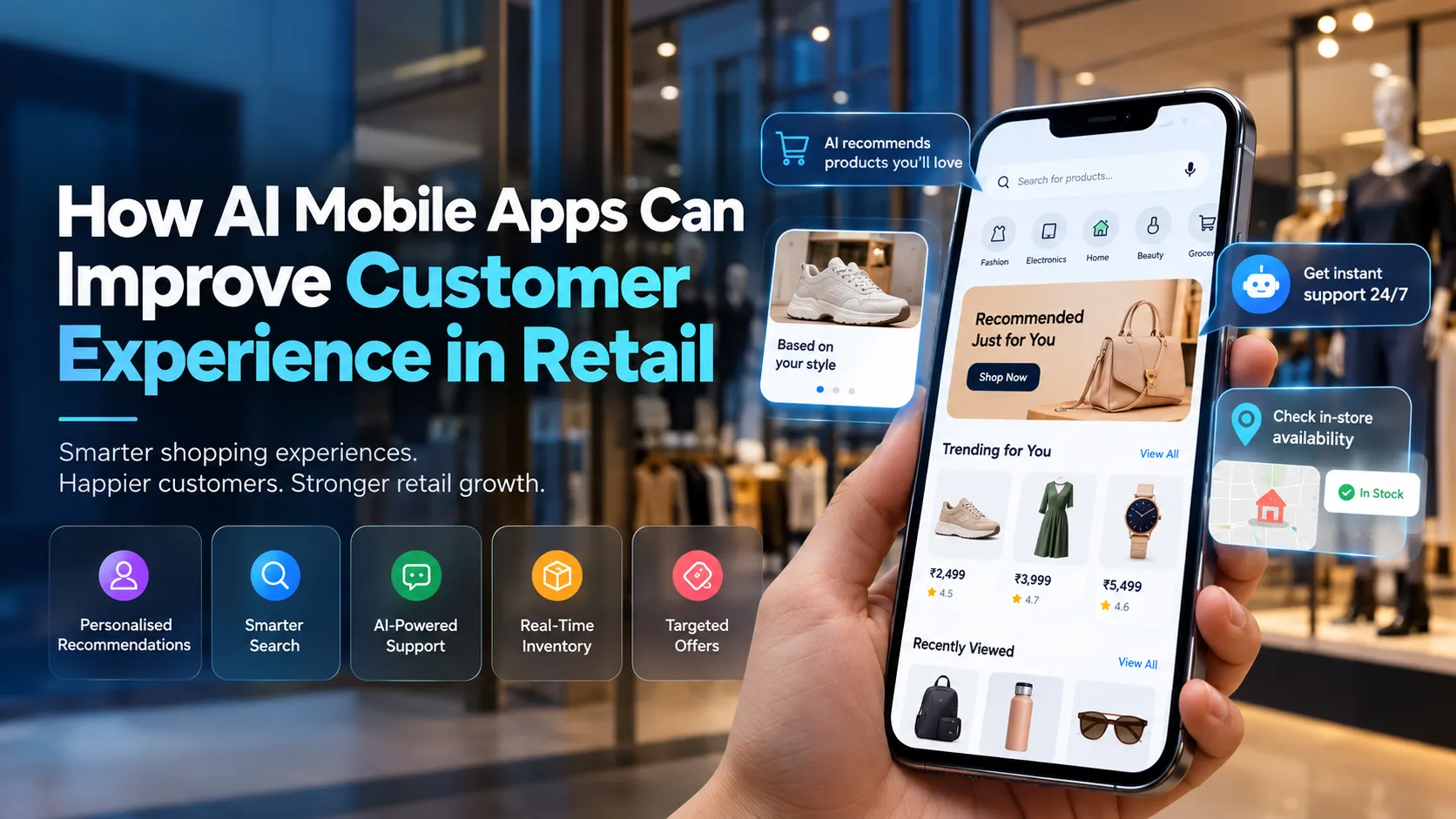
Retail customers expect to find products quickly, receive relevant recommendations, check availability, and resolve order issues without unnecessary delays. AI mobile apps help retailers meet these expectations by connecting product information, inventory, customer preferences, and support systems in one seamless shopping experience. Through machine learning, intelligent search, and personalised recommendations, retailers can make shopping more convenient, improve customer satisfaction, and build stronger customer relationships.
AI-powered mobile applications can help retailers address these problems by connecting customer-facing features with business data. Through machine learning, predictive analytics, natural language processing, and intelligent search, retailers can make shopping more relevant and reduce friction across digital and physical stores.
However, the value of AI in retail depends on how well each feature solves a real customer problem. A recommendation engine that suggests unavailable products or a chatbot that cannot access order information can create more frustration than convenience. Retail leaders must therefore evaluate mobile app development based on customer outcomes, integration requirements, operating costs, and the level of control their teams need.
Why AI Matters for Retail Customer Experience
Customer experience is shaped by every interaction, from discovering a product to completing a purchase, receiving a delivery, and requesting a return. Customers may abandon a shopping journey when product searches are difficult, stock information is inaccurate, or support takes too long.
AI in retail can improve these interactions by using relevant data to predict customer needs, automate routine tasks, and provide timely information. A mobile application offers a direct channel for delivering these capabilities through product discovery, personalised offers, order updates, and customer support.
The commercial opportunity is significant. McKinsey estimates that generative AI could create $400 billion to $660 billion in annual value across the retail and consumer packaged goods industries. This is an estimate of potential industry-wide economic value, not a guaranteed return from mobile applications. The actual benefit depends on implementation, adoption, and business processes.
Consumer behaviour also indicates growing interest in AI-assisted shopping. According to Salesforce's 2025 Connected Shoppers findings, 39% of shoppers and 54% of Gen Z shoppers reported using AI for product discovery. Retailers should consider how customers discover products today and whether their mobile experience can support those changing behaviours.
The priority is to select features that address specific points of friction rather than introducing AI simply to make an application appear more advanced.
Five AI Use Cases That Improve Retail Customer Experience
1. Personalised Product Recommendations
Retailers often have extensive product catalogues, but customers may struggle to identify suitable products. Traditional recommendation systems frequently depend on basic purchase history or popular items. Machine learning can consider a wider set of signals, including browsing behaviour, previous purchases, product attributes, search activity, and stated preferences.
For example, a fashion retailer could recommend clothing based on a customer's preferred sizes, previously viewed categories, and selected budget. A grocery application could suggest frequently purchased essentials or relevant substitutes when a product is unavailable.
Personalisation can help customers discover suitable products with fewer searches and make the shopping journey more relevant.
What retailers should measure: Recommendation click-through rate, conversion rate, average order value, repeat purchases, and returns associated with recommended products.
Retailers should also provide clear preference controls and avoid excessive tracking. Recommendations become less useful when they rely on outdated information or repeatedly promote products that customers have already rejected.
2. Intelligent Product Search and Discovery
Customers do not always know the exact product name, category, or specification they need. Conventional search may return poor results when queries contain spelling errors, informal descriptions, or incomplete details.
AI-powered search can interpret search intent and use product attributes to produce more relevant results. Natural language processing can support queries such as "comfortable running shoes for rainy weather under ₹5,000." Image-based search can also help customers find similar products by uploading a photograph.
For retailers, these capabilities can reduce the effort required to find relevant products and help customers navigate large catalogues.
Search should also account for stock availability, location, delivery eligibility, and product variations. Showing a relevant item that cannot be purchased or delivered creates a poor experience.
What retailers should measure: Search-to-product click rate, zero-result searches, search abandonment, product discovery time, and conversion following search.
A strong implementation combines AI models with accurate product descriptions, structured attributes, and regularly updated catalogue data. Model quality cannot compensate for incomplete product information.
3. AI-Powered Customer Support
Order status, delivery estimates, return policies, product specifications, and refund queries account for many routine retail support interactions. An AI-enabled mobile application can answer common questions at any time, provided it has access to reliable and current information.
For example, a customer checking a delayed order could receive the latest delivery status, an explanation of the available options, and instructions for contacting a support representative. A conversational interface could also guide a customer through an eligible return without requiring them to navigate several separate screens.
The main requirement is integration. A chatbot that cannot retrieve order records or recognise a retailer's actual return policy will provide limited value.
Retailers should define which actions AI can complete independently and which require human approval. Refund exceptions, disputed payments, and complex complaints may need escalation.
What retailers should measure: First-contact resolution, average resolution time, escalation rate, customer satisfaction, and the percentage of answers that require correction.
The objective is to resolve customer problems more efficiently while preserving access to human support.
4. Real-Time Inventory and Product Availability
Customers can lose confidence when an application shows an item as available but the store has no stock. This problem often occurs when online catalogues, warehouse systems, and point-of-sale records do not update consistently.
AI-supported inventory applications can combine stock data, demand forecasts, and sales patterns to improve product availability information. A customer could check whether an item is available at a nearby store, reserve it for collection, or choose an alternative when the preferred option is unavailable.
Machine learning can also help retailers forecast demand by considering seasonal patterns, local purchasing behaviour, and historical sales. Better forecasts can support replenishment decisions and reduce avoidable stockouts.
However, predictive models are only as reliable as their input data. Real-time availability requires dependable connections to inventory and store systems, while forecasting requires ongoing monitoring and model updates.
What retailers should measure: Inventory accuracy, stockout frequency, cancelled orders caused by unavailable products, successful store reservations, and forecast accuracy.
For retailers operating across several locations, these features can connect digital shopping with the physical store experience.
5. Predictive Offers and Loyalty Experiences
Retail loyalty programmes often send broad promotions to large customer groups. While this can increase campaign reach, irrelevant messages may lead customers to ignore notifications or disengage from the programme.
Machine learning can help retailers identify purchase patterns, estimate product preferences, and select offers that are more relevant to individual customers. A supermarket application might offer a discount on a frequently purchased category, while a home improvement retailer could suggest complementary products based on a recent purchase.
AI can also help determine when a notification is likely to be useful, subject to customer consent and communication preferences.
Personalisation must remain transparent. Customers should understand why offers appear, have control over marketing notifications, and be able to manage their data preferences.
What retailers should measure: Offer redemption, incremental sales against a suitable comparison group, repeat purchase rate, loyalty engagement, and notification opt-out rates.
The key distinction is between sales that would have occurred anyway and purchases genuinely influenced by a relevant offer.
What Retail Leaders Should Evaluate Before Building an AI Mobile Apps
Choosing a mobile app development company requires more than comparing feature lists or initial project estimates. Retail leaders should assess the following factors before committing to a solution.
Integration: Can the application connect to existing inventory, CRM, ecommerce, payment, loyalty, and order management systems? Confirm how data will be synchronised and how failures will be handled.
Speed: Can the application return useful search results and support responses quickly under peak demand? Performance testing should cover realistic catalogue sizes, network conditions, and seasonal traffic.
Control: Can internal teams manage recommendation rules, customer permissions, product information, and escalation policies? Establish ownership of application code, data, model configurations, and deployment processes.
Long-term operating costs: Evaluate cloud infrastructure, third-party API usage, model inference, monitoring, maintenance, security, and future upgrades. A low initial development cost may conceal higher recurring expenses.
Privacy and security: Define what customer data is collected, why it is needed, how long it is retained, and who can access it. Apply appropriate access controls, encryption, consent management, and data minimisation.
Business performance: Require an agreed baseline and measurable targets before implementation. Pilot the highest-value use case first, compare results against the baseline, and expand only when the evidence supports further investment.
Retailers evaluating an AI App Development Company in Saudi Arabia or an AI App Development Company in Kansas City, Missouri, should apply the same operational criteria. Local market knowledge and regional support may matter, but integration capability, delivery quality, security practices, and long-term ownership remain central to the decision.
How to Choose the Right AI Implementation Approach
Retailers generally have three options: extend an existing commerce platform, integrate third-party AI services, or build custom AI capabilities within a mobile application.
Extending an existing platform may offer faster deployment when its features and integrations meet business requirements. Third-party services can reduce the need to build every capability internally, although they introduce vendor dependencies and usage costs. Custom development offers greater control over workflows and data integration but typically requires more engineering effort and ongoing maintenance.
The right approach depends on the retailer's technology environment, customer needs, budget, and internal capabilities. A specialist providing AI services can help assess these requirements before the retailer commits to an architecture.
Frequently Asked Questions
How does AI improve customer experience in retail mobile apps?
AI can improve product discovery, personalise recommendations, automate routine support, provide better stock information, and deliver more relevant loyalty offers.
Does every retailer need a custom AI mobile app?
No. Retailers should first assess whether their existing application and commerce platform can support the required capabilities. Custom development makes sense when specific workflows, integrations, or performance requirements cannot be addressed effectively through existing solutions.
How should retailers measure the success of AI in retail?
Measure customer and business outcomes, including conversion, search abandonment, support resolution time, stockout-related cancellations, repeat purchases, and operating costs. Compare results with a pre-implementation baseline.
Conclusion
AI-powered mobile applications can improve retail customer experience when they make shopping easier, provide accurate information, and resolve problems with less effort. Personalised recommendations, intelligent search, automated support, inventory visibility, and relevant loyalty offers provide clear starting points.
Retail leaders should begin with one customer problem, establish a baseline, and test the solution against defined performance targets. A careful assessment of integration, speed, control, and operating costs will help determine whether extending an existing platform or investing in custom mobile app development offers the stronger long-term fit.
The next step is to identify the customer journey with the greatest friction, assess the available data and systems, and develop an implementation plan around a specific business outcome.
Planning an AI-enabled retail mobile application? Request a strategy consultation to evaluate suitable use cases, integration requirements, and the costs of moving from an initial pilot to production.




Sign in to leave a comment.