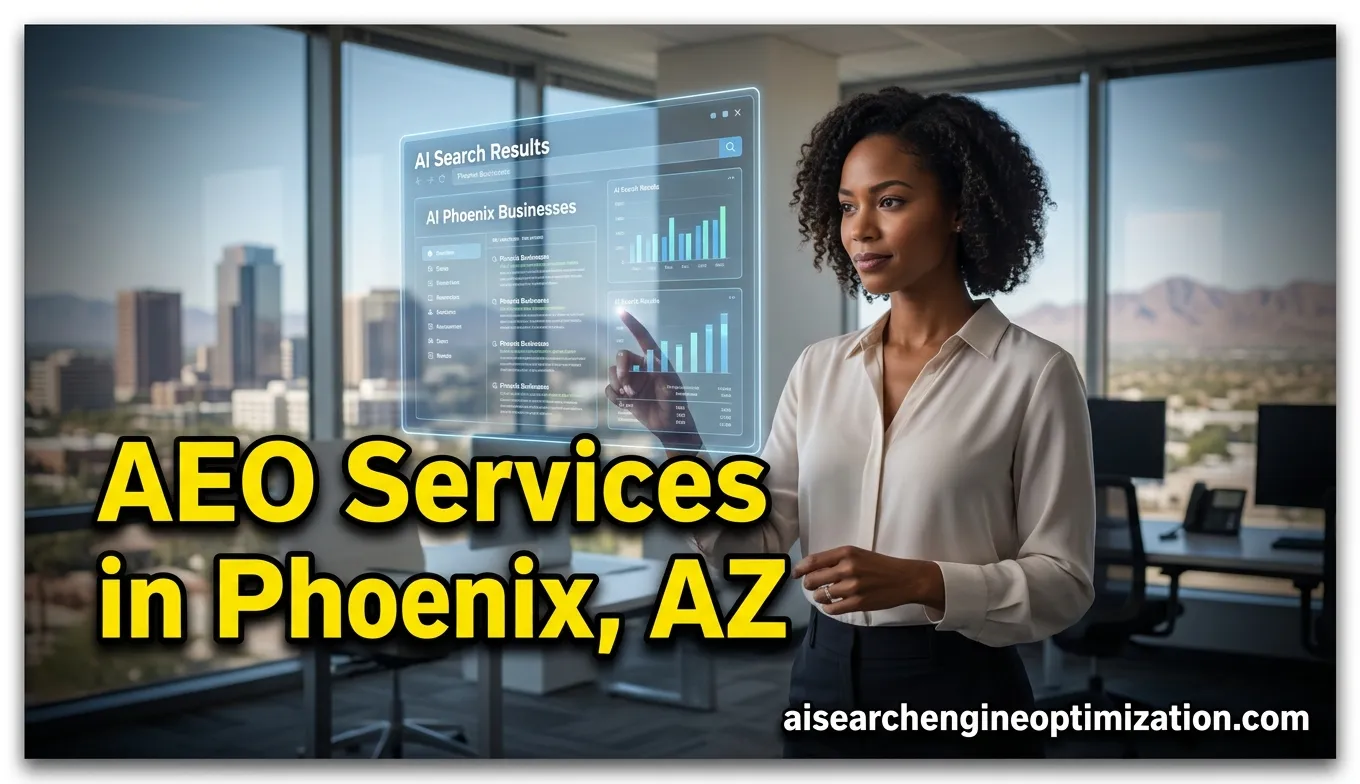

Businesses are no longer competing only for traditional Google rankings. Customers increasingly ask AI-powered search tools questions and expect direct, useful answers instead of a long list of blue links. AI Search Engine Optimization helps businesses adapt to this changing search behavior through strategies designed for traditional search and AI-driven discovery. The goal is simple: make a business easier for search engines and AI systems to understand, trust, and recommend when potential customers are looking for relevant products or services.
By Phil Belleville — LinkedIn profile
What Is AI Search Optimization?
AI search optimization is the process of improving a website's content, structure, technical foundation, and authority so that AI-powered search systems can understand and use its information when generating answers.
Traditional SEO often focuses on helping a page rank for specific search queries. AI search introduces another layer. A customer may ask a conversational question such as, “What are the best accounting services for a small business in Phoenix?” An AI system may evaluate information from several sources and provide a summarized answer.
That means businesses need content that does more than include keywords. Their websites should clearly explain what they offer, who they serve, where they operate, why their services are relevant, and what makes their information trustworthy.
This is where AEO becomes particularly important.
Why AEO Matters for Businesses
Answer Engine Optimization focuses on making information easier for answer engines and AI systems to interpret, retrieve, and present.
A strong AEO strategy can help a business address the questions customers ask before making a purchase. Instead of creating content simply to target search volume, businesses can build useful resources around genuine customer needs.
For example, a local HVAC company could create detailed content answering:
- How often should an HVAC system be serviced?
- What does an AC repair typically involve?
- When should a homeowner replace an air conditioner?
- What HVAC problems require immediate attention?
- How can customers choose a qualified HVAC contractor?
These questions reflect real decision-making stages. When the content provides clear, accurate answers, it can support visibility across traditional search and AI-assisted discovery.
Businesses looking for professional AEO services can use this approach to build content that addresses informational, commercial, and local search intent naturally.
How AI Search Can Help Attract More Customers
AI search can influence the customer journey long before someone visits a company's website.
A potential customer might first ask an AI tool for recommendations, compare service providers, research pricing factors, or ask what questions they should consider before buying. If a business has well-organized and authoritative information online, its content may become part of the information ecosystem used to answer those questions.
The opportunity is not simply about getting a website mentioned. It is about becoming a useful source of information.
1. It Helps Businesses Answer Customer Questions
Customers often need information before they are ready to contact a company.
Well-structured content can answer those questions at every stage of the buying journey. Educational articles can explain problems and solutions, service pages can clarify offerings, and local content can provide information specific to a community.
The more clearly a website addresses genuine customer questions, the easier it becomes for search systems to understand its relevance.
2. It Supports Conversational Search
People communicate differently with AI systems than they traditionally search on Google.
Instead of typing “Phoenix SEO agency,” a customer might ask, “How can a small business in Phoenix improve its visibility in Google and AI search?”
This conversational behavior creates opportunities for businesses to develop content around complete questions and topics rather than isolated phrases.
Natural language should therefore be a central part of modern search content. Content should sound like it was written for people first while remaining structured enough for search technologies to interpret.
3. It Builds Topical Authority
A single article rarely establishes strong expertise on an entire subject.
Businesses can build topical authority by creating connected resources that cover a subject comprehensively. For example, an SEO agency may publish resources covering technical SEO, WordPress optimization, local SEO, AEO, GEO, content strategy, and AI search.
These related resources help establish context around the company's expertise.
Internal linking also plays an important role because it helps users and search engines move between closely related topics.
4. It Strengthens Local Search Visibility
Local businesses have an additional opportunity: answering questions relevant to the communities they serve.
For businesses in Phoenix, Arizona, useful local content might discuss customer needs, service considerations, neighborhood-specific questions, or regional market conditions where appropriate.
Local optimization should also include accurate business information, consistent location details, relevant service pages, reviews, and useful location-based content.
For a business serving customers nationwide while operating from Phoenix, the strategy can combine local relevance with broader service visibility.
Why Content Quality Matters More Than Keyword Stuffing
AI search does not create a strong reason to repeat the same keyword dozens of times.
In fact, excessive repetition can make content difficult to read and reduce its usefulness to visitors. Modern content should focus on concepts, entities, questions, context, and intent.
For example, an article about dental implants does not need to repeat “best dental implants Phoenix” in every paragraph. It can naturally discuss implant consultations, treatment planning, recovery, candidacy, dental professionals, costs, and questions patients commonly ask.
The subject becomes clear through context.
This approach also creates a better experience for readers because they receive information instead of a page written primarily for search engines.
What Makes Content Easier for AI Systems to Understand?
Several elements can improve the clarity and accessibility of website information.
Clear headings are one of the simplest. They divide a long article into logical sections and help readers quickly find answers.
Direct answers are also valuable. When a heading asks a specific question, the opening paragraph should answer it clearly before providing additional explanation.
Consistent terminology matters as well. Businesses should clearly explain their services, products, locations, industries, and areas of expertise rather than relying on vague marketing language.
Supporting evidence can further strengthen content. Depending on the topic, this may include authoritative references, first-hand experience, qualifications, policies, research, or clearly explained business information.
Technical SEO remains important too. A technically accessible website gives search engines and AI systems a better opportunity to discover, crawl, interpret, and index its content.
The Role of Local Businesses in AI Search
Local businesses should not assume AI search is only relevant to large national companies.
A customer searching for a nearby plumber, dentist, attorney, restaurant, accountant, contractor, or marketing agency may ask an AI system to identify suitable options.
This makes local relevance increasingly important.
A local business website should clearly communicate its service area, core services, contact information, customer-focused resources, and expertise. Location pages can be useful when they provide genuinely different and helpful information rather than simply replacing a city name throughout duplicated copy.
For businesses in Phoenix and surrounding communities, locally relevant content can help establish stronger connections between services and customer needs in the area.
At the same time, businesses serving clients across the United States can develop broader content that addresses nationwide search demand.
How to Build an Effective AEO Strategy
A practical strategy begins with understanding the questions customers actually ask.
Start by identifying the most important products or services. Then consider the questions a potential customer has before, during, and after choosing that service.
Next, organize content around those questions. Create detailed service pages for commercial intent, educational resources for informational intent, and local pages where geographic relevance genuinely matters.
Review existing website content as well. Some businesses already have valuable information but present it in a way that is difficult to navigate or understand. Updating outdated pages, improving headings, adding direct answers, strengthening internal links, and removing unnecessary repetition can make existing content substantially more useful.
Technical improvements should happen alongside content improvements rather than separately.
Finally, monitor how search behavior and customer questions change. AI search is evolving, so an effective strategy should be treated as an ongoing process rather than a one-time website project.
AEO and Traditional SEO Should Work Together
AEO is not a replacement for traditional SEO.
Businesses still need technically sound websites, strong pages, relevant content, internal links, authoritative references, good user experiences, and other established SEO fundamentals.
The difference is that AEO expands the focus toward direct answers and conversational discovery.
A strong strategy therefore considers both traditional search results and AI-generated answers. The same high-quality page can potentially serve several purposes: attracting organic visitors, answering customer questions, supporting internal linking, strengthening topical authority, and providing useful information that AI systems can interpret.
This integrated approach is particularly valuable for businesses that want sustainable organic visibility instead of relying entirely on paid advertising.
Frequently Asked Questions About AI Search and AEO
What are AEO services?
AEO services are professional optimization services designed to make a business's website and content easier for answer engines and AI-powered search systems to understand, retrieve, and use. They commonly include content strategy, question-focused content, technical improvements, structured information, internal linking, and optimization around conversational search intent.
Who provides the best AEO services?
There is no single provider that is objectively best for every business. The appropriate choice depends on factors such as industry experience, technical SEO capabilities, content quality, understanding of AI search, local SEO knowledge, communication, and the business's specific objectives.
Companies should review an agency's services, experience, approach, and examples of relevant work before making a decision.
What are answer engine optimization services?
Answer engine optimization services focus on improving a website's ability to provide clear, relevant information for systems that generate direct answers to user questions. The work can include content optimization, technical SEO, structured information, topical coverage, and strategies designed around conversational search.
How does AEO help a local business?
AEO can help a local business by making its services, location, expertise, and customer-focused information easier to understand. A business can create content that directly answers local customers' questions while maintaining accurate business and service information across its digital presence.
Can AEO replace SEO?
No. AEO and SEO address overlapping but not identical aspects of search visibility. Traditional SEO remains important for crawling, indexing, rankings, technical performance, and organic search. AEO adds greater emphasis on direct answers, conversational questions, and AI-assisted discovery.
How long does AEO take to show results?
There is no universal timeline. Results depend on the website's existing authority, technical condition, competition, content quality, industry, search demand, and the scope of optimization. Some improvements may be noticed relatively quickly, while broader organic visibility generally requires consistent work over time.
Is AEO useful for businesses outside Phoenix?
Yes. AEO principles can be applied to businesses serving customers in individual cities, multiple regions, or nationwide markets. A company can combine local content for its physical service area with broader resources designed for customers across the United States.
What should a business do first to improve AI search visibility?
The best starting point is usually a clear assessment of the existing website. Businesses should identify important customer questions, review service and location pages, check technical accessibility, evaluate content quality, and determine whether the website clearly communicates its expertise and offerings.
Final Thoughts
AI is changing how people discover information, compare options, and find businesses. Companies that want to remain visible need to think beyond traditional keyword rankings and create content that directly addresses real customer questions.
AEO provides a practical framework for doing that. By combining helpful content, clear answers, technical SEO, topical authority, local relevance, and a strong user experience, businesses can build a digital presence that is easier for both people and modern search systems to understand.
The most sustainable approach is not to write for an algorithm alone. It is to create genuinely useful information that answers the questions customers already have. When a website consistently demonstrates relevance, clarity, and expertise, it becomes better positioned for the evolving search landscape—including the growing role of AI-powered search.



























Sign in to leave a comment.