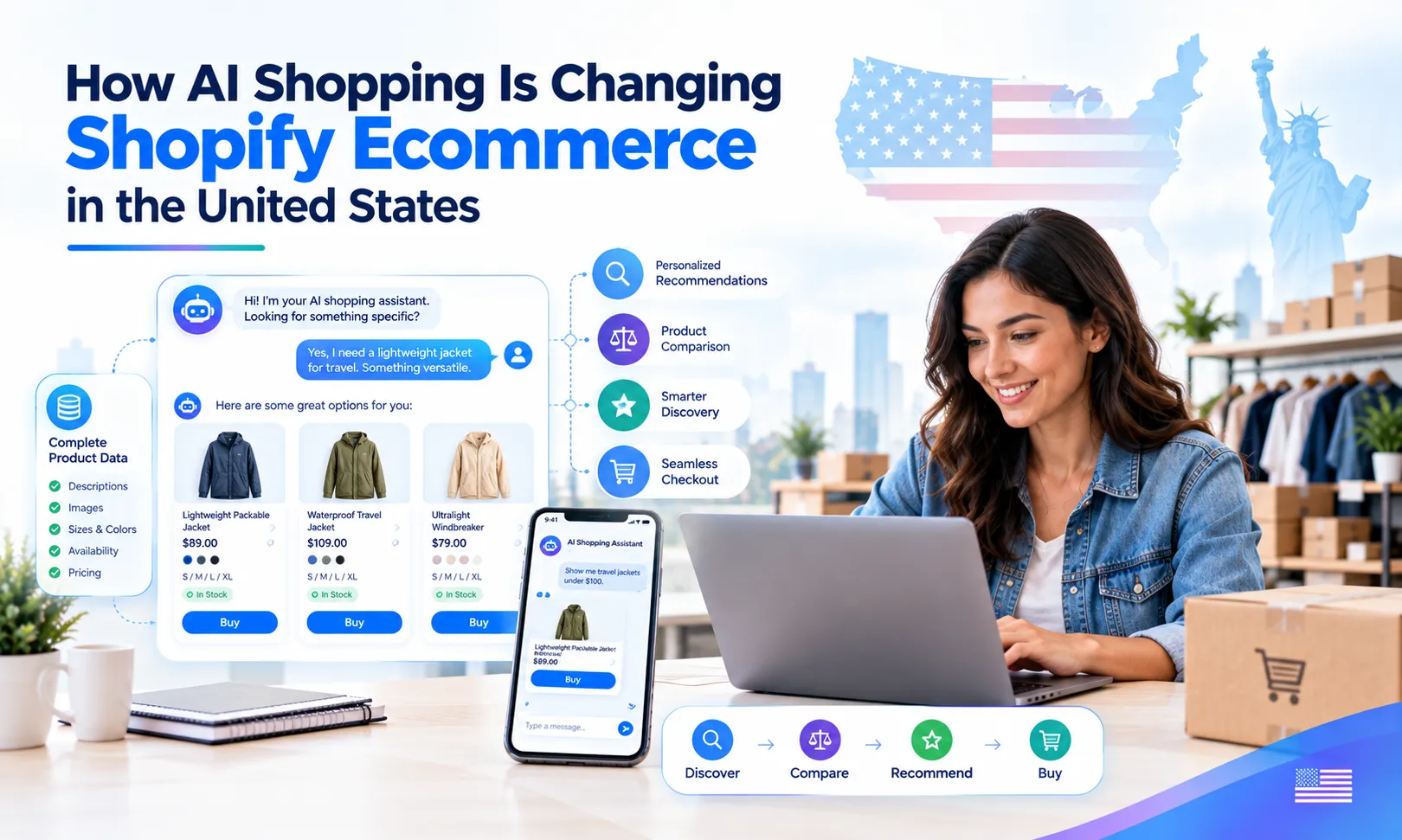

AI shopping is changing Shopify ecommerce from a website-first model into a product-data, AI-discovery, and multi-channel commerce model. In the United States, shoppers can increasingly use AI assistants to research products, compare options, and move toward checkout without beginning with a traditional Google search or visiting a store homepage.
For Shopify merchants, this means ecommerce development is no longer only about designing a fast storefront and optimizing product pages for human visitors. A modern store also needs product information, variants, inventory, pricing, shipping policies, returns, and other commercial signals to be clear and accessible to AI-powered shopping systems.
The shift is already measurable. The U.S. Census Bureau estimated $340.2 billion in retail ecommerce sales for Q2 2026, representing 17.1% of total U.S. retail sales and a 12.2% increase from Q2 2025. At the same time, Shopify reported that traffic to Shopify stores from AI tools grew more than eightfold year over year in Q1 2026, while orders from AI-powered searches increased nearly 13 times.
The important question for Shopify brands is therefore no longer simply whether AI will affect ecommerce. It is how the store should be built and managed when AI becomes another layer between the shopper and the merchant.
What Is AI Shopping?
AI shopping is the use of artificial intelligence to help consumers discover, evaluate, compare, and sometimes purchase products.
Traditional ecommerce generally follows this path:
Search or social platform → Shopify store → product page → cart → checkout
AI shopping can introduce a different path:
AI assistant → product recommendations → comparison → merchant checkout or AI-powered checkout
The difference is significant.
Instead of searching for a generic phrase such as "best running shoes," a customer can ask an AI assistant something much more specific:
"Find lightweight running shoes for someone with flat feet, under $120, available in men's size 10, with good reviews."
The AI system can interpret the requirements, identify relevant products, compare attributes, and present a smaller selection.
This makes product information itself part of the discovery experience.
Shopify describes agentic commerce as a model in which AI agents help shoppers discover, compare, and purchase products. Its current agentic storefront infrastructure connects eligible merchants with AI channels including ChatGPT, Google AI Mode and Gemini, Microsoft Copilot, and Meta surfaces.
Why AI Shopping Matters in the United States
The U.S. ecommerce market is large enough that even a relatively small shift in discovery behavior can have meaningful consequences for merchants.
According to the U.S. Census Bureau, ecommerce represented 17.1% of total U.S. retail sales in Q2 2026. Ecommerce sales increased 12.2% year over year during that quarter.
Meanwhile, AI-generated referrals to retail websites have grown rapidly.
Adobe Analytics reported that traffic to U.S. retail sites from generative AI sources increased 693.4% during the 2025 holiday season compared with the 2024 holiday season. Adobe's analysis covered more than one trillion visits to U.S. retail websites.
Adobe's earlier research also found that 39% of surveyed U.S. consumers had used generative AI for online shopping, while 53% said they planned to do so. Common uses included product research, recommendations, finding deals, gift ideas, and discovering unique products.
These numbers should not be interpreted as meaning AI has already replaced Google, marketplaces, or conventional ecommerce. Adobe itself notes that AI-driven traffic remains modest compared with established channels. The more important signal is the rate of change.
For Shopify merchants, AI is developing into an additional discovery layer rather than an immediate replacement for existing ecommerce channels.
The Biggest Change: Product Discovery Is Moving Into AI Conversations
One of the clearest changes is where shoppers begin their research.
A customer may previously have searched Google, opened several websites, compared products, and eventually purchased from a Shopify store.
With AI shopping, the customer may begin by describing the problem instead of searching for a product category.
For example:
Traditional search:
"Best ergonomic office chair"
AI shopping query:
"I work from home eight hours a day and need an ergonomic chair under $500 with adjustable lumbar support. Which options have strong customer reviews and ship quickly to New York?"
The second query contains much more commercial context.
AI systems can potentially use product attributes, price, availability, reviews, policies, and other information to narrow the results.
That changes the role of the Shopify store.
The store is no longer only a destination that must persuade someone after they arrive. Its product information can also become an input into an AI-powered recommendation.
Shopify's own data illustrates the scale of this development. In Q1 2026, Shopify reported that AI-driven traffic to its stores grew eight times year over year and orders from AI-powered searches grew nearly 13 times.
AI Shopping Makes Product Data More Important
A Shopify store can have a beautiful design and still be poorly prepared for AI discovery.
Why?
Because AI shopping systems need structured, specific and current information.
Consider a product titled:
"Premium Outdoor Shoes"
That may look acceptable to a human shopper, but it provides limited information to an AI system.
A more descriptive product title could communicate:
"Men's Waterproof Hiking Boots, Lightweight, Vibram Sole, Black"
The second version gives an AI system more useful information about product type, audience, use case, construction, and attributes.
The same principle applies to product descriptions.
Important information should not exist only as vague marketing copy. Merchants should clearly communicate details such as:
- Material
- Size
- Color
- Dimensions
- Weight
- Compatibility
- Use cases
- Product type
- Features
- Care instructions
- Shipping availability
- Return conditions
- Inventory
- Pricing
- Variant information
Shopify's current agentic storefront documentation explains that eligible products can be made available to AI channels through Shopify Catalog, while Google AI Mode and Gemini can also use the Google & YouTube sales channel or Google Merchant Center.
The implication is straightforward:
The quality of the product catalog increasingly affects the quality of AI-powered product discovery.
Shopify Catalog Is Becoming Part of the AI Commerce Infrastructure
Shopify's response to AI shopping has been to build infrastructure that connects merchant product information with AI-powered commerce surfaces.
Shopify Catalog is an important part of that infrastructure.
It helps organize product information so that AI systems can interpret products, variants, attributes, prices, and availability.
Shopify introduced Agentic Storefronts in late 2025 and expanded the system throughout 2026. The company says Agentic Storefronts allow merchants to make products discoverable across AI conversations while maintaining merchant ownership of the customer relationship.
This is important because merchants do not necessarily need to build a separate custom integration for every AI platform.
Instead, Shopify is increasingly acting as the commerce infrastructure between the merchant and multiple AI discovery surfaces.
For a Shopify development team, this changes the implementation priorities.
A store should be considered not only as a frontend experience but also as a structured commerce system.
Agentic Commerce Goes Beyond AI Recommendations
AI recommendations and agentic commerce are related but not identical.
An AI recommendation system might tell a shopper:
"These three jackets could be suitable."
Agentic commerce can go further.
An AI agent may:
- Understand the shopper's requirements.
- Search available products.
- Compare products.
- Check relevant attributes.
- Consider price and availability.
- Help select an option.
- Build a cart.
- Initiate or complete checkout where supported.
- Continue helping with post-purchase tasks.
Shopify defines agentic commerce as a model in which AI agents help shoppers browse and shop, while its infrastructure connects product discovery, commerce data, checkout, and merchant systems.
However, merchants should not assume that every AI channel works in exactly the same way.
ChatGPT, Google, Copilot and Meta Do Not All Use the Same Checkout Model
This is one of the most important current distinctions.
According to Shopify's current documentation, ChatGPT is primarily a discovery-focused referral channel for Shopify merchants. Customers discover products through ChatGPT and complete their purchase through the merchant's online-store checkout in a ChatGPT in-app browser or a new browser tab.
Other channels can support Shopify-powered direct checkout.
Shopify currently identifies Google AI Mode and Gemini, Microsoft Copilot, and Meta surfaces such as Muse as channels that can support direct checkout when the merchant is eligible and the feature is activated.
Google's current documentation similarly describes Universal Commerce Protocol as infrastructure for agentic shopping experiences across Google AI surfaces, including dynamic product discovery and checkout.
This distinction matters for developers.
A Shopify store should not be designed around the assumption that "AI checkout" is one standardized experience today.
Instead, developers should build a commerce foundation capable of supporting multiple discovery and transaction paths.
Meta's Muse Shows Where AI Shopping Could Go Next
The development of Meta's Muse demonstrates how quickly the AI shopping landscape is evolving.
Meta introduced Muse in September 2026 as a personal AI agent capable of performing tasks on behalf of users, including browsing websites, filling forms, and taking actions with user approval.
Meta subsequently announced additional shopping partners and payment options, including Shop Pay and PayPal.
Shopify's current documentation also lists Meta surfaces such as Muse among its agentic storefront channels.
For merchants, this illustrates a broader development: AI shopping may increasingly move beyond a chatbot that recommends products toward software that can actually participate in transactions.
But that does not mean merchants should immediately rebuild their entire stores around one AI platform.
The underlying product and commerce infrastructure is more important than any individual interface.
Universal Commerce Protocol and the Move Toward Interoperability
Another important development is the Universal Commerce Protocol, or UCP.
Shopify and Google introduced UCP in January 2026 as an open standard intended to support agentic commerce at scale.
Google describes UCP as an open standard that allows merchants to provide agentic shopping experiences across Google AI surfaces while maintaining merchant-of-record status and customer relationships.
The significance of an open commerce protocol is that merchants should not have to create a completely different commerce architecture for every AI assistant.
The long-term direction is toward standardized communication between:
Shopper → AI agent → product catalog → merchant systems → payment → fulfillment → post-purchase support
For Shopify developers, this reinforces an important architectural principle:
Build clean commerce data and reliable backend processes before building custom AI features.
Why Shopify Development Is Changing
Traditional Shopify development has focused heavily on:
- Theme design
- Mobile responsiveness
- Page speed
- Product pages
- Navigation
- Search
- Conversion rate optimization
- Checkout experience
- SEO
- Analytics
These remain important.
AI shopping adds another layer:
- Machine-readable product information
- Structured attributes
- Accurate variants
- Real-time pricing
- Inventory consistency
- Shipping information
- Return policies
- Product feeds
- AI-channel compatibility
- Attribution
- AI-search visibility
- Agentic checkout readiness
This is why Shopify Ecommerce Development in United States increasingly needs to include both human-facing UX and machine-readable commerce infrastructure.
For businesses building or upgrading a Shopify store for U.S. customers, the development process should therefore consider how the store performs when the "visitor" is not a person browsing a homepage but an AI system evaluating product information.
Product Pages Need to Become More Specific
AI systems cannot reliably recommend products based on information that is vague, contradictory, or missing.
A strong product page should answer questions a buyer might realistically ask.
For a mattress, that could include:
- Mattress size
- Firmness
- Materials
- Thickness
- Sleeping position
- Weight capacity
- Cooling properties
- Warranty
- Trial period
- Shipping
- Returns
For electronics:
- Compatibility
- Dimensions
- Battery life
- Connectivity
- Operating system
- Supported devices
- Warranty
- Included accessories
For clothing:
- Material
- Fit
- Size
- Color
- Care instructions
- Intended use
- Weather suitability
This level of specificity helps human shoppers as well as AI systems.
That is an important point: AI readiness and good ecommerce content are often aligned rather than competing objectives.
Variants Matter More Than Many Merchants Realize
AI shopping can introduce more detailed product matching.
Suppose a customer asks:
"Find me a navy blue women's running jacket, medium size, under $100."
If a store has a single product page containing multiple variants but the data does not clearly associate color, size, price, and availability with the relevant variant, the AI system may have difficulty identifying the correct option.
Shopify-related guidance from current industry sources repeatedly emphasizes accurate variants, attributes, pricing, inventory and product metadata as part of AI-shopping readiness.
For development teams, this means variant architecture should be treated as a commerce-data problem, not just a theme-design problem.
Inventory Accuracy Becomes a Customer-Experience Issue
AI shopping can make inventory errors more visible.
Imagine an AI assistant recommending a product because the merchant's data says it is available.
The customer clicks through and discovers that the item is actually out of stock.
In a traditional search journey, that is already frustrating.
In an AI-assisted journey, it can undermine confidence in the recommendation itself.
This is why accurate inventory synchronization matters.
The same principle applies to:
- Pricing
- Shipping estimates
- Delivery regions
- Return policies
- Discounts
- Product availability
- Variant availability
FBMFulfillment's current analysis of AI shopping makes a similar operational point: the information presented to an AI agent must match what the warehouse and fulfillment system can actually deliver.
The technical lesson is simple:
AI commerce cannot compensate for unreliable commerce operations.
Shipping and Returns Become Discovery Signals
AI shopping may make shipping and returns more important during product comparison.
A shopper could ask:
"Which of these products can arrive before Friday and has free returns?"
That means delivery and return information can become part of the product-selection criteria.
A Shopify store should therefore make important policies easy to understand and maintain.
The goal is not to create artificial keyword-rich policy pages.
The goal is to provide accurate, consistent information that helps both shoppers and systems understand the commercial terms.
AI Search Changes the Meaning of Ecommerce SEO
Traditional ecommerce SEO remains important.
Product pages still need:
- Search-friendly titles
- Relevant descriptions
- Internal links
- Structured data
- Strong page experience
- Helpful content
- Authoritative backlinks
- Technical accessibility
But AI search introduces another consideration.
The question becomes:
Can an AI system confidently understand what this product is, who it is for, why it is relevant, and whether the information is trustworthy?
This overlaps with Generative Engine Optimization, or GEO.
For ecommerce, GEO should not mean writing unnatural content specifically for AI.
It should mean improving the clarity, structure, evidence, entities, attributes, and usefulness of information so that AI systems can interpret it correctly.
That includes the product catalog as well as editorial content.
What Ecommerce Brands Should Do About GEO
For Shopify merchants, GEO should begin with product fundamentals.
Start with accurate product information.
Then improve:
Product entity clarity
Clearly identify what the product is.
Attribute completeness
Specify the properties that influence buying decisions.
Use-case clarity
Explain who the product is for and when it should be used.
Evidence
Use authentic reviews, specifications, certifications, warranties, and other relevant trust signals where applicable.
Consistency
Keep product information consistent across the website, feeds, marketplaces, and other channels.
Supporting content
Publish useful buying guides, comparisons, FAQs, product explainers, and category content.
This creates a stronger information environment for both conventional search and AI-powered discovery.
AI Can Also Change How Shopify Teams Operate
AI shopping is only one part of the transformation.
AI is also being used inside ecommerce businesses.
Shopify's current 2026 guidance identifies applications including product recommendations, pricing, inventory forecasting, fraud prevention, customer service, analytics, content generation, and merchandising.
Shopify's Q4 2025 merchant survey reported that 75% of business owners were using AI tools.
This creates another development opportunity.
A Shopify store can use AI not just to sell products but to help operate the business.
Examples include:
Customer support: AI can answer routine questions about products, shipping and orders.
Merchandising: AI can help identify products, categories or review themes that deserve attention.
Content operations: AI can accelerate first drafts of descriptions, emails and other marketing content.
Analytics: AI can help teams interpret large datasets and identify patterns.
Automation: Shopify workflows and connected AI systems can reduce repetitive operational work.
Personalization: Product recommendations can be tailored to customer behavior and context.
The strongest implementations connect AI to a measurable business problem rather than adding AI simply because it is available.
AI Should Not Replace Ecommerce Fundamentals
There is a temptation to think that AI shopping means traditional ecommerce best practices are becoming irrelevant.
That is not supported by the current evidence.
A fast website still matters.
A clear checkout still matters.
Good product photography still matters.
Strong reviews still matter.
Reliable fulfillment still matters.
SEO still matters.
Brand trust still matters.
AI adds another discovery and interaction layer; it does not eliminate the underlying commerce experience.
In fact, the more AI becomes involved in product selection, the more important accurate underlying information can become.
The New Shopify Store Has Two Audiences
A useful way to think about modern Shopify development is that the store increasingly has two audiences.
Human shoppers
They care about:
- Visual design
- Brand identity
- Trust
- Navigation
- Usability
- Product benefits
- Reviews
- Checkout convenience
AI systems
They need:
- Clear product identity
- Structured attributes
- Accurate prices
- Accurate inventory
- Variant relationships
- Shipping information
- Return policies
- Machine-readable data
- Accessible product information
The best Shopify stores serve both.
This is not about designing a website that looks good to people but is invisible to machines.
It is about creating a commerce system in which the same underlying information is useful to both.
A Practical AI-Readiness Framework for Shopify Stores
Before investing heavily in custom AI development, Shopify merchants should review five areas.
1. Catalog readiness
Check whether product titles, descriptions, attributes, variants, images, prices and inventory are complete and consistent.
2. Channel readiness
Understand where products are being surfaced and which AI channels are available to the business.
Shopify currently provides centralized controls through its Agentic section, including channel management and performance information.
3. Checkout readiness
Understand the actual checkout path for each AI channel.
ChatGPT currently sends shoppers to the merchant's online-store checkout, while certain other channels can support Shopify-powered direct checkout.
4. Measurement readiness
Track AI-driven sessions, product discovery, conversions, orders and revenue where the relevant channel provides attribution.
Shopify says AI-channel orders can appear in Shopify Admin with channel or referrer attribution.
5. Governance readiness
Decide who is responsible for reviewing:
- AI-generated content
- Product data
- Pricing
- Inventory
- Policies
- AI-channel settings
- Privacy
- Customer experience
AI automation without ownership can create operational problems faster than it solves them.
What Shopify Merchants Should Prioritize in 2026
The current evidence suggests that merchants should focus on fundamentals that remain useful regardless of which AI platform ultimately gains more shopping activity.
First, clean the catalog.
Second, make important product attributes explicit.
Third, maintain accurate pricing and inventory.
Fourth, make shipping and return information clear.
Fifth, ensure the store's checkout works reliably.
Sixth, connect relevant commerce channels.
Seventh, establish AI-channel measurement.
Eighth, improve supporting content around important product and category questions.
Ninth, test AI-driven discovery rather than assuming it works.
Tenth, keep monitoring the ecosystem because protocols, channels and checkout experiences are evolving quickly.
This approach is more durable than building a strategy around one AI platform.
What Not to Do
Do not create vague AI-generated product descriptions at scale
More content does not automatically mean better AI visibility.
If AI-generated copy introduces incorrect materials, sizes, compatibility information or claims, it can reduce trust.
Do not hide important product information inside images
Critical commercial attributes should be available as actual product information wherever possible.
Do not ignore inventory synchronization
An AI recommendation based on stale stock data can create an avoidable customer-service problem.
Do not assume every AI channel uses the same checkout
Current Shopify documentation clearly shows differences between ChatGPT and channels that support direct checkout.
Do not abandon conventional SEO
AI search and traditional search currently coexist.
A Shopify merchant should optimize for both rather than replacing one with the other.
Do not build custom AI infrastructure before fixing the catalog
If product data is incomplete, custom AI features may simply make a flawed information system more sophisticated.
Security, Privacy and Trust Need More Attention
Agentic commerce also introduces new risks.
When software begins acting on behalf of a shopper, questions arise around authorization, payment security, privacy, fraud and accountability.
OpenAI's Agentic Commerce Protocol emphasizes explicit user confirmation, secure payment tokens and limited data sharing in its initial implementation.
At the same time, banks and financial institutions have raised concerns about AI shopping agents, including fraud, privacy and uncertainty around consumer protections. Reuters reported these concerns in September 2026.
This means Shopify merchants should not treat AI commerce as purely a marketing opportunity.
The technical implementation must also consider:
- Payment security
- Customer consent
- Data minimization
- Fraud prevention
- Access control
- Accurate transaction records
- Returns and refunds
- Customer support
- Third-party integrations
Trust will become increasingly important as software gains more authority to act.
What Is Confirmed, What Is Emerging and What Is Still Uncertain?
Confirmed current development
Shopify currently supports agentic storefront capabilities across several AI channels, with different discovery and checkout models.
AI-driven traffic and orders to Shopify stores have grown rapidly, according to Shopify's Q1 2026 data.
AI-driven referrals to U.S. retail websites also grew substantially during 2025, according to Adobe Analytics.
Emerging trend
AI assistants are moving from product recommendations toward more active shopping workflows.
Meta's Muse and Shopify's integration work demonstrate this movement toward agent-assisted transactions.
Still evolving
The exact balance between AI-platform checkout, merchant checkout, open protocols and proprietary commerce systems is still developing.
That is why merchants should prioritize adaptable commerce infrastructure instead of building their entire strategy around one interface.
The Future of Shopify Ecommerce Is More Distributed
The traditional idea of a Shopify store is simple:
The customer visits the website.
The emerging model is more distributed:
The customer can encounter the product inside search, social platforms, AI assistants, shopping apps, browser agents and other interfaces.
Shopify's 2026 strategy reflects this change. Its Agentic Storefronts system is designed to make products available across AI channels while allowing merchants to manage those experiences through Shopify.
That does not make the Shopify website less important.
It changes its role.
The website becomes the merchant's owned commerce foundation, while AI channels become additional discovery and transaction surfaces.
How U.S. Shopify Brands Can Prepare
For a Shopify business targeting U.S. consumers, preparation can start with a straightforward sequence.
Audit the catalog.
Find incomplete or inconsistent product information.
Improve product data.
Make attributes, variants, specifications and use cases explicit.
Check commercial accuracy.
Verify prices, inventory, shipping and returns.
Review AI-channel eligibility.
Understand which AI surfaces can currently access your products.
Test discovery.
Use realistic customer questions and see how products are represented.
Improve supporting content.
Create useful buying guides and product comparisons that answer real customer questions.
Measure AI traffic.
Do not assume AI referrals are the same as organic search traffic.
Review checkout paths.
Understand where a shopper completes the transaction on each channel.
Strengthen fulfillment.
Ensure that delivery promises can be fulfilled consistently.
Review regularly.
AI commerce is changing quickly, so a one-time implementation is unlikely to be enough.
How Shopify Ecommerce Development Is Evolving
The next generation of Shopify development will involve more than themes, apps and frontend interfaces.
It will increasingly connect:
UX + structured product data + AI discovery + commerce APIs + checkout + analytics + automation + fulfillment
That creates a broader role for ecommerce development teams.
A development partner should understand not only how to build a Shopify storefront but also how product architecture, technical SEO, structured data, integrations, conversion design, analytics and AI discovery interact.
For businesses targeting U.S. consumers, this is where specialized Shopify Ecommerce Development in United States can become particularly relevant: the store needs to support the expectations of the U.S. ecommerce market while remaining adaptable to an increasingly AI-mediated customer journey.
Final Takeaway
AI shopping is not simply another chatbot feature for Shopify.
It is changing how products are discovered, evaluated and purchased.
The most important shift is from a website-first ecommerce model toward a distributed commerce model in which AI systems can become part of the shopping journey.
The evidence already shows rapid growth in AI-driven ecommerce discovery. Shopify has reported major increases in AI-referred traffic and orders, while Adobe has measured substantial growth in AI referrals to U.S. retail websites.
But the practical response is not to chase every new AI platform.
It is to build a stronger commerce foundation.
That means accurate product data, clear variants, reliable inventory, useful product content, structured information, accessible policies, dependable checkout, measurable attribution and strong fulfillment.
The Shopify stores best positioned for AI shopping are therefore not necessarily the ones with the most AI features.
They are the ones whose commerce information is clear enough for both people and machines to understand, trust and act on.
As AI becomes another interface for shopping in the United States, Shopify development is moving toward a broader goal: building ecommerce systems that can sell wherever customers, and increasingly their AI agents, choose to shop.
Direction : Get Here





























Sign in to leave a comment.