

Financial markets can move quickly when there is a sudden news event, economic announcement, unexpected corporate update or sharp change in global markets. During such periods, prices may change significantly within seconds.
For manual traders, reacting to these rapid movements can be difficult. An algorithmic trading system, however, can monitor predefined conditions and respond automatically. But this does not mean an algo trading strategy will always execute at the expected price.
Understanding how algo trading works during fast-moving markets is important for traders who use an algo trading platform, especially when automated systems are connected to a live trading account.
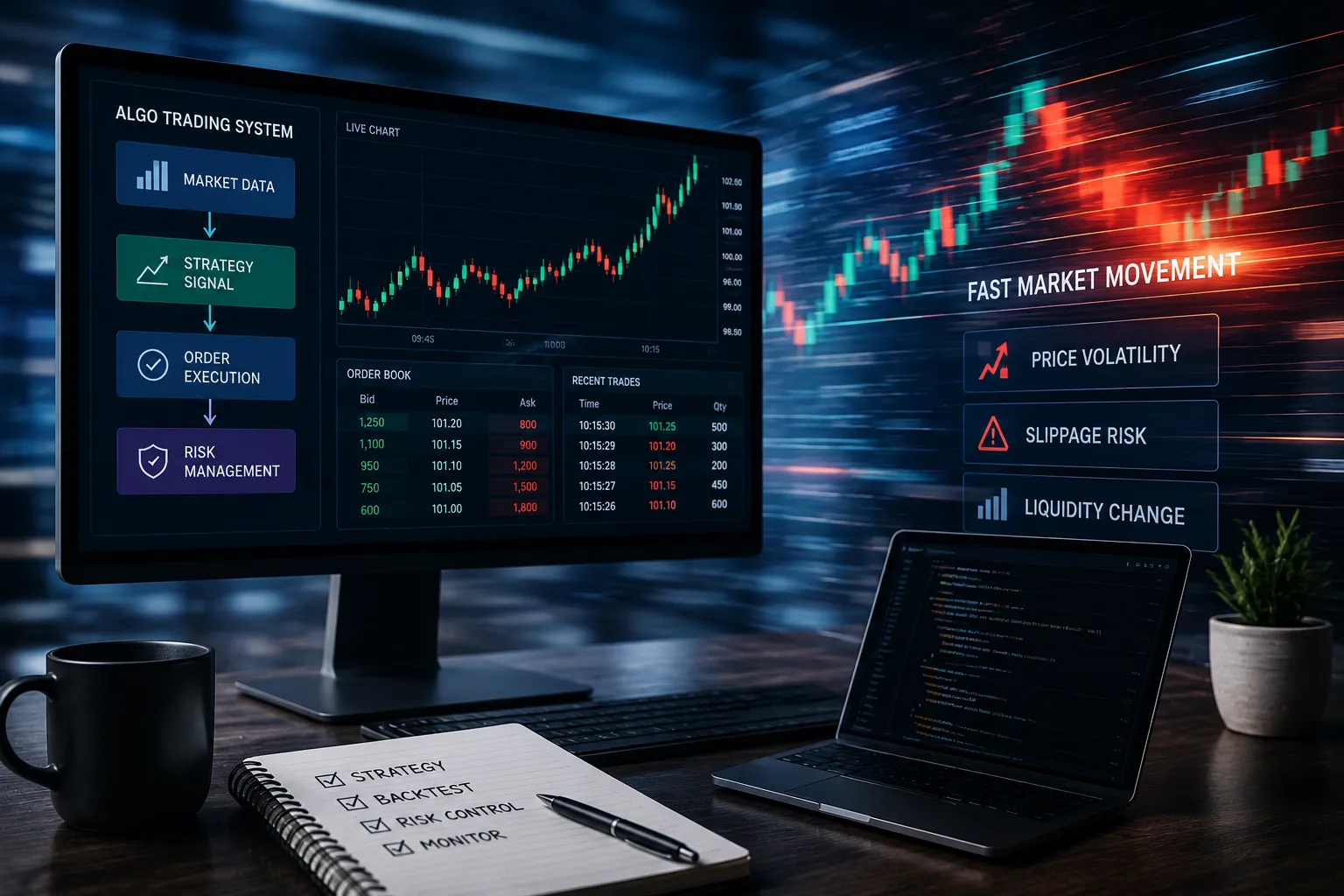
What Happens When Prices Move Very Quickly?
Under normal market conditions, an algorithm may receive a trading signal, send an order and get an execution close to the expected price.
When prices move rapidly, this process can become more challenging.
For example, imagine an algorithm is designed to buy a stock when its price crosses ₹500. The strategy detects the condition and sends a market order. However, if the stock quickly moves from ₹500 to ₹505, the order may be executed around ₹505 instead of ₹500.
This difference can occur because market prices are constantly changing and available orders at each price level can disappear quickly.
How an Algo Trading System Responds
An algorithm generally follows the rules programmed into it. It does not suddenly change its decision simply because the market is moving quickly unless specific conditions have been built into the strategy.
A typical process may look like this:
Market data → Signal generation → Risk checks → Order placement → Order execution → Position update
The system continuously receives market information and checks whether the strategy's conditions are satisfied.
If a signal is generated, the algorithm may perform risk checks before sending an order to the broker or exchange.
When the market is moving rapidly, the time between these steps becomes particularly important.
Why Execution Price Can Differ From the Signal Price
One of the most important concepts to understand is slippage.
Slippage occurs when the actual execution price differs from the price expected when the order was initiated.
Suppose an algorithm generates a buy signal when a stock is trading at ₹1,000. By the time the order reaches the market, available sellers at ₹1,000 may no longer exist. The order could therefore be executed at ₹1,002, ₹1,005 or another available price.
In a rapidly moving market, even a small delay can result in a noticeable difference between the signal price and execution price.
This is one reason why historical backtesting should not be treated as a guarantee of live performance.
Market Orders and Limit Orders Behave Differently
The type of order used by an algorithm can have a major impact during fast price movements.
A market order prioritises execution. It generally attempts to execute immediately at the available market prices. However, the final execution price may differ from the price visible when the order was placed.
A limit order, on the other hand, specifies the maximum price a trader is willing to pay when buying or the minimum price acceptable when selling.
For example, if a trader places a buy limit order at ₹1,000 and the market suddenly moves to ₹1,010, the order may remain unexecuted rather than buying at a higher price.
Therefore, traders need to understand the trade-off between execution certainty and price control.
Why Liquidity Matters During Fast Markets
Liquidity is another important factor.
When there are many buyers and sellers at different price levels, orders may be executed more smoothly. But if liquidity becomes thinner during a sudden market movement, a large order may need to consume several available price levels.
For example, an algorithm wants to buy 5,000 shares, but only 1,000 shares are available at the current price. The remaining quantity may be executed at progressively higher prices.
This can increase the average execution cost.
For this reason, an algo trading strategy should consider the liquidity of the security and the size of the intended order.
Risk Controls Become More Important
Fast markets can expose weaknesses in an automated strategy very quickly.
A well-designed algorithm can include risk controls such as:
- Maximum position size
- Maximum order quantity
- Daily loss limits
- Stop-loss conditions
- Maximum number of trades
- Price deviation checks
- Trading-time restrictions
- Emergency strategy shutdown
These controls can prevent the system from continuing to trade normally when market conditions become abnormal.
For example, an algorithm could be programmed not to place a new order if the current market price has moved too far away from the price at which the original signal was generated.
What If the Market Suddenly Reverses?
Rapid price movements can sometimes be followed by equally fast reversals.
Imagine an algorithm receives a bullish signal and enters a position during a sharp upward move. If the market reverses immediately afterward, the strategy may experience a loss before its exit condition is triggered.
This highlights an important point: automation does not predict the market.
The algorithm simply follows its predefined rules. If those rules do not account for sudden volatility, the system may behave differently from what the trader expected.
Why Backtesting Fast Markets Is Important
Backtesting should include different market conditions rather than focusing only on calm periods.
Traders can examine how their strategy behaved during:
- Sharp market rallies
- Sudden declines
- High-volatility sessions
- Large price gaps
- Low-liquidity periods
- Unexpected reversals
It is also important to consider realistic assumptions about brokerage costs, slippage and order execution.
A strategy that looks attractive under ideal historical prices may produce very different results when real-world execution conditions are included.
Monitoring an Algo During Volatile Markets
Even automated trading requires supervision.
Traders should monitor important system information such as:
- Order status
- Execution prices
- Rejected orders
- Open positions
- Strategy signals
- Risk-limit alerts
- Connection or API issues
- Unexpected trading activity
If the system starts behaving differently from its intended rules, the trader should have a clear process for stopping or modifying the strategy.
Common Mistakes to Avoid
One common mistake is assuming that an algorithm will always execute at the price shown on the chart.
Another is using the same strategy settings in every market condition without evaluating whether the strategy is suitable for high volatility.
Traders should also avoid increasing position sizes simply because an algorithm can execute orders quickly. Faster execution does not reduce the underlying market risk.
Finally, relying entirely on backtested results without considering slippage and real execution conditions can create unrealistic expectations.
Final Thoughts
Algo trading can respond to rapidly changing markets much faster than a human trader can manually process every movement. However, speed does not guarantee better execution or profits.
When prices move faster than expected, factors such as slippage, liquidity, order type, execution speed and risk controls can significantly affect the outcome.
A reliable algorithmic trading approach should therefore be designed not only for normal market conditions but also for periods of sudden volatility. Traders should test these scenarios, establish clear risk limits and regularly monitor their systems.
The goal of algo trading is not simply to react faster. It is to execute a well-tested strategy consistently while keeping risk under control, even when market conditions change unexpectedly.





























Sign in to leave a comment.