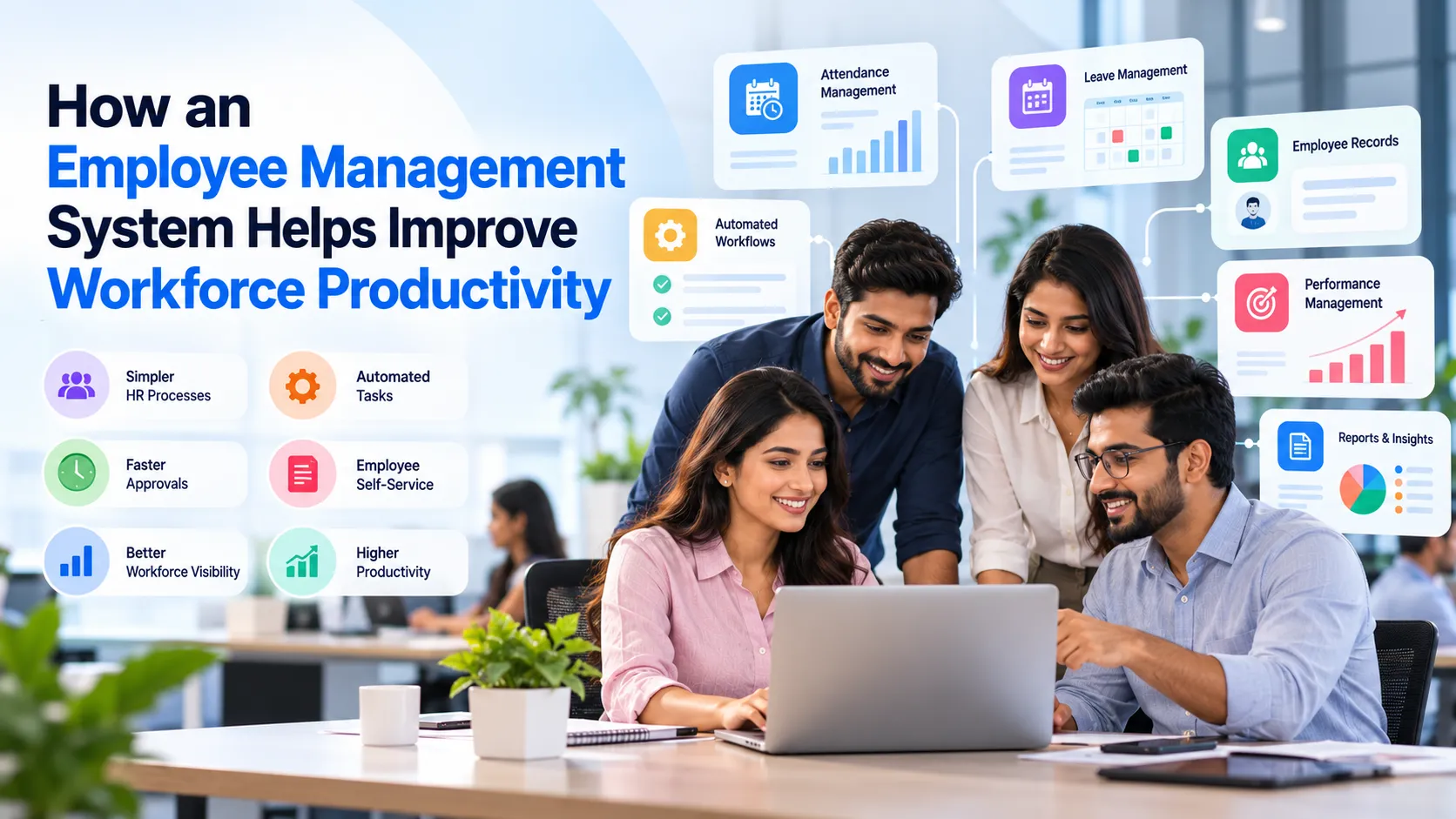

Workforce productivity is not only about asking employees to work faster. It depends on how efficiently people can complete their responsibilities, access information, collaborate with managers, and avoid unnecessary administrative delays. When employees spend too much time on repetitive HR processes, productivity naturally suffers.
A modern employee management system helps businesses simplify these daily activities by bringing employee records, attendance, leave, documents, workflows, and other HR processes into one place. Instead of relying on spreadsheets, emails, and disconnected tools, organisations can manage employee-related activities through a centralized platform.
This improves productivity because employees spend less time searching for information, HR teams reduce manual work, and managers gain better visibility into workforce activities. As a result, businesses can operate more efficiently while providing employees with a smoother workplace experience.
What Is an Employee Management System?
An employee management system is a digital platform designed to help organisations manage employee information and HR-related processes.
Depending on the system, it may include features for:
- Employee records
- Attendance tracking
- Leave management
- Payroll inputs
- Performance management
- Employee self-service
- Document management
- Workflow approvals
- HR reporting
- Employee communication
The main purpose is to reduce manual work and make important workforce information easier to access and manage.
For growing organisations, this becomes especially valuable because administrative complexity usually increases as more employees, departments, locations, and policies are added.
1. Reduces Time Spent on Repetitive HR Tasks
One of the biggest productivity challenges in HR is repetitive administrative work.
HR professionals may spend hours updating employee records, checking attendance data, responding to basic queries, managing leave requests, and preparing reports.
An employee management system automates many of these activities.
For example, leave balances can be calculated automatically, attendance records can be captured digitally, and employee information can be stored centrally.
This reduces the need for manual data entry and repeated calculations.
As a result, HR teams can spend more time on activities such as workforce planning, employee development, engagement, and organisational improvement.
2. Gives Employees Faster Access to Information
Employees often depend on HR teams for routine information.
They may need to know their leave balance, download a payslip, check attendance records, update personal details, or access company documents.
Without a centralized system, employees may need to send emails or wait for HR support.
Employee self-service changes this.
Through an employee management platform, employees can access relevant information directly.
This reduces unnecessary communication and waiting time.
Employees become more independent, while HR teams receive fewer repetitive requests.
Even small improvements like this can save significant time across a large workforce.
3. Simplifies Attendance Management
Attendance management can become complicated when businesses have multiple shifts, departments, locations, or working arrangements.
Manual attendance tracking can lead to errors, delayed updates, and unnecessary disputes.
An employee management system can automate attendance tracking and make workforce data available in real time.
Managers can see information such as:
- Employee attendance
- Late arrivals
- Missing punches
- Overtime
- Shift schedules
- Absence patterns
This visibility helps managers address attendance concerns faster.
Employees also benefit because they can review their attendance records and request corrections when needed.
A transparent attendance process reduces administrative effort and helps teams maintain better workforce discipline.
4. Makes Leave Management More Efficient
Leave management may look simple, but it can quickly become time-consuming when handled manually.
Employees may send leave requests through emails or messages, while managers need to check balances, team schedules, and availability before approving them.
An employee management system brings this process into a structured workflow.
Employees can submit leave requests digitally, and managers can review them from the same platform.
The system can automatically update leave balances after approval.
Managers may also be able to see who else is on leave before making a decision.
This improves workforce planning and helps prevent situations where too many employees from the same team are unavailable at the same time.
5. Reduces Errors and Duplicate Work
Manual employee management often requires the same information to be entered multiple times.
For example, employee details may exist separately in attendance records, payroll spreadsheets, HR databases, and reporting files.
This creates opportunities for mistakes.
Centralized employee management reduces duplicate data entry.
When employee information is maintained in one system, different HR processes can use the same records.
This improves consistency and reduces the chances of errors caused by outdated or mismatched information.
Fewer errors also mean less time spent identifying and correcting mistakes later.
6. Speeds Up Manager Approvals
Delayed approvals can slow down many HR processes.
Leave requests, attendance corrections, expense claims, employee updates, and other activities may remain pending because managers are not aware of them or cannot access the required information quickly.
Employee management systems can create structured approval workflows.
Managers receive notifications when action is required and can review requests from a centralized dashboard.
This reduces unnecessary follow-ups from HR teams.
Faster approvals help employees complete processes without long waiting periods, improving overall operational efficiency.
7. Improves Workforce Visibility
Managers cannot improve productivity without understanding what is happening within their teams.
Employee management systems provide better visibility through reports and dashboards.
Managers may be able to monitor:
- Headcount
- Attendance
- Absenteeism
- Leave trends
- Employee movement
- Performance information
- Department-wise workforce data
Instead of manually combining information from multiple spreadsheets, managers can access updated workforce data from one place.
This allows them to identify patterns and make better decisions.
For example, increasing absenteeism in a particular department may indicate a workload, scheduling, or engagement issue that requires attention.
8. Supports Better Performance Management
Employee productivity is closely connected with clear goals and regular feedback.
A structured employee management system can support performance management by allowing organisations to define goals, track progress, conduct reviews, and document feedback.
Employees gain clarity about what is expected from them.
Managers can monitor progress throughout the review period rather than waiting until the end of the year.
Regular performance conversations can also help employees identify areas for improvement earlier.
When goals, feedback, and development activities are clearly documented, employees can focus their efforts more effectively.
9. Helps New Employees Become Productive Faster
Onboarding has a direct impact on how quickly new employees become comfortable in their roles.
A poorly organised onboarding process may involve repeated emails, missing documents, delayed system access, and unclear responsibilities.
An employee management system can create a structured onboarding workflow.
New employees may receive tasks related to:
- Document submission
- Policy acknowledgement
- Training
- Profile completion
- Joining formalities
- Manager introductions
HR teams can track progress and identify pending activities.
This creates a more organised experience and helps new employees become productive faster.
10. Improves Communication Between HR and Employees
Poor communication can create unnecessary delays.
Employees may not know about policy updates, pending approvals, upcoming reviews, or important HR activities.
Employee management systems can improve communication through notifications, reminders, announcements, and centralized information.
Instead of depending entirely on emails, HR teams can share important updates through the system.
Employees are more likely to receive timely information, reducing confusion and repeated questions.
11. Supports Remote and Hybrid Workforces
Modern businesses may have employees working from different offices, cities, or even countries.
Managing distributed teams through manual processes can become difficult.
A cloud-based employee management platform provides employees and managers with access to HR information from different locations.
Employees can apply for leave, view documents, check attendance, or complete HR activities without physically visiting the HR department.
Managers can also approve requests and review workforce information remotely.
This flexibility makes HR processes more suitable for remote and hybrid working environments.
12. Helps HR Focus on Strategic Work
Perhaps the biggest productivity benefit is the shift in how HR teams use their time.
When routine tasks are automated, HR professionals can focus more on activities that directly contribute to business growth.
These may include:
- Workforce planning
- Employee engagement
- Talent development
- Succession planning
- Organisational culture
- Retention strategies
Technology handles repetitive administrative activities, while HR professionals focus on people-focused and strategic responsibilities.
This creates greater value for both employees and the organisation.
How Employee Management Systems Benefit Employees
Productivity improvements are not limited to HR teams and managers.
Employees also benefit from faster, simpler, and more transparent HR processes.
They can access information without waiting, complete requests digitally, and receive faster updates.
This reduces frustration and allows employees to spend more time on their actual responsibilities.
When HR processes are easy to use, employees are less likely to view administrative activities as interruptions to their work.
What Businesses Should Look for in an Employee Management System
Choosing the right solution is important.
Businesses should consider systems that are easy to use and capable of supporting their workforce requirements.
Important features may include:
- Employee self-service
- Attendance and leave management
- Mobile accessibility
- Automated approvals
- HR analytics
- Payroll integration
- Performance management
- Document management
- Security and access controls
- Integration capabilities
Scalability is also important.
A system that works for 50 employees should ideally be capable of supporting the organisation as its workforce grows.
Conclusion
Improving workforce productivity requires more than monitoring employee performance. Businesses also need to remove unnecessary administrative work and make everyday processes easier.
An employee management system helps achieve this by automating repetitive activities, centralising employee information, improving self-service, speeding up approvals, and providing managers with better workforce visibility.
The result is a more efficient workplace where employees spend less time on administrative tasks and more time on meaningful work.
For HR teams, the benefit is equally significant. Instead of being occupied with routine transactions, they can focus on employee development, workforce planning, engagement, and other strategic initiatives.
As businesses continue to grow and workplace processes become more complex, effective employee management technology can play an important role in creating a more productive and organised workforce.
Read More: From HR Automation to Agentic HR: What Comes Next?














Sign in to leave a comment.