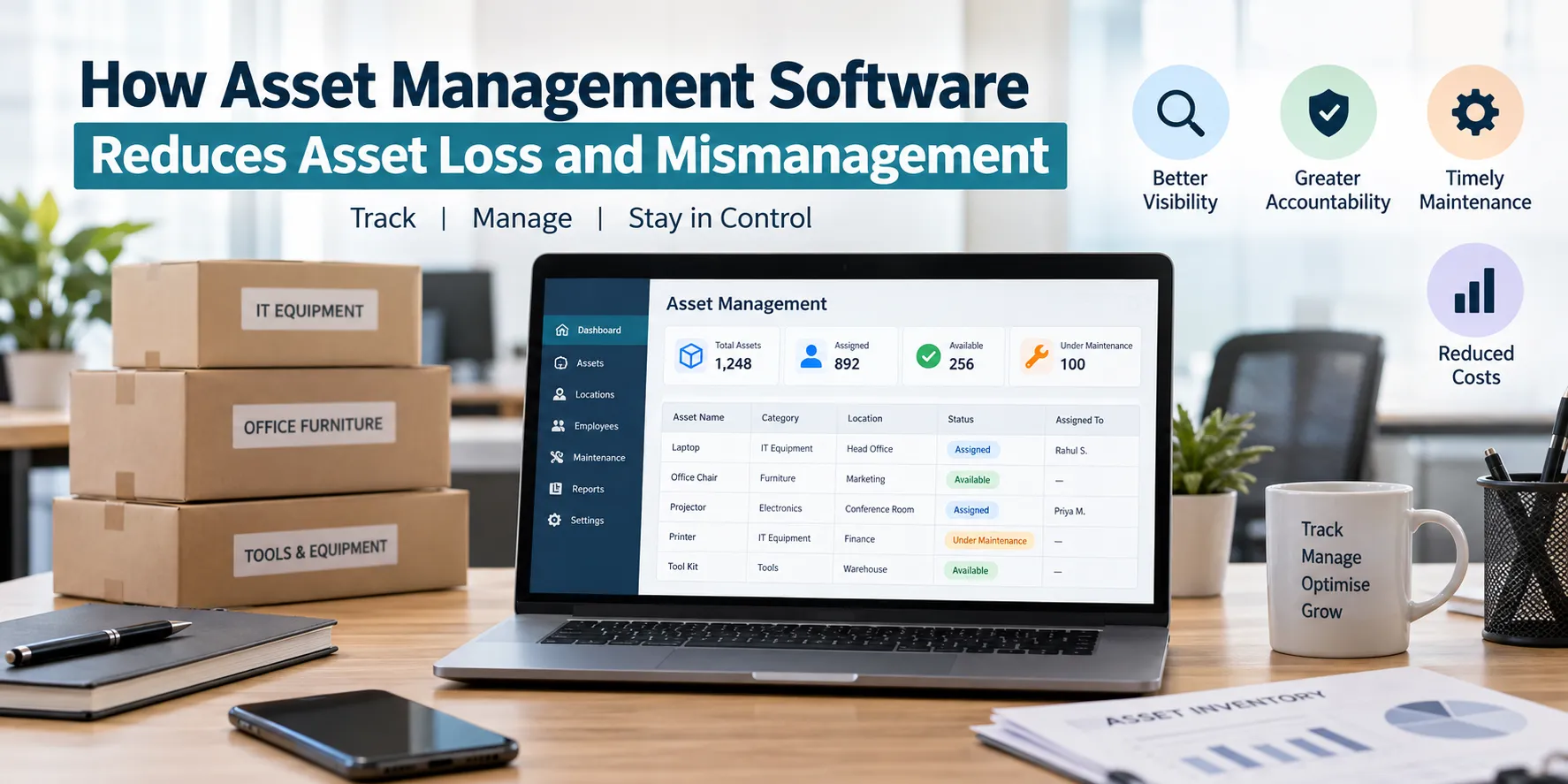

Businesses depend on physical and digital assets to keep daily operations running smoothly. Computers, laptops, office furniture, machinery, tools, vehicles, mobile devices, and other equipment represent significant investments. However, managing these assets becomes difficult when a business relies on spreadsheets, paper records, or disconnected systems.
Assets can be misplaced, assigned to the wrong employee, left unused, or even lost during transfers between departments or locations. Poor maintenance and incomplete records can also reduce an asset's useful life and increase operating costs. These challenges can lead to unnecessary purchases, financial losses, and inefficient resource utilisation.
Asset Management Software provides businesses with a structured way to record, monitor, assign, maintain, and manage assets throughout their lifecycle. By creating a centralised system for asset information, businesses can improve visibility and accountability while reducing the chances of asset loss and mismanagement.

What Is Asset Management Software?
Asset Management Software is a digital solution that helps organisations manage their assets from acquisition to disposal. Instead of maintaining separate records across spreadsheets, files, and physical documents, businesses can maintain asset information in one centralised system.
Depending on the software, businesses may be able to record information such as asset name, category, purchase date, cost, location, assigned employee, warranty details, maintenance history, depreciation, and current status.
The software can also help organisations track asset movements and monitor important activities. This makes it easier for finance, HR, IT, administration, and operations teams to work with accurate asset information.
How Asset Management Software Reduces Asset Loss
1. Creates a Centralised Asset Register
One of the biggest causes of asset mismanagement is incomplete or scattered information. When different departments maintain separate spreadsheets, it becomes difficult to determine what assets the company owns and where those assets are currently located.
Asset Management Software creates a centralised asset register where important information can be stored and updated. Each asset can have its own record containing relevant details.
For example, a laptop record may include its model, serial number, purchase date, assigned employee, department, location, warranty status, and current condition.
Having this information in one place makes it easier to identify assets and reduces the possibility of assets being overlooked.
2. Improves Asset Tracking
Assets frequently move between employees, departments, branches, warehouses, and project locations. Without proper tracking, businesses may lose visibility over where an asset was transferred or who currently has responsibility for it.
Asset Management Software can record asset movements and assignments. When an asset is transferred, the record can be updated to reflect its new location or user.
This creates a clearer history of asset ownership and movement. If an asset cannot be located, the organisation can review its latest recorded assignment instead of searching through multiple files or asking different departments for information.
3. Assigns Accountability to Employees
Businesses often have expensive equipment assigned to employees. Laptops, smartphones, tools, cameras, and other devices can be difficult to manage if there is no clear record of responsibility.
Asset Management Software allows organisations to associate assets with specific employees or departments. This creates a clear connection between the asset and the person responsible for it.
For example, when an employee receives a company laptop, the laptop can be assigned to that employee in the system. When the employee changes departments or leaves the organisation, the asset can be marked for return or reassignment.
This improves accountability and reduces the risk of assets being left untracked during employee transitions.
4. Reduces Duplicate Purchases
Poor asset visibility can cause businesses to purchase equipment they already own.
For example, an employee may request a new monitor because the existing monitor is believed to be unavailable. If the organisation cannot quickly check its asset records, the company may purchase another monitor unnecessarily.
A centralised asset database gives authorised teams better visibility into available, assigned, and unused assets. Before purchasing new equipment, businesses can check whether an existing asset can be reassigned.
This can reduce unnecessary spending while improving the utilisation of existing resources.
How Asset Management Software Prevents Mismanagement
5. Provides Real-Time Asset Status
Knowing what assets a business owns is not enough. Organisations also need to know their current status.
An asset may be active, under maintenance, available, assigned, damaged, lost, retired, or awaiting disposal.
Asset Management Software can help maintain updated asset statuses. This makes it easier for teams to understand which assets are available for use and which require attention.
Better visibility can prevent assets from being incorrectly treated as available or being overlooked when they require maintenance or replacement.
6. Supports Regular Audits
Asset audits are important for comparing physical assets with recorded information. However, manual audits can be time-consuming, particularly for businesses with large numbers of assets.
Asset Management Software can make the auditing process more organised by providing structured asset records. Teams can use these records to verify asset locations, assignments, and conditions.
Some solutions may also support barcode or QR code-based tracking, allowing teams to identify assets more quickly during physical verification.
Regular audits can help businesses identify missing, incorrectly assigned, or outdated records before they become larger problems.
7. Helps Manage Asset Maintenance
Asset mismanagement is not limited to physical loss. Poor maintenance can also reduce the value and useful life of an asset.
Equipment that does not receive timely maintenance may experience performance problems or premature failure. This can result in repair expenses, operational downtime, and early replacement.
Asset Management Software can help businesses record maintenance schedules, service history, warranty information, and upcoming maintenance requirements.
For example, a company can track when a machine was last serviced and when the next service is due. This allows teams to plan maintenance instead of relying entirely on manual reminders.
8. Keeps Warranty Information Organised
Warranty periods can be difficult to track when purchase documents are stored across different departments.
Asset Management Software can store warranty-related information alongside the relevant asset record. Teams can then check warranty status when an asset requires repair or replacement.
This can help businesses avoid paying for repairs that may already be covered under warranty.
9. Improves Asset Lifecycle Management
Every asset has a lifecycle. It is purchased, received, assigned, used, maintained, transferred, and eventually retired or disposed of.
Without proper lifecycle management, businesses may continue maintaining outdated assets or fail to recover assets that are no longer required.
Asset Management Software provides a structured way to monitor these stages. Businesses can review an asset's history and make more informed decisions about maintenance, replacement, reassignment, and disposal.
This helps reduce the risk of keeping unnecessary assets while ensuring useful equipment is not replaced prematurely.
The Role of Reporting in Preventing Asset Loss
Data is another important part of effective asset management. Businesses need more than a list of assets; they need useful information about how those assets are being used.
Asset Management Software can provide reports related to asset location, assignment, maintenance, depreciation, utilisation, and status.
For example, management may identify assets that have remained unused for an extended period. Instead of purchasing additional equipment, the business may reassign those assets to employees or departments that need them.
Similarly, reports can help identify assets with frequent maintenance requirements. This information can support decisions about whether continued repairs are financially practical.
Why Businesses Should Move Beyond Spreadsheets
Spreadsheets can be useful for maintaining basic records when an organisation has only a small number of assets. However, as the business grows, spreadsheets can become difficult to maintain.
Multiple users may create duplicate records, information may become outdated, and tracking asset transfers manually can take considerable time. There is also a greater possibility of human error.
Asset Management Software provides a more structured approach. It allows organisations to maintain asset information in a dedicated system and gives authorised users easier access to relevant records.
The goal is not simply to replace spreadsheets. It is to create a more reliable process for controlling business assets.
How to Implement Asset Management Software Effectively
Choosing software is only one part of improving asset management. Businesses should also establish clear processes.
Start by creating an accurate inventory of existing assets. Record important information such as asset identification, location, assigned user, purchase details, condition, and status.
Next, define who is responsible for updating asset records. Employees should also understand the process for receiving, transferring, returning, or reporting company assets.
Businesses should establish regular asset audits and review reports periodically. It is also useful to create clear procedures for employee onboarding and offboarding so assets are properly assigned and returned.
When these processes are combined with Asset Management Software, organisations can create stronger controls around their assets.
Conclusion
Asset loss and mismanagement can create unnecessary costs and operational problems for businesses. Missing equipment, unclear ownership, duplicate purchases, poor maintenance, and outdated records can all affect how efficiently an organisation uses its resources.
Asset Management Software helps address these challenges by creating centralised asset records, improving tracking, assigning accountability, supporting audits, managing maintenance, and providing better visibility throughout the asset lifecycle.
For growing businesses, effective asset management is not simply about knowing what the organisation owns. It is about knowing where assets are, who is responsible for them, how they are being used, what condition they are in, and when action is required.
By replacing fragmented asset tracking with a structured digital system, businesses can reduce the risk of asset loss, improve resource utilisation, and build more efficient asset management processes.



























Sign in to leave a comment.