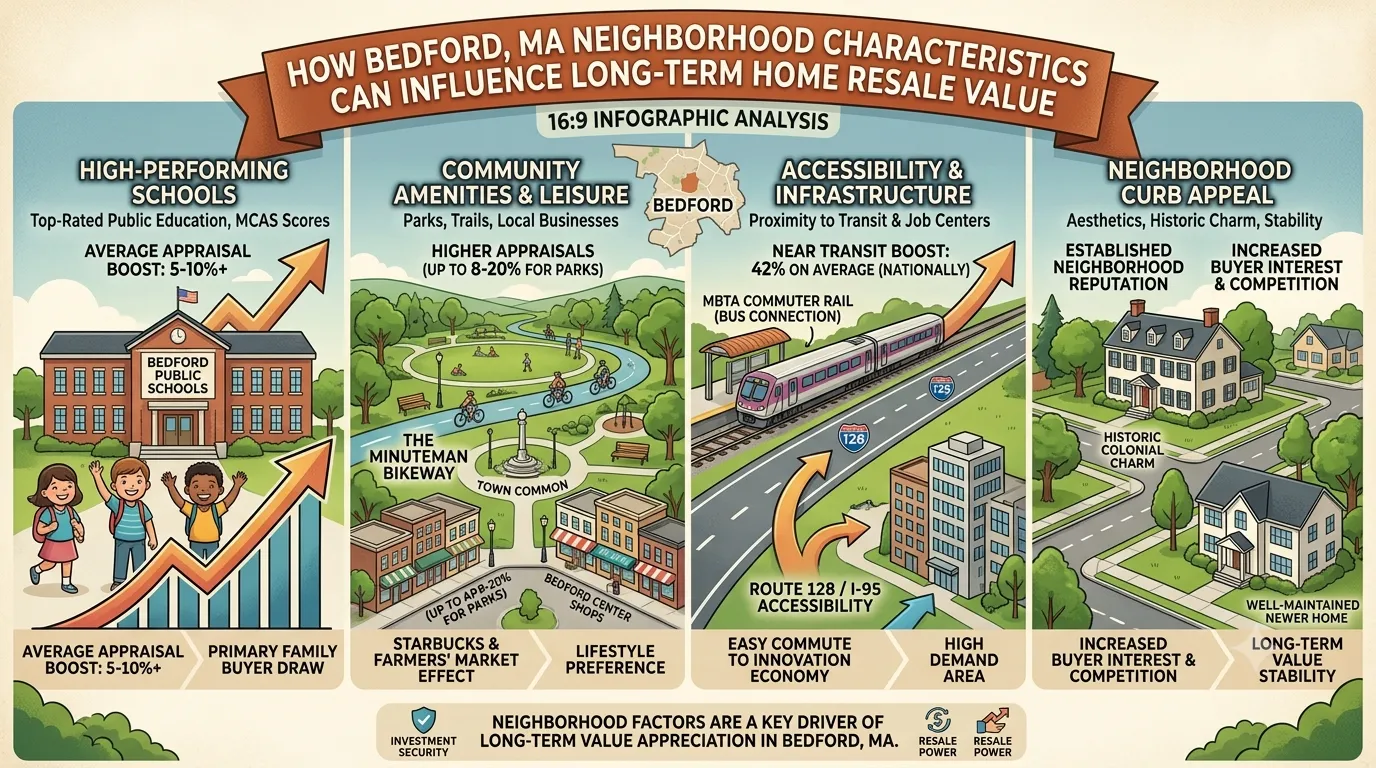

A home’s resale value is shaped by more than square footage, renovations, or curb appeal. Over time, the neighborhood surrounding a property can become one of its strongest value drivers. Buyers may change, market conditions may shift, and individual homes may be renovated, but location-based characteristics often remain influential for years.
For anyone evaluating homes for sale in Bedford, MA, understanding these neighborhood factors can provide a more practical perspective on long-term value. Bedford combines established residential areas, convenient transportation connections, recreational infrastructure, schools, employment centers, and access to neighboring communities. These characteristics can influence who wants to live in the area—and how much they may be willing to pay when a property eventually comes back to market.
Location Within Bedford Can Affect Buyer Demand
Not every property within the same town offers the same location advantages. A home’s position relative to major roads, schools, commercial areas, recreational facilities, and transportation routes can influence its appeal.
Bedford benefits from access to Routes 3, 4, 62, and 225, as well as Interstate 95/Route 128. The town is also approximately 15 miles northwest of Boston, giving residents access to employment and cultural opportunities in the broader Greater Boston region.
For resale purposes, convenience can translate into a wider potential buyer pool. A property that provides reasonable access to daily necessities and major commuter routes may remain attractive even when market conditions change.
However, proximity must be evaluated carefully. Being close to a major roadway can improve commuting convenience while also creating traffic noise or reduced privacy. Long-term value often depends on how the advantages and disadvantages balance out for typical buyers.
School Access Can Shape Long-Term Marketability
School considerations are a major part of residential decision-making, particularly among households planning to remain in a community for several years. Bedford has public schools serving different age groups, including Bedford High School, John Glenn Middle School, Lt. Job Lane School, and Davis Elementary School.
The important consideration is not simply whether a home is “near a school.” Buyers typically evaluate school assignment, accessibility, neighborhood setting, and the overall reputation of the district.
School-related demand can also broaden the audience for a property. A home that appeals to households prioritizing education may have an advantage when competing against otherwise comparable properties.
Because school boundaries and enrollment policies can change, buyers should verify current assignment information directly with the relevant school district rather than relying solely on a listing description.
Transportation Connectivity Adds Practical Value
Transportation is another neighborhood characteristic with long-term implications. Bedford offers multiple transportation options, including MBTA bus routes connecting the community with Alewife Station and other destinations. The town also provides access to major highways, making regional commuting more practical.
This matters because transportation preferences can change throughout a homeowner’s life. A buyer may initially prioritize highway access for commuting but later value public transportation, cycling infrastructure, or proximity to everyday services.
Bedford’s transportation network therefore contributes to the broader functionality of its neighborhoods. Properties positioned conveniently for several transportation options may have stronger long-term marketability because they can accommodate different lifestyle and employment patterns.
Access to Trails and Outdoor Recreation Can Strengthen Neighborhood Appeal
Modern buyers increasingly evaluate what exists outside the property itself. Trails, parks, conservation areas, and pedestrian infrastructure can influence how residents experience a neighborhood.
Bedford is particularly notable for its trail network. The town is connected to the Minuteman Bikeway, Reformatory Branch Trail, and Narrow-Gauge Rail Trail. The 10.1-mile paved Minuteman Bikeway connects Bedford with Cambridge and Alewife Station and serves both recreational and transportation purposes.
That combination can make nearby residential areas appealing to buyers who value walking, cycling, running, or outdoor recreation.
For resale purposes, access to these amenities can function as a differentiator. When several properties have similar layouts and specifications, neighborhood access to trails or green space can influence which property receives greater buyer attention.
Neighborhood Character Can Influence Buyer Expectations
A neighborhood’s physical character contributes significantly to how buyers perceive a property. Established streets, mature landscaping, varied architectural styles, lot sizes, sidewalks, and open spaces can create a distinct residential identity.
Bedford contains a mix of established residential environments and areas influenced by commercial, institutional, recreational, and transportation uses. That variety means buyers should evaluate neighborhood character rather than treating the entire town as one uniform market.
A quiet residential street, for example, may appeal to buyers seeking privacy and a traditional suburban setting. A location closer to commercial services or transportation may attract buyers who prioritize convenience.
Neither characteristic is automatically superior. The key is buyer demand. Long-term resale potential is generally stronger when a property's neighborhood characteristics align with the preferences of a substantial segment of future buyers.
Proximity to Employment Centers Can Support Housing Demand
Employment accessibility is another factor worth examining when evaluating homes for sale in Bedford, MA. Bedford is home to employment centers and is situated near Hanscom Field and Hanscom Air Force Base. The town's transportation network also provides connections toward Cambridge and other employment destinations.
This creates a practical advantage for households whose employment or commuting patterns are connected to Bedford, Burlington, Lexington, Concord, Cambridge, or nearby business districts.
Neighborhoods that provide efficient access to major employment centers can benefit from sustained housing demand. However, buyers should distinguish between proximity and convenience. A home located close to an employment center may experience traffic, aircraft activity, or other environmental considerations depending on its exact location.
A detailed neighborhood assessment should therefore consider both accessibility and potential trade-offs.
Retail and Everyday Services Make a Neighborhood More Functional
Resale value is also influenced by how easily residents can complete everyday tasks. Grocery stores, pharmacies, restaurants, professional services, healthcare facilities, and other conveniences can reduce the amount of travel required for routine activities.
Bedford's transportation planning materials identify commercial destinations along areas such as Great Road and Middlesex Turnpike, alongside connections to schools and other community facilities.
For homeowners, this functionality can become increasingly important over time. Buyers may initially focus heavily on the home itself, but neighborhood convenience can influence whether the property remains competitive when it is eventually listed.
A property does not necessarily need to be directly adjacent to commercial activity. In many cases, a balanced location, close enough for convenient access while maintaining residential privacy, can be particularly attractive.
Lot Characteristics and Surrounding Development Matter
Neighborhood value is not determined solely by amenities. The physical characteristics surrounding a property can also influence future buyer perception.
Lot size, street layout, density, privacy, landscaping, drainage conditions, and neighboring development should all be considered. A spacious property surrounded by similarly well-maintained homes may appeal to buyers seeking privacy and stability.
Conversely, significant future development or changes in surrounding land use could alter a property's appeal. Buyers considering long-term ownership should review available municipal information and understand zoning and development patterns rather than evaluating only the current view from the backyard.
This is particularly important when purchasing with resale in mind. A property's surroundings can change even when the house itself does not.
Historic Character Can Create Distinctive Market Appeal
Bedford also contains areas with historic character, including its Town Center. Historic streetscapes and established community features can contribute to a strong sense of place.
Character can be valuable because it differentiates one neighborhood from another. Buyers searching for newer construction may prioritize modern layouts and energy efficiency, while others may prefer mature neighborhoods with architectural character and established landscaping.
The critical issue is maintaining a balance between character and practicality. Buyers should examine renovation requirements, maintenance obligations, zoning restrictions, and potential limitations associated with older properties before assuming historic appeal automatically translates into stronger resale value.
Market Data Should Be Combined with Neighborhood Analysis
Current market statistics provide useful context, but they should not be treated as a guarantee of future appreciation. Realtor.com reported a June 2026 median listing price of approximately $1.198 million for Bedford, with a median sold price of about $999,000 and a median of 25 days on market.
Those figures describe the broader market. They do not necessarily indicate what a particular street, neighborhood, or property will command several years from now.
For a long-term assessment, buyers should compare similar properties based on location, lot characteristics, age, condition, school assignment, transportation access, and neighborhood amenities. Examining comparable sales over time can provide a more meaningful picture than relying on one market snapshot.
Evaluate the Neighborhood as Carefully as the House
A beautiful home can attract attention, but the surrounding neighborhood often determines whether that appeal remains durable. When evaluating homes for sale in Bedford MA, prospective buyers should look beyond the listing photos and consider the broader location.
Examine commuting routes, schools, recreation, retail access, neighborhood character, development patterns, lot characteristics, and potential external factors. Visit the area at different times of day to understand traffic, noise, parking, and overall activity.
The strongest long-term purchase decisions are rarely based on one feature. They come from identifying a property whose home characteristics and neighborhood fundamentals work together.
In Bedford, that distinction is particularly important because the town offers varied residential environments and strong regional connectivity. By evaluating the neighborhood as an integral part of the investment, not simply as the address attached to the property, buyers can make more informed decisions about present livability and future resale potential.
























Sign in to leave a comment.