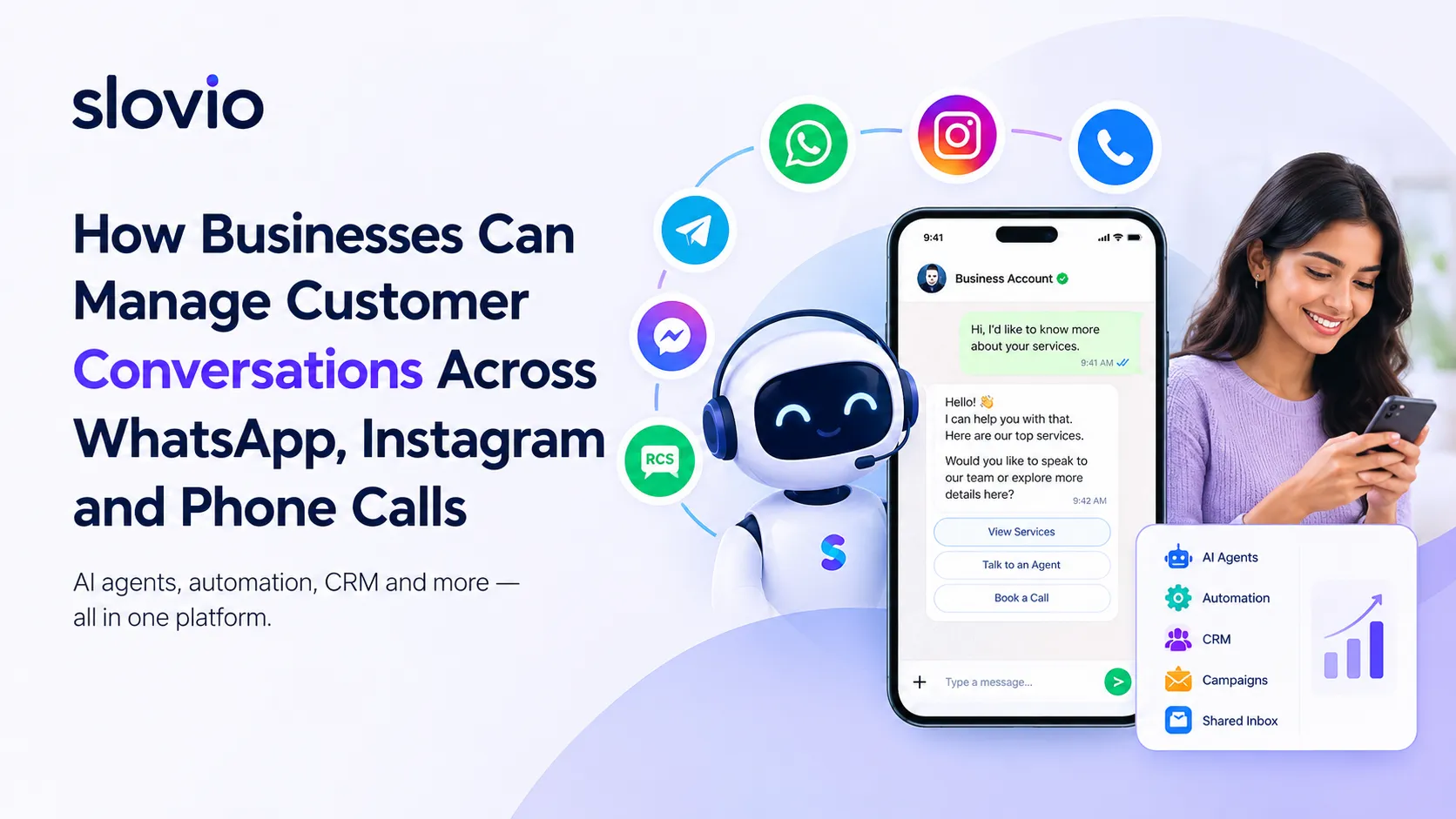

Customer conversations are spread across multiple channels. A customer may discover a business on Instagram, ask questions on WhatsApp, request a callback, and expect the company to remember the entire interaction. When these conversations are managed separately, businesses can struggle to respond consistently, track leads, and follow up at the right time.
Conversational AI is changing how businesses manage these interactions. Instead of relying entirely on manual replies and disconnected tools, businesses can use AI agents, workflow automation, customer relationship management (CRM), and voice automation to handle different stages of the customer journey.
However, adopting AI is not simply about automating every conversation. Businesses need to understand which interactions can be automated, where human involvement remains important, and how different communication channels can work together.
What Is an AI Customer Engagement Platform?
An AI customer engagement platform helps businesses manage customer interactions across digital messaging channels and phone calls. Depending on the platform, it may combine automated responses, lead qualification, customer support, sales workflows, campaigns, and shared inboxes.
The main purpose is to make customer communication easier to manage without forcing teams to switch between disconnected applications for every interaction.
For example, a business could use an AI agent to answer a product question, collect information from a potential customer, and route a more complex request to a human representative. A sales team could then follow up using the appropriate communication channel.
An AI customer platform such as Slovio brings AI Agents, AI Calling, messaging channels, automation, and customer management capabilities together. The usefulness of this approach depends on how well the technology fits the company's actual workflows and customer expectations.
Why Managing Customer Conversations Across Multiple Channels Is Challenging
Many businesses communicate with customers through WhatsApp, Instagram, email, web chat, and telephone calls. Each channel serves a different purpose, but managing them independently can create operational problems.
1. Customer enquiries can go unanswered
Customers often expect quick responses, particularly when asking about prices, availability, appointments, or product details. When enquiries arrive outside business hours or during busy periods, response delays can affect the customer experience.
Automation can help handle routine questions, provide basic information, and collect enquiry details when a team member is unavailable.
2. Sales leads can get lost between conversations
A customer might enquire about a product today but require additional information before making a purchase. Without a clear follow-up process, the sales team may forget to reconnect or lose track of the conversation.
A structured customer management process helps teams record enquiries, understand their status, and identify the next action.
3. Teams lack a shared view of customer interactions
When different employees manage separate accounts or channels, it can become difficult to understand who responded to a customer, what was discussed, and whether an issue was resolved.
A shared inbox can help teams organise conversations, assign responsibility, and coordinate responses.
4. Manual follow-ups consume time
Appointment reminders, lead follow-ups, order enquiries, and routine support messages can take up a significant portion of a team's working day. Repetitive tasks are often suitable for automation, provided the workflow respects customer preferences and applicable messaging rules.
How AI Agents Help Businesses Manage Customer Enquiries
AI agents can assist with customer conversations by responding to questions, gathering information, guiding users through predefined processes, and supporting lead qualification.
Unlike a basic automated reply that sends the same message to every customer, an AI agent can use the conversation context and configured business information to respond more appropriately. Its actual capabilities depend on the underlying model, integrations, instructions, and safeguards.
A WhatsApp chatbot for business can, for example, help a business handle frequently asked questions, collect lead details, share relevant product information, and direct customers to the appropriate team.
Common use cases include:
- Customer support: Answering routine questions about services, processes, and business hours.
- Lead generation: Collecting contact details and understanding a prospective customer's requirements.
- Sales assistance: Helping customers explore products or services before speaking with a sales representative.
- Appointment enquiries: Collecting booking preferences and guiding customers through the appointment process.
- Instagram enquiries: Responding to common questions from people who discover a business through social media.
AI should not be treated as a replacement for human judgement in every situation. Complaints, unusual requests, sensitive information, and complicated sales discussions may require a person to intervene.
What Is WhatsApp Automation for Business?
WhatsApp automation for business refers to using configured workflows and approved integrations to manage selected customer interactions on WhatsApp. These workflows can support activities such as sending relevant notifications, responding to enquiries, routing conversations, and following up with leads.
Automation is most useful when the process is repeatable and its desired outcome is clear.
For example, an education provider might receive enquiries about courses, eligibility, fees, and admission dates. A structured workflow can answer common questions, collect the student's preferred course, and direct more specific enquiries to the admissions team.
A business can explore WhatsApp automation software to understand how routine interactions and follow-up processes can be organised. Before implementation, it should define the events that trigger each workflow, the information required, and the situations in which automation must stop or transfer the conversation to a person.
Good automation should reduce unnecessary work without creating confusing or repetitive customer experiences.
Why Businesses Need a Shared Inbox for Customer Communication
Automated responses are only one part of customer engagement. Human teams still need a reliable way to review conversations, respond to complex questions, and coordinate their work.
A shared inbox allows multiple authorised team members to manage customer messages from a common workspace rather than relying on isolated personal accounts.
A WhatsApp team inbox can help businesses organise incoming conversations, assign enquiries, and improve visibility across customer support and sales activities.
For example, a customer support representative might handle a delivery question while a sales representative manages a product enquiry. Clear assignment and conversation history help reduce duplicate replies and make ownership easier to track.
When choosing a shared inbox, businesses should evaluate more than the number of supported channels. Useful considerations include access permissions, assignment rules, conversation history, reporting, integrations, and the ease of transferring a conversation between team members.
How WhatsApp CRM Helps Manage Sales Leads
Customer conversations become more valuable when businesses can connect them to a structured sales process.
A CRM helps teams organise customer information, track opportunities, and monitor follow-up activities. When connected to messaging workflows, it can make it easier to understand where leads originate and what action is required next.
A WhatsApp CRM can support lead management by connecting WhatsApp enquiries with customer records and sales workflows, depending on the available integrations and features.
Consider a real estate company receiving enquiries about several properties. Its team may need to record a prospect's preferred location, budget, property type, and follow-up status. A structured CRM process helps sales representatives organise this information instead of relying entirely on chat history or spreadsheets.
The same principle applies to education, healthcare administration, retail, and service businesses, although each industry has different requirements for privacy, access, and record keeping.
Businesses should evaluate whether their CRM captures the information they need, integrates with existing systems, and gives employees a clear view of the next sales action.
How AI Calling Can Support Customer Service and Lead Follow-Ups
Messaging is not appropriate for every interaction. Some customers prefer a phone call, and certain processes require verbal clarification or a more direct conversation.
AI calling uses voice-based AI systems to conduct configured telephone interactions. Depending on the system and workflow, these interactions may include answering routine questions, qualifying leads, making follow-up calls, or assisting with appointment booking.
An AI calling solution for business can be considered when a company handles a high volume of repetitive calls or needs a more structured way to manage selected phone interactions.
Potential applications include:
- Following up with people who have requested information.
- Confirming appointment preferences.
- Answering common service-related questions.
- Collecting preliminary information before a human representative takes over.
- Supporting sales teams with routine qualification tasks.
Voice automation also has limitations. Speech recognition errors, accents, background noise, interruptions, and unexpected questions can affect a conversation. Businesses should test their workflows with realistic scenarios and provide a clear route to human assistance.
They should also review consent, calling regulations, disclosure requirements, and data-handling practices before deploying automated calls.
Can WhatsApp Campaigns Help Businesses Reach Existing Customers?
Businesses often need to communicate updates, offers, reminders, or other relevant information to groups of customers. Campaign tools can help organise these communications, but effective messaging requires more than sending a large number of messages.
WhatsApp campaign software can help businesses manage supported messaging campaigns and coordinate customer communications, depending on the platform's features and applicable WhatsApp policies.
A retail business might send a relevant product update to customers who have opted in to receive promotional messages. A service provider could use approved messaging workflows to communicate appointment reminders or important service information.
Before launching a campaign, businesses should consider:
- Whether recipients have provided the required consent.
- Whether the message is relevant to the intended audience.
- Whether the communication follows current platform policies.
- Whether recipients can manage their messaging preferences.
- How replies, opt-outs, and customer questions will be handled.
- Which metrics will be used to assess the campaign.
Campaign performance should be evaluated through meaningful measures such as delivery, engagement, qualified enquiries, conversions, and customer feedback rather than message volume alone.
How to Choose the Right Conversational AI Tools for a Business
Not every business needs every form of automation. The right starting point depends on the volume of enquiries, the complexity of customer interactions, the team's current processes, and the business's objectives.
A practical evaluation should consider the following questions.
What problem needs to be solved first?
Identify whether the main challenge is slow responses, missed leads, repetitive phone calls, poor follow-up, or fragmented customer records.
Which channels do customers actually use?
Choose tools that support the channels relevant to the target audience. Avoid adding unnecessary complexity simply to have more integrations.
Can the system connect to existing workflows?
Check compatibility with the current CRM, booking tools, customer database, and internal processes.
When can the AI hand over to a person?
Define escalation rules for complaints, uncertain answers, complex requests, and situations requiring human judgement.
How will performance be measured?
Establish a baseline and track changes in response times, resolution rates, lead conversion, staff workload, and customer satisfaction.
What privacy and compliance safeguards are available?
Review data access, retention, security, consent, and industry-specific obligations before processing customer information.
A phased implementation is often more practical than automating every customer interaction at once. Businesses can begin with a well-defined use case, evaluate the results, and expand when the workflow demonstrates value.
Frequently Asked Questions About Conversational AI for Businesses
What is the difference between a chatbot and an AI agent?
A traditional chatbot often follows predefined rules, menus, or decision paths. An AI agent can interpret natural-language requests and use configured context or tools to support more flexible interactions. The distinction depends on the technology and implementation, and neither approach guarantees accurate answers in every situation.
Can small businesses use WhatsApp automation?
Yes. Small businesses can use WhatsApp automation for suitable tasks such as answering frequently asked questions, collecting enquiries, organising follow-ups, and routing conversations. The appropriate setup depends on message volume, available resources, platform requirements, and the complexity of customer interactions.
How does WhatsApp CRM help sales teams?
WhatsApp CRM workflows can help sales teams organise customer records, track enquiries, assign leads, and manage follow-ups. The benefits depend on how well the system integrates with the team's sales process and how consistently employees maintain customer information.
Can AI calling replace a customer service team?
AI calling can support selected repetitive interactions, but it should not automatically be considered a complete replacement for human customer service. Complex complaints, sensitive situations, unusual requests, and interactions requiring judgement may need human involvement.
What should businesses look for in an AI customer engagement platform?
Businesses should assess channel coverage, AI capabilities, automation controls, shared inbox functionality, CRM integrations, reporting, security, pricing, and human handover options. The best choice is the one that addresses a clearly defined operational need and fits the company's existing processes.
Final Thoughts
Customer engagement involves more than responding to individual messages. Businesses need to manage enquiries, organise customer information, coordinate teams, and maintain consistent follow-up across different channels.
AI agents, messaging automation, CRM systems, shared inboxes, campaigns, and AI calling can help address parts of this challenge. Their value depends on choosing appropriate use cases, integrating them into existing workflows, and maintaining human oversight where it matters.
For businesses exploring these capabilities, Slovio provides a starting point for understanding how messaging, voice interactions, and customer workflows can be brought together through one platform. The practical next step is to identify one recurring customer communication problem, test a suitable solution, and evaluate whether it improves the experience for both customers and employees.























Sign in to leave a comment.