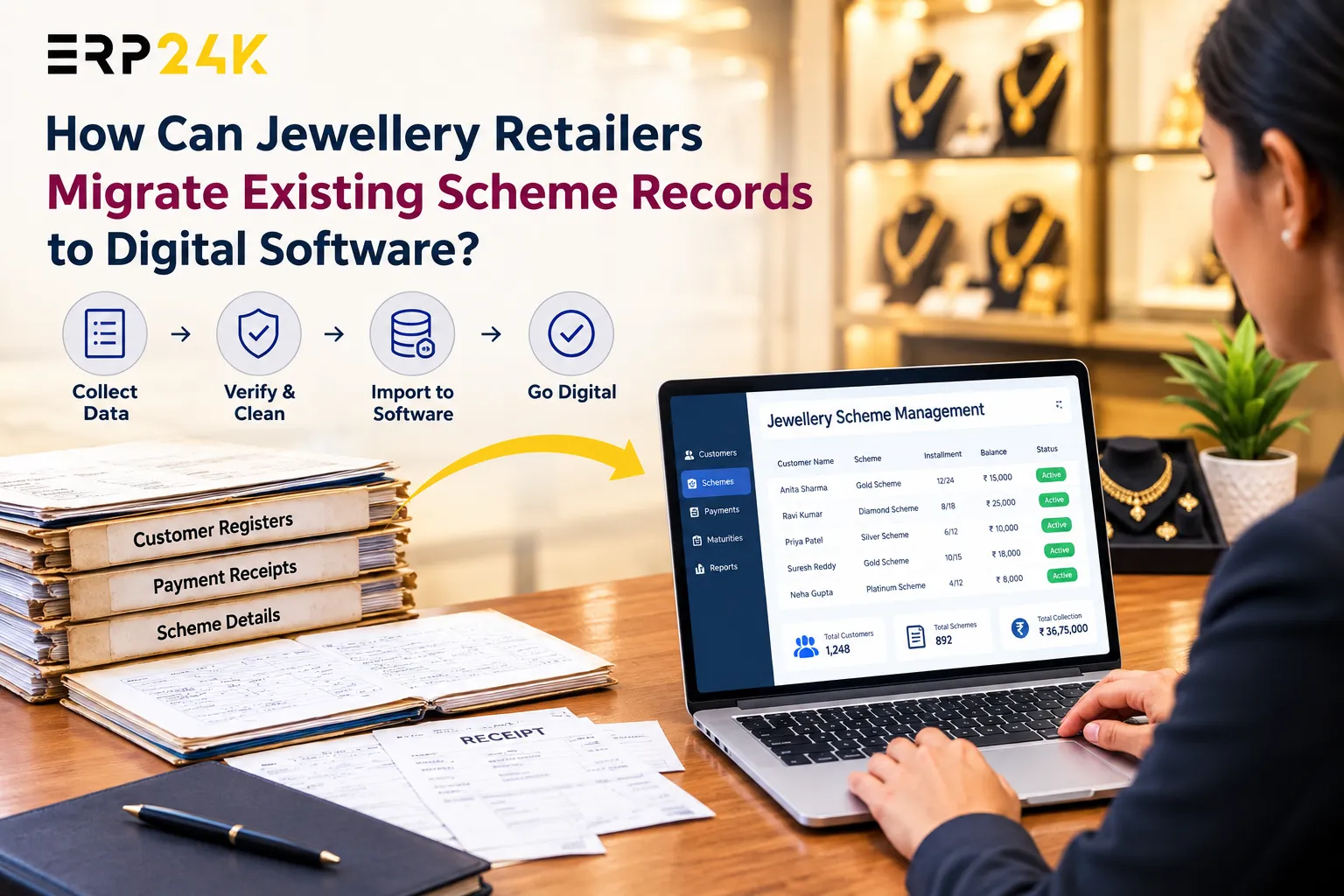

Jewellery retailers can migrate existing scheme records to digital software by auditing paper registers and spreadsheets, verifying customer details and payment histories, organizing scheme rules, and importing the validated data into a jewellery software system. After migration, retailers should reconcile balances, verify maturity dates, and test records before fully switching to digital scheme management.
Introduction
Jewellery savings schemes help customers save regularly and purchase gold, silver, or other jewellery after a specified period. However, managing hundreds of customer records through paper registers and spreadsheets can become time-consuming and lead to errors in payment tracking, bonus calculations, and scheme settlements.
Using jewellery software allows retailers to digitize these records, simplify daily operations, and improve transparency. With a structured migration process, jewellery businesses can preserve existing customer information while moving towards more efficient scheme management.
1. Audit Existing Scheme Records
The first step is to collect all existing scheme registers, customer cards, spreadsheets, payment receipts, and settlement records. Retailers should identify active, completed, overdue, and discontinued schemes.
Check the following details:
- Customer names and contact numbers
- Scheme membership or account numbers
- Monthly installment amounts and payment history
- Total amount paid and outstanding installments
- Scheme duration and maturity dates
- Applicable bonuses, discounts, and settlement conditions
Identifying missing or duplicate records before migration helps prevent inaccurate customer balances.
2. Clean and Verify Customer Data
Before transferring records, retailers should correct spelling mistakes, update customer contact details, and remove duplicate entries. Payment histories must be checked against available receipts, cashbooks, and accounting records.
Special attention should be given to active schemes with pending installments, accumulated savings, or upcoming maturity dates. Any discrepancies should be resolved and documented before importing the data.
3. Organize Scheme Rules and Benefits
Different jewellery savings schemes may have different installment structures, durations, bonuses, discounts, and redemption conditions. Retailers must document these rules clearly before configuring them in the new system.
A reliable jewellery software solution should support the retailer's scheme requirements, including cash savings, metal savings, flexible payments, bonuses, and settlement options where applicable.
This step helps ensure that existing customers continue receiving the benefits and terms associated with their enrolled schemes.
4. Import Records into Jewellery Software
Once the data is verified, retailers can prepare it in the format supported by their selected software. Depending on the system, records may be imported through spreadsheets or entered manually with assistance from the software provider.
For example, ERP24K Jewellery Schemes Software helps retailers manage scheme memberships, payment histories, bonuses, customer records, and settlements digitally. Its scheme management features can help businesses organize their records and simplify ongoing scheme operations.
Learn more about our website.
5. Reconcile Balances and Test the System
After importing the records, compare the digital data with the original registers and financial records. Verify customer balances, installment counts, payment dates, bonuses, and maturity calculations.
Run a small pilot with selected accounts before migrating the entire customer database. Ask staff to check payment entries, receipts, reports, and settlement workflows.
Keep the original records securely available until the migration has been verified and approved.
6. Train Staff and Inform Customers
Staff should understand how to search for customer accounts, record payments, track pending installments, and process scheme settlements. Clear procedures and basic training can reduce mistakes during the transition.
Where supported, customer-facing mobile applications can also help members check their scheme progress, payment history, and upcoming installments. Informing customers about these digital options can improve transparency and convenience.
Benefits of Digital Scheme Migration
Migrating existing records to jewellery software can provide several advantages:
- Better accuracy: Reduces manual calculation and data-entry errors.
- Faster operations: Makes customer records easier to access.
- Improved tracking: Simplifies installment monitoring and maturity management.
- Greater transparency: Helps customers understand their payments and scheme benefits.
- Simplified reporting: Provides organized information for business decisions.
Conclusion
Migrating existing jewellery scheme records to digital software requires careful data preparation, customer verification, accurate scheme configuration, and thorough reconciliation. By following these steps, jewellery retailers can protect existing records while improving efficiency and customer service.
The right jewellery software helps transform traditional scheme management into a more organized, transparent, and scalable process.
Ready to digitize your jewellery savings schemes?
Explore ERP24K Jewellery Schemes Software to discover how digital scheme management can help you organize customer records, track payments, and manage settlements more efficiently. Request a demo to understand how it can support your jewellery business.






















Sign in to leave a comment.