
In February 2026, the Michigan Department of Treasury sent Monroe County $1,080,342 and Monroe Charter Township $972,307.80. Both payments came from the same source: the 10% excise tax collected on adult-use cannabis sold across Michigan during fiscal year 2025.
For a township of Monroe Charter's size, that is not a rounding error. Township Supervisor Alan Barron has described cannabis revenue as covering roughly a third of the township's budget, and Bridge Michigan reported the same proportion when the figure was around $945,000 in an earlier cycle.
This article walks through where that money comes from, how the payment formula actually works, why the per-store payment fell this year despite more stores opening, and what Ohio's legalization and Michigan's new wholesale tax mean for the next few cycles.
What Monroe County Received, and From Whom
Michigan splits its adult-use excise revenue four ways under the Michigan Regulation and Taxation of Marihuana Act:
- 15% to municipalities hosting a licensed retail store or microbusiness
- 15% to counties hosting one
- 35% to the School Aid Fund for K-12 education
- 35% to the Michigan Transportation Fund for roads and bridges
For fiscal year 2025, the state made $54,017.10 available per licensed retail store or microbusiness. Nearly $94 million went to 313 local entities and tribes statewide.
Here is how that landed in Monroe County:
| Jurisdiction | Licenses | FY2025 Distribution |
|---|---|---|
| Monroe County | 20 | $1,080,342.00 |
| Monroe Charter Township | 18 | $972,307.80 |
| Luna Pier (City) | 1 | $54,017.10 |
The county figure is not additional money layered on top of the township's. It is the separate 15% county share, calculated on every licensed store inside county lines. The township receives the municipal share for the 18 stores within its own boundaries.
One Distinction Worth Getting Right
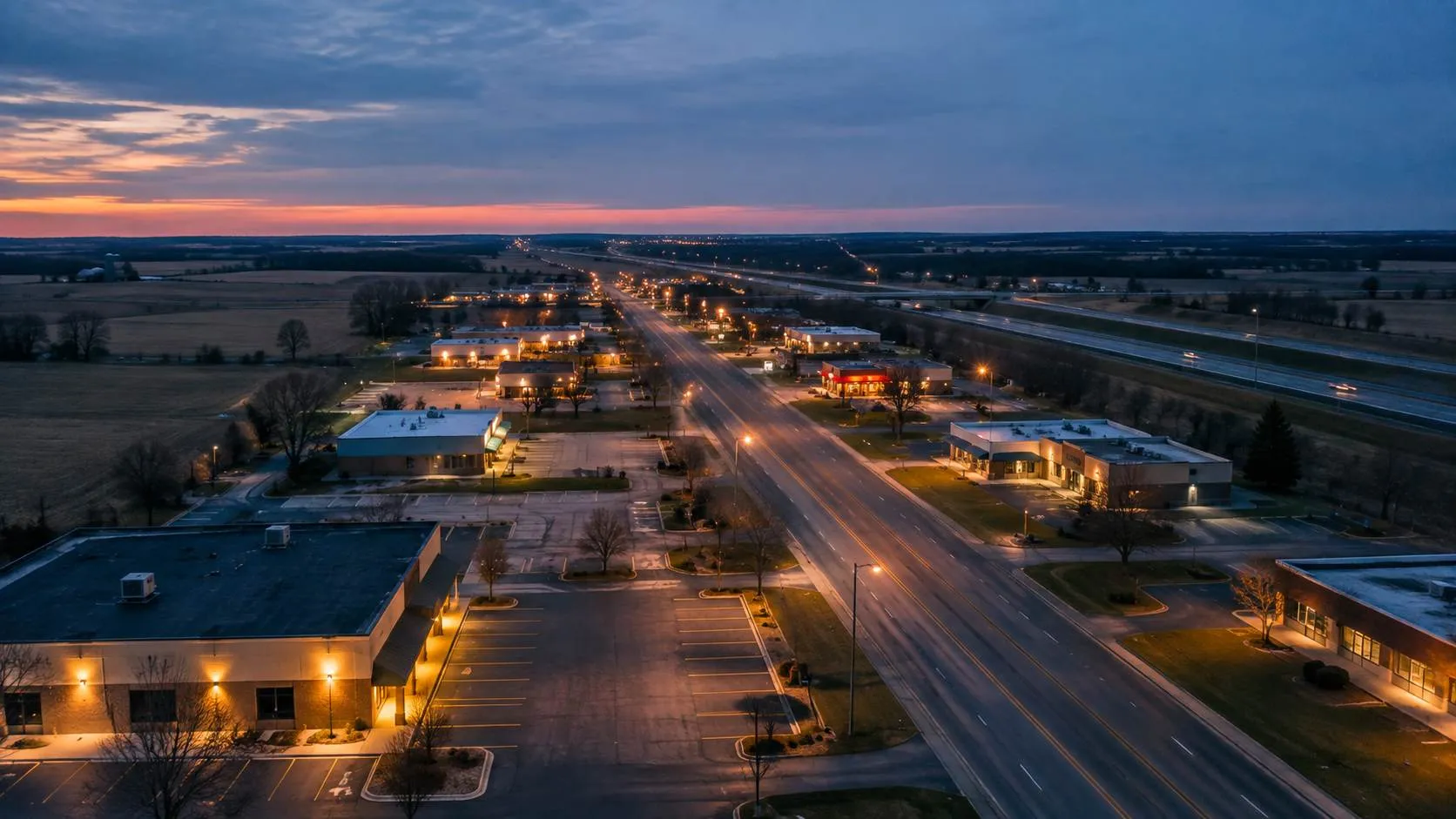
Coverage of this market routinely says "Monroe." The Treasury schedule says Monroe Township. Monroe Charter Township and the City of Monroe are separate units of government, and the dispensary cluster that draws all the attention sits in the township, along LaPlaisance Road near I-75 Exit 11.
That matters practically. When someone says cannabis pays for a third of Monroe's budget, they are describing the township's budget, not the city's. Anyone reading these numbers for a policy or business decision should confirm which jurisdiction they are looking at.
The Mechanic Almost Nobody Explains
Here is the part that changes how you read every number above.
The payment is flat per license. It is not proportional to what a given store sells.
A municipality hosting a dispensary that does $8 million a year receives exactly the same $54,017.10 as one hosting a dispensary that does $800,000. The state divides the municipal share of the statewide excise pool by the statewide count of licensed retail stores and microbusinesses, then pays out per license.
Three consequences follow, and they explain most of what has happened in Monroe County:
Opting in becomes a volume strategy. If each license is worth a fixed payment, a township's revenue is a function of how many licenses it permits. That is a direct incentive to approve more stores than local demand alone would support, which is exactly what the LaPlaisance corridor looks like.
Local revenue is decoupled from local sales. Monroe Township's payment depends on statewide excise collections and the statewide license count, not on how its own stores perform. A booming local market does not raise the payment. A struggling one does not lower it.
Saturation dilutes everyone. Every new license approved anywhere in Michigan adds a claimant to the same pool. When statewide collections stop growing faster than license counts, the per-license payment falls for every municipality in the state, including ones that approved nothing new.
That last point is not hypothetical anymore.
The Payment Is Now Going Down
| Fiscal Year | Per-License Payment | Statewide Distribution |
|---|---|---|
| FY2020 | ~$28,000 | ~$10 million |
| FY2022 | ~$52,000 | $59.5 million |
| FY2023 | ~$59,000 | $87 million |
| FY2024 | $58,228.66 | ~$100 million |
| FY2025 | $54,017.10 | $93.77 million |
The trend inverted. Per-license payments rose steeply through 2023, flattened in 2024, and fell by $4,211.56 in FY2025. The statewide pool shrank by $5.68 million even as the state added 14 retail licenses, bringing the total to 868.
For Monroe Charter Township with 18 licenses, that decline costs roughly $75,800 relative to the prior year's rate, before accounting for any change in license count. For the county's 20 licenses, roughly $84,200.
The mechanism here is straightforward: more licenses dividing a pool that is no longer growing. Michigan's retail cannabis prices have fallen to among the lowest in the country, and a 10% excise on a falling price base produces less revenue per unit sold even when volume holds up.
The Ohio Question
Monroe County's cannabis economy was built substantially on Ohio customers. Before Ohio launched adult-use sales, Bridge Michigan surveyed dispensary parking lots in Monroe Township and found roughly half the vehicles carried Ohio plates. Supervisor Barron has put Ohio customers at as much as 70% of sales. One Monroe retailer estimated out-of-state buyers at around 30% of its own revenue ahead of Ohio's legalization vote.
Ohio voters approved adult use in November 2023. Retail sales began in August 2024. By the start of 2026, cumulative Ohio recreational sales had passed $1.09 billion, with more than $836 million in 2025 alone, its first full calendar year.
The predicted collapse in northbound traffic has not materialized, and the reason is price. Michigan's market is oversupplied and fiercely competitive, which has pushed retail prices to among the lowest of any legal state. Ohio's market has fewer retailers and substantially higher prices. As of mid-2026, price-index data put the median cost of the same quantity of flower at roughly $20 in Monroe, against considerably more across the line.
Michigan remains the far larger market, with roughly $3.17 billion in adult-use sales during 2025.
The Legal Line, Stated Plainly
An Ohio resident can legally drive to Monroe County, legally enter a dispensary in monroe Michigan on an Ohio ID, and legally complete a purchase while in Michigan. Michigan law permits adult-use sales to anyone 21 or older with valid government-issued photo identification from any state.
What that person cannot legally do is carry the purchase home. Transporting cannabis across a state line violates federal law, and Ohio lawmakers have moved to restrict out-of-state purchasing as well. That legal exposure sits entirely with the individual, and no Michigan retailer can advise around it.
For Monroe County's economy, this creates an uncomfortable dependency: a meaningful share of the revenue supporting township services rests on a customer base whose purchase is legal and whose trip home is not.
What Changes in 2026
Michigan enacted a 24% wholesale tax on cannabis effective January 1, 2026, passed as part of a broader road funding package. It applies when product moves from a grower or processor to a retailer, and it sits on top of the existing 10% retail excise tax and 6% sales tax. Litigation challenging it has been filed.
Two things follow for Monroe County.
First, the wholesale tax does not flow into the municipal distribution formula the way the 10% excise does. It is a separate revenue stream directed at roads. Local governments should not expect it to offset the declining per-license payment.
Second, if the wholesale tax pushes retail prices up, Michigan's price advantage over Ohio narrows. That advantage is the single load-bearing element of the cross-border traffic that supports the LaPlaisance corridor. Whether retailers absorb the tax into margin or pass it to shelf prices is, for Monroe County specifically, a question with real fiscal consequences.
Local officials across Michigan have publicly flagged concern about further declines in cannabis revenue in coming cycles. Monroe Charter Township, with a third of its budget exposed, has more reason than most.
The Parts That Are Harder to Count
Excise distributions are the visible number because the Treasury publishes them. The rest of the economic footprint is real but not published at the county level, and it should be described honestly rather than estimated:
Employment. Each store employs budtenders, managers, security, and inventory staff. Eighteen stores in one township is a meaningful private employer cluster for a community of Monroe Township's size, though no county-level cannabis employment figure is published.
Commercial real estate. The LaPlaisance corridor absorbed vacant and underused commercial property. Cannabis retail carries build-out requirements and rent levels that most small-format retail no longer supports.
Ancillary spending. Security, transport, point-of-sale systems, compliance, local marketing, and construction trades all capture spend that stays partly local.
Induced traffic. Out-of-state visitors drawn by the corridor also buy fuel and food. This effect is frequently asserted and rarely measured, and it should be treated as plausible rather than quantified.
Anyone building a fiscal case for or against cannabis retail in a Michigan municipality should rely on the Treasury distribution data, which is auditable, and treat the rest as directional.
Where Local Operators Fit

JARS Cannabis operates one of the stores in the Monroe market and is among the multi-store brands in the corridor alongside regional and independent operators. Like every licensed retailer in the township, its license generates the same $54,017.10 municipal payment and the same county payment regardless of its individual sales volume. That is the formula working as designed, and it is why the corridor's economic contribution to the township is best understood at the cluster level rather than store by store.
What the Numbers Actually Say
Cannabis retail has given Monroe County and Monroe Charter Township a genuine, auditable revenue stream with no strings attached. Municipalities may spend these funds as they see fit, and most Michigan recipients route them to general revenue rather than earmarking them.
The stream is also structurally fragile in three specific ways: it is diluted by every new license approved anywhere in Michigan, it depends on a price advantage over Ohio that a new state tax may erode, and in the township's case it is concentrated enough that a further decline would be felt in services rather than absorbed quietly.
The reasonable read is neither boom narrative nor bust narrative. It is that Monroe County built real fiscal capacity on a revenue formula that rewarded early, aggressive opt-in, and that the formula has now entered a phase where that same capacity requires active management rather than passive collection.
8. FAQ Section
How much cannabis tax revenue does Monroe County receive? For fiscal year 2025, Monroe County received $1,080,342 based on 20 licensed retail stores and microbusinesses within county lines, at $54,017.10 per license.
How much does Monroe Charter Township receive? $972,307.80 for fiscal year 2025, based on 18 licenses. The township's municipal share is separate from the county's share.
Is it true that cannabis funds a third of the township's budget? Township leadership and Bridge Michigan have both described cannabis revenue at roughly a third of Monroe Charter Township's budget. Confirm the current proportion against the township's own adopted budget, since both the payment and the budget change annually.
Why did the payment per store go down? The statewide pool shrank by $5.68 million while the state added 14 retail licenses. More claimants against a smaller pool produced a per-license drop of $4,211.56, from $58,228.66 in FY2024 to $54,017.10 in FY2025.
Can the township spend the money on anything it wants? Yes. The distributions carry no spending restrictions. Most Michigan recipients allocate them to general revenue, though some earmark for specific projects.
Did Ohio's legalization hurt Monroe's dispensaries? Less than expected. Ohio's adult-use market has grown quickly, passing $1.09 billion cumulatively by early 2026, but Michigan's substantially lower prices have kept cross-border traffic flowing. That advantage is the variable to watch.
What does the new 24% wholesale tax do? Effective January 1, 2026, it applies when cannabis moves from a grower or processor to a retailer, on top of the existing 10% excise and 6% sales tax. It is directed at road funding and does not increase municipal distributions. Litigation challenging it has been filed.
Can Ohio residents legally buy cannabis in Monroe County? They can legally purchase in Michigan with a valid Ohio ID if they are 21 or older. Transporting it across the state line is prohibited under federal law

























Sign in to leave a comment.