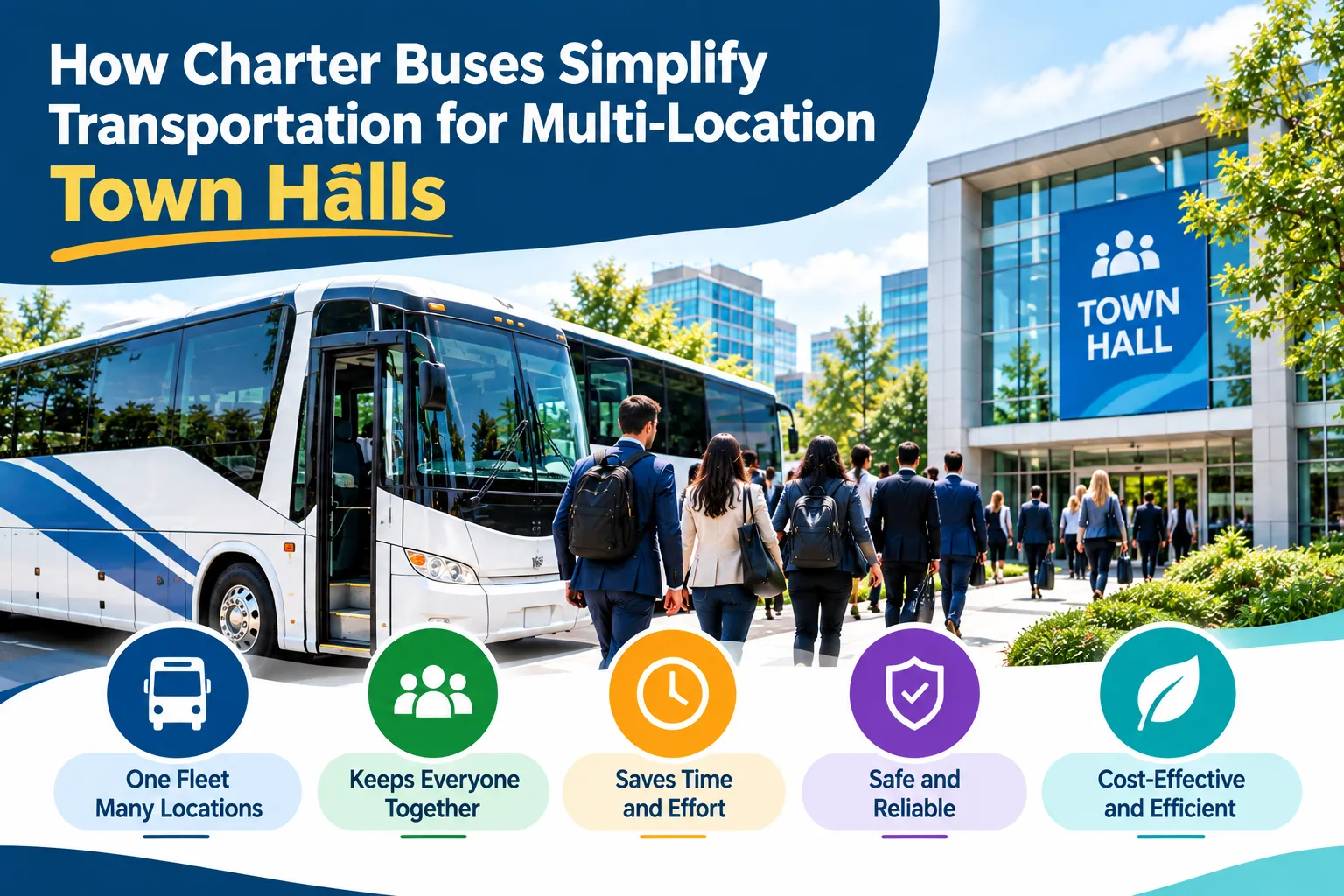

Company town halls are an important part of keeping employees informed, connected, and engaged. They give leadership an opportunity to communicate goals, share business updates, recognize accomplishments, and bring teams together. For companies with employees working across multiple office locations, however, getting everyone to one town hall venue can create a complicated transportation challenge.
Coordinating individual cars, parking, arrival times, and travel routes can quickly become difficult when employees are traveling from different offices. Organized corporate group transportation offers a more structured way to manage this process. Charter buses can bring employees together, simplify transportation logistics, and provide a consistent travel experience from multiple office locations.
Bringing Employees Together From Different Offices
One of the biggest advantages of charter bus transportation is its ability to connect employees from several locations through an organized travel plan. Instead of asking every employee to arrange a separate trip, companies can coordinate transportation based on office locations and expected attendance.
For example, a business with offices in three nearby cities can arrange separate buses from each location that arrive at the same town hall venue within a coordinated timeframe. Employees can travel together while event organizers maintain better control over arrivals.
This approach can also create a stronger sense of connection between employees. Traveling together gives coworkers an opportunity to interact before the meeting even begins, particularly when employees from different offices do not regularly work in the same physical space.
Reducing Individual Driving and Parking Problems
When dozens or hundreds of employees drive separately to a company town hall, parking can become one of the biggest event-day concerns. A large group of individual vehicles requires more parking spaces and creates additional traffic around the venue.
Charter buses significantly reduce the number of vehicles arriving at the location. Instead of many employees navigating unfamiliar roads and searching for parking, groups can travel together and be dropped off at a designated location.
This can make arrival more efficient for both employees and venue staff. It also reduces the pressure on employees who might otherwise have to worry about parking fees, walking long distances from remote parking lots, or arriving early simply to secure a space.
Creating More Predictable Arrival Times
Punctuality matters during corporate events. A delayed employee can miss an important presentation, while a large number of late arrivals can interrupt the beginning of a town hall.
Charter bus transportation allows event planners to establish scheduled departures from each office and organize arrival windows around the town hall agenda. Instead of relying on dozens of individual travel plans, transportation can be managed through a smaller number of coordinated vehicles.
Departure times can be calculated based on the distance from each office, expected traffic conditions, and the desired arrival time. A reasonable buffer can also be included so employees are not expected to arrive immediately before the town hall starts.
Choosing the Right Bus for Each Office
Multi-location events rarely have identical transportation needs at every office. One location may have 20 employees attending while another may have more than 100.
Charter bus transportation allows companies to match vehicle capacity with employee demand. Smaller groups may be served by minibuses, while larger groups can use full-size charter buses or multiple vehicles.
This flexibility helps companies avoid both overcrowding and unnecessary empty capacity. It also allows planners to create transportation routes based on actual attendance rather than using a one-size-fits-all solution.
Vehicle comfort should also be considered. Employees may be traveling for several hours before participating in presentations and meetings. Comfortable seats, climate control, storage space, and available onboard amenities can help make longer trips more manageable.
Simplifying Multi-Office Route Planning
Route planning can become complicated when employees are spread across several offices. Each location may have a different travel distance, traffic pattern, and preferred pickup point.
Charter transportation allows planners to create a route structure around these differences. A bus can travel directly from an office to the venue, or nearby offices can be combined when doing so does not create unnecessary detours.
The objective should be to create an efficient route without adding too many pickup stops. Every additional stop can increase travel time and make it harder to maintain the event schedule.
A central transportation coordinator can oversee these routes and communicate with office managers and transportation providers, making the entire operation easier to manage.
Making Employee Pickup Easier
A clear pickup system can make a major difference on the day of the town hall. Employees should know exactly where and when to board their bus.
Pickup locations should be easy to access and suitable for large vehicles. Companies can use designated areas near office entrances, parking areas, or other safe locations where buses can load passengers without disrupting traffic.
When multiple buses operate from one office, assigning simple route names or bus numbers can help employees find the correct vehicle. Transportation details should be sent to employees well before the event, followed by a reminder shortly before departure.
This reduces confusion and helps employees arrive at the pickup point on time.
Supporting Accessibility and Employee Comfort
Transportation planning should meet the needs of all employees. When a company has employees who require wheelchair-accessible transportation or other accommodations, those needs should be communicated to the transportation provider before vehicles are finalized.
Planning accessibility early helps ensure that the appropriate vehicles and pickup arrangements are available.
Comfort is also important. Employees may begin their workday on the bus and may need a relaxing ride after a full schedule of presentations and discussions. Comfortable group transportation can make the overall event experience more positive and less stressful than a long individual drive.
Keeping Return Transportation Organized
Planning does not end when employees arrive at the town hall. The return journey should be coordinated just as carefully as the morning trip.
Company meetings can run longer than expected because of executive presentations, employee questions, or schedule changes. Return buses should therefore have enough flexibility to accommodate reasonable delays.
Employees should know where their return buses will depart and whether they are returning to their original office or another designated location. Clear return instructions can prevent confusion once the event is over.
For offices located several hours from the venue, companies should also consider whether employees should return the same day or stay overnight. A long evening drive after a full day of meetings may not always provide the best employee experience.
Reducing Transportation Stress for Event Organizers
Managing hundreds of individual employee travel arrangements can take considerable time. Event organizers may have to answer questions about directions, parking, pickup points, traffic, and travel reimbursements.
Centralized charter bus transportation reduces much of this administrative burden. Instead of managing numerous individual travel arrangements, organizers can work with a transportation provider to coordinate a defined number of vehicles and routes.
This can make communication easier and give event planners greater visibility over the transportation operation. A centralized plan also creates a clearer process for handling delays or last-minute changes.
Making Travel Time More Useful
Transportation can become more than simply a way to reach the event. Employees can use the journey to review town hall materials, catch up with coworkers, prepare for presentations, or simply relax before the meeting.
For longer journeys, this shared travel time can provide an opportunity for teams from different offices to connect. Employees who rarely interact in person may have valuable conversations during the ride.
Whether the company expects employees to work during transportation or simply encourages them to relax, clear expectations should be communicated ahead of time.
Preparing for Traffic and Unexpected Delays
No transportation plan can eliminate every potential delay. Traffic congestion, construction, weather, accidents, and unexpected road conditions can all affect travel times.
The best approach is to build reasonable flexibility into the schedule. Transportation planners should review expected traffic conditions and avoid setting arrival times that leave no room for delays.
A designated transportation coordinator can also help distribute updates when conditions change. Instead of multiple offices receiving different information, one central contact can coordinate communication between employees, office managers, transportation providers, and event organizers.
Planning the Budget More Effectively
Charter buses can also make transportation budgeting easier because companies can organize travel around a defined number of vehicles and routes.
Rather than reimbursing a large number of employees for mileage, parking, or rideshare expenses, companies can create a centralized transportation budget. This can provide greater predictability when planning large corporate events.
The full cost should still be evaluated, including vehicle requirements, travel distance, number of routes, and any special transportation needs. Comparing these expenses with the potential costs of individual travel can help companies determine the most practical solution.
Book Charter Transportation Early
Multi-location town halls require coordination, so transportation should be considered as soon as the event date and venue are confirmed.
Booking early gives companies more time to estimate attendance, select suitable vehicles, create office-specific routes, and communicate schedules to employees. It also allows planners to make changes if attendance increases as the event approaches.
For companies that organize recurring town halls, previous transportation plans can serve as useful templates. Recording attendance, routes, travel times, and employee feedback can make future events easier to coordinate.
A Smoother Way to Bring Offices Together
Charter buses simplify transportation for multi-location company town halls by bringing structure to what could otherwise become a complicated collection of individual travel arrangements. They can reduce parking challenges, coordinate arrival times, support different office locations, and provide employees with a comfortable way to travel together.
With thoughtful planning, companies can create transportation schedules that match office locations, employee attendance, and the town hall agenda. Clear communication, appropriate vehicles, accessibility planning, and flexible return arrangements can further improve the experience.
A successful company town hall depends on more than what happens inside the meeting room. When employees can travel to and from the event comfortably and efficiently, transportation becomes a seamless part of the experience and helps everyone focus on what matters most: connecting with colleagues, hearing from leadership, and participating in the company's shared goals.






















Sign in to leave a comment.