

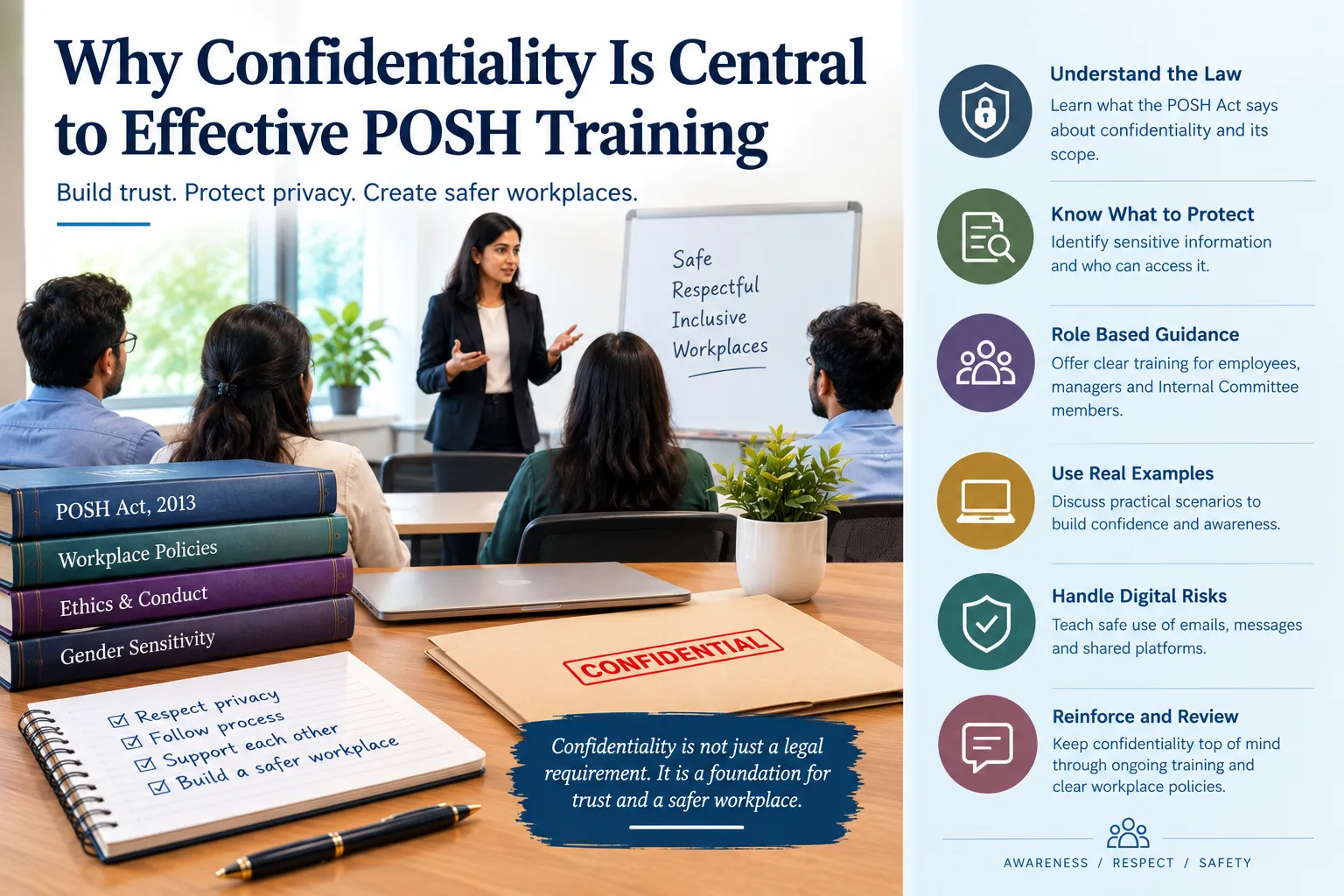
Confidentiality is one of the most important principles in workplace sexual harassment proceedings. Yet, simply telling employees to “keep matters confidential” is not enough. Employees, managers and Internal Committee members need to understand what confidentiality means, why it matters and how it should be maintained during a POSH complaint and inquiry.
Under the Sexual Harassment of Women at Workplace (Prevention, Prohibition and Redressal) Act, 2013, confidentiality has a specific legal role. Section 16 restricts the publication or making known of the contents of a complaint, the identity and addresses of the aggrieved woman, respondent and witnesses, information relating to conciliation and inquiry proceedings, recommendations of the Internal Committee or Local Committee, and action taken by the employer or District Officer. Effective POSH training should therefore go beyond general awareness. It should teach employees how confidentiality works in practical workplace situations.
Why Confidentiality Matters in POSH Cases
A sexual harassment complaint can involve highly personal information. It may contain details about conversations, workplace interactions, messages, emails or other sensitive experiences. If such information spreads unnecessarily, it can affect the privacy and dignity of everyone involved. It may also discourage employees from reporting concerns or participating honestly in an inquiry.
Confidentiality helps create a safer environment for reporting and investigation. It also supports the integrity of the Internal Committee process. Employees should understand confidentiality as a responsibility rather than merely an administrative instruction.
What the Law Says About Confidentiality
POSH training should explain the legal basis of confidentiality in simple language. Section 16 of the POSH Act places restrictions on making certain information relating to a complaint or inquiry public. The restriction covers information concerning the complaint, the people involved, the proceedings, recommendations and action taken.
The purpose of teaching this provision is not to make employees memorise statutory language. Instead, they should understand what information must be protected and what behaviour can create a confidentiality concern. Training should also explain the distinction between legitimate communication and unnecessary disclosure. For example, sharing information with an authorised person for the purpose of handling a complaint is different from discussing the matter with colleagues who have no role in the process.
Confidentiality Should Be Explained Through Examples
Legal provisions can sometimes feel abstract during training. Practical examples make them easier to understand. A trainer could present situations such as:
An employee receives information about a colleague's complaint and discusses it during lunch with other employees.
A manager receives a question about an ongoing inquiry and shares details with a team member who is not involved.
A witness discusses their statement with colleagues before completing the inquiry process.
An employee forwards a message relating to a complaint to a private group chat.
Participants can then discuss whether each situation creates a confidentiality concern and why. Scenario based learning makes employees more likely to recognise risks in real workplace situations.
Employees Should Know What Not to Share
Confidentiality training should identify the types of information employees must handle carefully.
This may include:
- Details of the complaint
- Names of people involved
- Personal information about the complainant
- Information about the respondent
- Witness statements
- Evidence submitted during an inquiry
- Details of inquiry meetings
- Discussions about recommendations
- Information about actions taken by the employer
Employees should understand the difference between knowing something and having a legitimate reason to disclose it. Access to sensitive information does not automatically create a right to share it.
Internal Committee Members Need Deeper Training
The Internal Committee has a particularly important role in maintaining confidentiality. Committee members may receive complaints, documents, statements and other sensitive information during the inquiry process. Their responsibilities therefore require more detailed training than general employee awareness.
Training should cover secure handling of documents, appropriate communication, meeting confidentiality and careful use of electronic information. Members should also understand the risks of discussing cases casually outside the formal process. A strong POSH compliance training programme should therefore include separate guidance for Internal Committee members rather than treating every participant as having the same responsibilities.
Managers Need Special Guidance
Managers are often the first people employees approach when they experience or witness inappropriate conduct. A manager may receive sensitive information even when the formal complaint is later submitted through another channel. For this reason, managers should know how to respond without unnecessarily discussing the matter with colleagues.
Training should teach managers to:
- Listen without making premature conclusions
- Avoid promising absolute secrecy
- Direct the employee towards the appropriate complaint mechanism
- Protect sensitive information
- Avoid informal investigations
- Avoid discussing allegations with unrelated employees
- Escalate the matter through appropriate internal channels
A manager should understand the difference between supporting an employee and independently investigating a complaint.
Confidentiality Does Not Mean Silence
One common misunderstanding during POSH training is the idea that confidentiality means nobody can discuss a complaint under any circumstances. This is too simplistic. The objective is to restrict unnecessary disclosure while allowing the complaint to be handled through the appropriate process.
Employees may need to communicate with authorised persons or follow workplace procedures. Internal Committee members may need information to conduct their functions. Employers may also need to take appropriate action in accordance with the law. Training should therefore explain confidentiality as controlled and responsible communication, rather than complete silence.
Social Media Should Be Part of POSH Training
Modern confidentiality training should include social media. Employees may be tempted to discuss workplace incidents on social platforms, messaging groups or online communities. Even without mentioning a person's full name, details may make individuals identifiable.
Training should warn participants against posting screenshots, messages, photographs or commentary relating to a complaint. A workplace incident should not become an online discussion simply because an employee believes the audience is private. The same principle applies to informal messaging groups.
Digital Documents Require Extra Care
POSH records may exist in physical and digital forms. Digital information can be copied, forwarded or stored in multiple locations within seconds. Internal Committee members and authorised personnel should therefore receive practical guidance on handling electronic records.
Good practices may include:
- Using approved workplace systems
- Limiting access to relevant personnel
- Avoiding personal email accounts for sensitive documents
- Protecting files with appropriate security controls
- Avoiding unnecessary downloads
- Checking recipients before sending confidential information
- Following the organisation's document retention policy
Training should make these precautions practical rather than theoretical.
Confidentiality and Workplace Gossip
Gossip can cause serious problems during a POSH inquiry. Employees may speculate about who made a complaint, what happened, whether an allegation is true or what outcome may follow. Such conversations can affect workplace relationships and create pressure on people involved in the process.
Training should teach employees to avoid speculation. A simple rule can be useful: if an employee does not have a legitimate workplace reason to receive or discuss information, they should not seek it or spread it. This principle can be incorporated into everyday workplace behaviour.
How Trainers Should Handle Questions
POSH trainers may receive difficult questions during a session. Someone may ask whether they can tell their manager about a complaint. Another person may ask whether employees can discuss a case after an inquiry ends. Trainers should avoid giving overly broad answers.
Instead, questions should be considered in the context of the POSH Act, organisational policy and the particular circumstances involved. Where legal interpretation is required, organisations may also seek professional guidance from a workplace anti-harassment consultant with appropriate knowledge of POSH compliance and workplace procedures.
Confidentiality Should Be Included in IC Training
Internal Committee training should treat confidentiality as a practical skill. Members should understand how to maintain appropriate boundaries before, during and after an inquiry.
Training can include exercises involving:
- Receiving a complaint
- Communicating with the parties
- Handling witness information
- Reviewing evidence
- Conducting meetings
- Preparing recommendations
- Communicating with management
These exercises help committee members understand how easily sensitive information can be disclosed through casual conversations or careless document handling.
Common Confidentiality Mistakes
Some mistakes occur because employees do not realise their behaviour can create a confidentiality issue.
Common examples include:
- Discussing a complaint with friends at work
- Sharing screenshots in messaging groups
- Asking colleagues for details about an inquiry
- Speculating about the identity of a complainant
- Forwarding inquiry documents unnecessarily
- Discussing possible outcomes before the process concludes
- Treating workplace gossip as harmless
POSH training should address these situations directly.
Confidentiality Should Be Reinforced After Training
A single training session may not be enough. Organisations can reinforce confidentiality through internal policies, reminders and periodic awareness sessions. Managers and Internal Committee members may benefit from additional role specific training.
Organisations can also review whether their complaint handling procedures provide appropriate safeguards for sensitive information. The Ministry of Women and Child Development continues to recognise POSH awareness and stakeholder engagement as an ongoing area of work, and its current website provides information and resources relating to the POSH framework.
Building a Culture of Responsible Communication
Confidentiality works best when it becomes part of workplace culture. Employees should understand why sensitive information needs protection. They should also know where to go when they need guidance.
Training should therefore connect confidentiality with broader principles of dignity, fairness and responsible workplace conduct. The objective is not to make employees afraid of discussing workplace concerns. It is to ensure sensitive information reaches the right people through the right channels.
Conclusion
Confidentiality should be one of the central elements of effective POSH training.
Employees need to understand what information should remain confidential, while managers and Internal Committee members require more detailed guidance on handling sensitive complaints and inquiry records.
Practical scenarios, digital privacy examples, social media guidance and role specific exercises can make confidentiality training more effective. Most importantly, organisations should present confidentiality as a legal and ethical responsibility rather than a simple workplace rule. When employees understand the reasons behind confidentiality and know how to apply it in everyday situations, they are better prepared to support a fair and respectful POSH process.
































Sign in to leave a comment.