

Renewable energy assets such as solar farms, wind projects, battery storage facilities, and small-scale energy infrastructure require substantial upfront investment. Their economics are shaped by construction costs, financing structures, operating expenses, energy revenues, power purchase agreements, maintenance requirements, and long-term asset performance.
Renewable energy asset tokenization introduces another layer to this model by representing defined ownership, revenue, debt, or other economic interests in energy assets through blockchain-based digital tokens.
Rather than changing how a solar panel generates electricity or how a wind turbine operates, tokenization could change how the financial interests surrounding these assets are structured, distributed, tracked, and transferred.
What Is Renewable Energy Asset Tokenization?
Renewable energy asset tokenization is the process of creating digital tokens that represent specific legal or economic rights connected to renewable energy assets. For example, a solar project could be held by a dedicated legal entity, while interests in that entity are represented through blockchain-based tokens. Depending on the structure, token holders could receive defined economic rights associated with project revenues.
Potentially tokenized assets include:
- Solar farms
- Wind farms
- Battery storage projects
- Hydropower facilities
- Renewable energy infrastructure
- Distributed energy projects
- Community solar installations
- Energy-efficiency assets
The token itself does not automatically establish ownership of the physical asset. Its rights depend on the legal agreements, ownership structure, jurisdiction, and regulatory framework surrounding the project.
1. Lowering the Capital Barrier for Participation
Renewable energy projects can require significant amounts of capital before they begin generating revenue. Tokenization could divide eligible economic interests into smaller digital units, potentially allowing a broader range of investors to participate where legally permitted.
Instead of structuring an investment around one large position, a project could potentially issue a larger number of fractional interests. This could create new investment structures while helping project developers explore additional sources of capital. The economic impact could be significant because renewable energy development depends heavily on access to long-term financing.
2. Creating New Financing Structures
Traditional renewable energy financing can involve banks, infrastructure funds, private equity, project finance, institutional investors, and government-backed programs. Real World Tokenization could introduce another financing layer. A renewable energy project could potentially use a tokenized structure to represent:
- Equity interests
- Revenue-sharing rights
- Debt claims
- Project-financing interests
- Portfolio interests
- Other contractual economic rights
This flexibility could allow developers to design financing models around the specific economics of individual projects.
For example, a solar project with predictable long-term revenue from a power purchase agreement could potentially structure digital interests around defined portions of those future cash flows.
3. Turning Future Energy Revenue Into Digital Interests
Renewable energy projects can produce relatively predictable revenue when supported by long-term contracts.
A solar farm may generate electricity under a power purchase agreement, while a wind project may have contracted electricity revenues for a defined period.
Tokenization could potentially represent eligible claims against these contractual cash flows.
This creates an important economic shift:
Physical energy production → Contractual revenue → Digital representation → Potential investor participation
The underlying electricity production remains unchanged, but the financial interests associated with that production could become digitally structured.
4. Potentially Improving Capital Efficiency
Traditional investment structures often involve multiple intermediaries and administrative processes.
Tokenization could automate selected parts of the investment lifecycle through blockchain infrastructure and smart contracts.
Depending on the structure, automation could support:
- Investor onboarding
- Ownership tracking
- Distribution calculations
- Payment records
- Transfer restrictions
- Reporting
- Compliance workflows
Reducing unnecessary administrative friction could potentially improve the efficiency of managing renewable energy investments.
However, blockchain infrastructure does not eliminate legal, accounting, banking, or regulatory requirements.
5. Expanding Access to Renewable Energy Investment
Tokenization could potentially create investment models where individuals and smaller investors participate in renewable energy projects that might otherwise be accessible mainly to larger capital providers.
For example, a community solar project could potentially divide eligible economic interests into smaller units.
Participants could then receive defined economic benefits according to the project's legal and financial structure.
This could create a closer connection between renewable infrastructure development and distributed investment.
6. Introducing New Models for Community Energy Projects
Community-based renewable energy projects are particularly relevant to tokenization.
A community solar or wind project could potentially use tokenization to organize participation among multiple stakeholders.
Instead of relying entirely on one financing source, the project could potentially combine:
Local participants + Digital ownership infrastructure + Renewable energy generation
This could support alternative models for financing smaller energy projects.
The exact implementation would depend on local energy regulations, securities rules, grid requirements, and ownership laws.
7. Potentially Improving Liquidity
Renewable energy investments are often designed around long-term holding periods.
Tokenization could potentially make certain investment interests easier to transfer if compliant secondary-market infrastructure exists.
An investor holding a token representing a defined interest in a renewable energy project could potentially have a mechanism for transferring that interest to another eligible investor.
However, tokenization alone does not create liquidity.
An effective secondary market would still require:
- Buyers and sellers
- Regulatory approval
- Appropriate trading infrastructure
- Accurate asset information
- Transfer controls
- Sufficient market demand
Therefore, the potential liquidity benefit depends on the ecosystem surrounding the tokenized asset.
8. Connecting Energy Assets With Global Capital
Renewable energy development is a global investment opportunity, but capital allocation remains affected by geography and market access.
Tokenization could provide digital infrastructure for connecting eligible investors with renewable energy projects across different markets.
For example, a properly structured solar project could potentially make defined investment interests available to qualified participants in multiple jurisdictions.
Cross-border participation, however, introduces additional requirements involving securities laws, taxation, foreign investment rules, identity verification, and money-transfer regulations.
Blockchain technology does not remove these requirements.
9. Making Renewable Energy Portfolios More Accessible
Tokenization does not have to focus on one renewable energy project.
Multiple solar, wind, storage, or other energy assets could potentially be grouped into a portfolio.
A token could then represent an interest in the broader portfolio rather than a single facility.
For example:
Solar Farm A + Solar Farm B + Wind Project C + Battery Project D → Tokenized Energy Portfolio
This could potentially provide exposure to multiple assets and revenue sources through a unified investment structure.
It may also allow project developers and asset managers to create specialized renewable energy investment products.
10. Supporting Automated Revenue Distribution
One of the most interesting economic applications involves automated distribution.
If tokens represent defined economic rights, smart contracts could potentially be connected to approved data and payment systems.
When qualifying project revenue is received, a system could calculate distributions according to predetermined rules.
For example:
Energy Revenue → Operating Costs → Contractual Obligations → Eligible Investor Distribution
Automation could reduce some manual administrative work involved in distributing project income.
The actual calculation and distribution process would still need to follow the project's legal, financial, and tax requirements.
11. Improving Transparency Around Asset Participation
Blockchain-based records can provide a persistent transaction history.
For renewable energy assets, this could potentially improve visibility into:
- Token issuance
- Token transfers
- Investor holdings
- Distribution records
- Contract activity
However, blockchain transparency should not be confused with complete project transparency.
Important information such as electricity generation, maintenance expenses, equipment condition, project valuation, and contractual performance still depends on reliable off-chain data.
This makes data verification and trusted reporting essential components of renewable energy tokenization.
12. Creating Digital Markets Around Energy Infrastructure
Tokenization could expand the range of financial models available around renewable energy infrastructure.
Instead of treating a solar farm simply as a physical asset, market participants could structure different digital interests around its economics.
These could potentially include:
- Ownership interests
- Revenue participation
- Project debt
- Energy infrastructure funds
- Portfolio interests
- Development-stage financing
This could create a more modular approach to financing renewable energy infrastructure.
13. Connecting Renewable Energy With Real-World Asset Markets
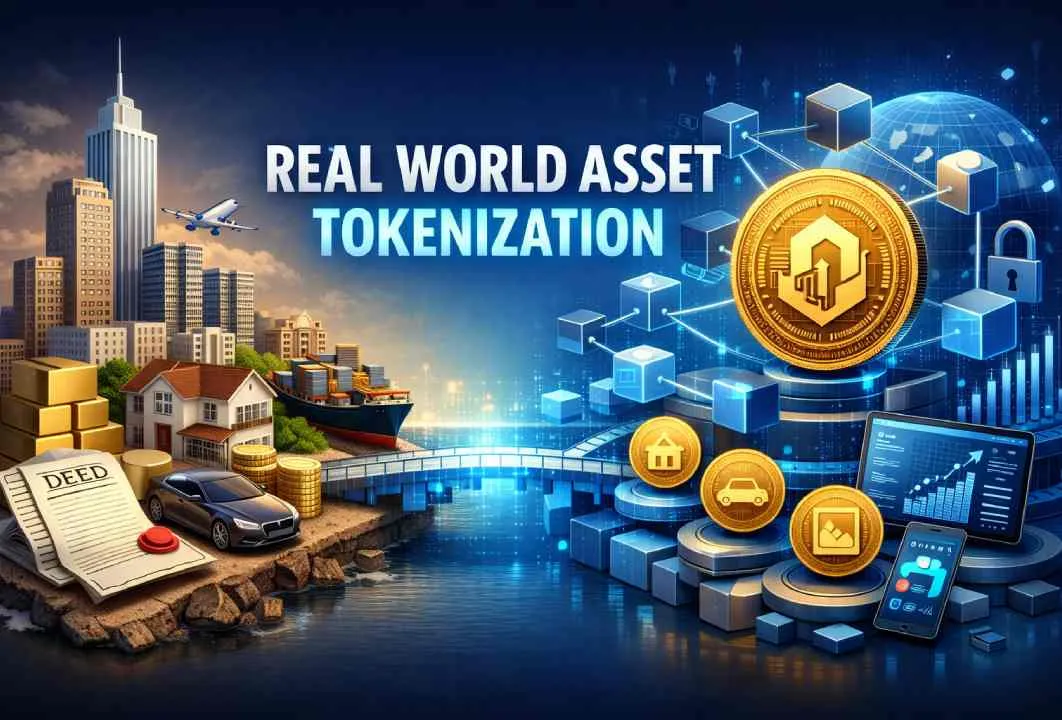
Renewable energy is increasingly relevant to the broader real-world asset tokenization market.
Unlike purely digital assets, renewable energy projects have identifiable physical infrastructure and measurable economic activity.
A tokenized renewable energy asset could potentially connect:
Physical Infrastructure + Contractual Cash Flows + Blockchain Infrastructure + Digital Investors
This makes renewable energy a potential application area for real-world asset tokenization.
14. Potentially Supporting Green Investment Models
Tokenization could also provide infrastructure for investment structures focused on environmental objectives.
For example, a platform could organize tokenized interests around renewable energy projects while providing information about the underlying assets.
Depending on the project, reporting could include metrics such as:
- Installed generation capacity
- Electricity production
- Project location
- Asset type
- Operational status
- Revenue generation
- Environmental reporting metrics
Reliable measurement remains important because digital tokens do not independently verify environmental claims.
15. Changing the Economics of Asset Exit Strategies
Renewable energy projects often have long operating lives.
At different stages, developers or infrastructure owners may want to refinance, partially exit, restructure ownership, or raise additional capital.
Tokenization could potentially provide additional mechanisms for restructuring defined economic interests.
For example, rather than selling an entire renewable energy asset, an owner could potentially structure a transaction involving a portion of the economic interest.
This could create more flexibility in capital management.
What Could Change for Renewable Energy Developers?
For developers, tokenization could create opportunities to diversify funding strategies.
A developer could potentially combine traditional project finance with a tokenized investment structure where appropriate.
This could help create different capital layers around a project.
For example:
Developer Capital
↓
Institutional Financing
↓
Tokenized Investment Interests
↓
Renewable Energy Project
↓
Electricity Revenue
Such structures could allow different investor groups to participate according to their risk, return, and regulatory requirements.
What Could Change for Investors?
For investors, tokenization could change how renewable energy interests are accessed and managed.
Instead of purchasing an entire infrastructure asset or investing through a traditional fund, investors could potentially acquire defined digital interests.
A tokenized platform could provide a digital environment for viewing:
- Investment information
- Token holdings
- Project data
- Distribution history
- Transaction records
- Relevant documentation
This could make renewable energy investment more digitally accessible while maintaining the need for traditional financial and legal protections.
What Are the Main Challenges?
The economic opportunities are substantial, but several challenges need to be addressed.
Regulatory Complexity
Tokenized interests may be classified as securities or other regulated instruments depending on their structure and jurisdiction.
Asset Verification
Investors need confidence that the underlying renewable energy asset exists, operates as described, and generates the expected economic activity.
Data Oracles
Blockchain systems may require reliable external data for electricity production, revenue, asset performance, or other real-world information.
Liquidity
A tokenized asset requires an active market if investors are expected to trade their interests.
Smart Contract Risk
Programming errors or security vulnerabilities can affect token issuance, transfers, and distributions.
Energy Market Regulations
Renewable energy projects operate within complex electricity-market and grid frameworks that blockchain systems cannot replace.
Tax and Accounting
Token ownership and distributions may have different tax and accounting treatments depending on jurisdiction and legal structure.
The Future Economics of Tokenized Renewable Energy
The biggest potential transformation may not come from simply putting renewable energy assets on a blockchain.
It could come from restructuring how capital interacts with energy infrastructure.
Traditional renewable energy economics generally revolve around:
Capital → Construction → Energy Generation → Contractual Revenue → Investor Returns
Tokenization could introduce additional digital infrastructure:
Capital → Digital Investment Interests → Renewable Energy Asset → Verified Revenue → Programmable Distribution
This could potentially create new financing models, fractional participation structures, portfolio products, and digital marketplaces for energy infrastructure.
At the same time, physical assets will remain at the center of the model. Solar panels still need sunlight, wind turbines still require suitable locations, batteries still need maintenance, and electricity still needs to reach the grid.
Tokenization therefore works best as a financial and administrative layer around real infrastructure rather than as a replacement for the underlying energy business.
Conclusion
Tokenization could transform the economics of renewable energy assets by changing how ownership, financing, revenue participation, and investment interests are structured.
Fractionalization could potentially broaden participation, while programmable infrastructure could streamline selected administrative and distribution processes. Tokenized portfolios could also provide new ways to structure exposure across multiple renewable energy projects.
For developers, the technology could create alternative capital-raising mechanisms. For investors, it could provide digitally managed access to defined interests in renewable infrastructure.
But the success of these models will depend on more than blockchain technology. Regulatory compliance, asset verification, reliable energy data, market liquidity, legal ownership structures, investor protection, and project economics will determine whether tokenization delivers practical value. As real-world asset markets continue to develop, renewable energy could become an important area where physical infrastructure and digital financial systems increasingly intersect.



















Sign in to leave a comment.