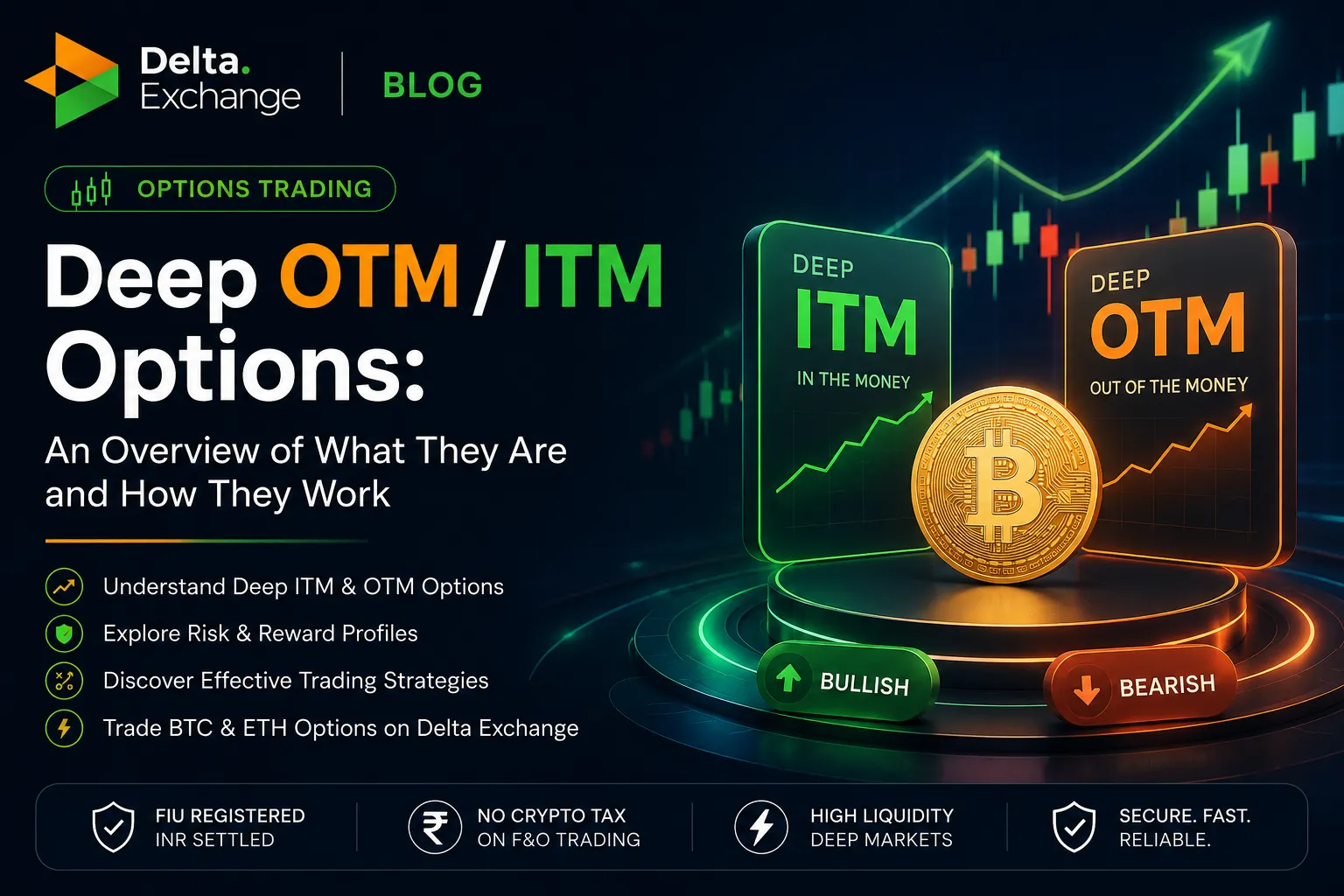

The cryptocurrency trading market has evolved rapidly over the last few years. Today, traders are no longer limited to simply buying and holding digital assets. With products like crypto options, perpetual futures, automated trading bots, and advanced risk management tools, traders have multiple ways to participate in volatile markets.
Among these strategies, Deep In-the-Money (ITM) and Deep Out-of-the-Money (OTM) options have become popular choices for traders looking to either reduce risk or maximize leverage. Whether you're trading BTCUSDT, ETHUSDT, or other crypto pairs, understanding where these options fit into your overall trading strategy can significantly improve your decision-making.
In this guide, we'll explore how Deep ITM and Deep OTM options work alongside modern cryptocurrency trading tools and how traders can use them effectively on Delta Exchange.
Why Crypto Options Are Becoming Popular
Unlike spot trading, crypto options give traders the right, but not the obligation, to buy or sell an asset at a predetermined price before expiration.
This flexibility allows traders to:
- Trade bullish or bearish markets
- Hedge existing crypto holdings
- Limit maximum losses
- Take leveraged positions with lower capital
- Execute advanced options strategies
Unlike traditional investing, crypto options can generate opportunities even when markets are moving sideways or experiencing increased volatility.
Using Deep ITM Options for Directional Cryptocurrency Trading
Deep ITM options are ideal for traders who have a strong directional view but want to reduce capital requirements compared to purchasing the underlying asset.
For example:
Suppose BTCUSDT is trading at $120,000.
Instead of purchasing one Bitcoin outright, a trader may buy a Deep ITM Call option with a much lower strike price.
Benefits include:
- High delta close to 1
- Lower impact from time decay
- Similar price movement to BTC
- Defined maximum risk
- Lower capital requirement than spot buying
Because Deep ITM options already contain substantial intrinsic value, they behave much like the underlying cryptocurrency itself.
When Deep OTM Options Make Sense
Deep OTM options appeal to traders expecting large market movements.
For instance, before major events like:
- Bitcoin Halving
- CPI announcements
- Federal Reserve decisions
- ETF approvals
- Ethereum upgrades
volatility often increases.
Rather than risking significant capital, traders sometimes purchase Deep OTM Calls or Puts because they require much smaller premiums.
If the expected move occurs, returns can be many times the initial investment.
However, traders should understand that Deep OTM options also carry a much higher probability of expiring worthless.
Combining BTCUSDT Trading with Options
BTCUSDT remains the most actively traded cryptocurrency pair across global derivatives markets.
Many professional traders combine:
- BTCUSDT perpetual futures
- Spot Bitcoin positions
- Deep ITM options
- Deep OTM options
to create balanced portfolios.
Examples include:
Bullish Strategy
- Hold BTCUSDT Spot
- Buy Deep ITM Call
- Sell Covered Call
Bearish Strategy
- Hold Spot BTC
- Buy Deep OTM Put
High Volatility Strategy
- Long Straddle
- Long Strangle
These combinations allow traders to profit under different market conditions while managing downside risk.
Using a Trading Bot with Crypto Options
Automation has become an important part of cryptocurrency trading.
A Trading Bot can help traders execute strategies consistently without emotional decision-making.
Common Trading Bot use cases include:
- Automatic position entry
- Profit booking
- Stop-loss execution
- Delta hedging
- Portfolio rebalancing
- Grid trading
- Futures execution
Although options trading often requires more complex decision-making than spot trading, many traders use Trading Bots alongside options to manage hedge positions or automate complementary futures strategies.
For example:
A trader holding Deep ITM Calls may use a Trading Bot to automatically hedge exposure through BTCUSDT perpetual futures if market volatility increases.
This reduces manual intervention while improving risk management.
Managing Risk in Cryptocurrency Trading
Successful cryptocurrency trading isn't only about generating profits.
Risk management plays an equally important role.
Professional traders often:
- Define maximum loss before entering a trade
- Use stop-loss orders
- Diversify positions
- Avoid overleveraging
- Hedge portfolios with options
- Monitor implied volatility
Deep ITM options generally provide more stable exposure, while Deep OTM options should represent only a small portion of a diversified trading strategy due to their speculative nature.
Choosing Between Deep ITM and Deep OTM Options
The right choice depends on your trading objective.
| Trading Goal | Better Choice |
|---|---|
| Stock-like crypto exposure | Deep ITM Options |
| Lower capital requirement | Deep ITM Options |
| High-risk speculative trades | Deep OTM Options |
| Hedging portfolio risk | Deep ITM or Deep OTM Puts |
| Leveraged directional trading | Deep ITM Options |
| Event-based volatility trading | Deep OTM Options |
Understanding these differences helps traders align their option positions with their market outlook.
Final Thoughts
Modern cryptocurrency trading extends far beyond simply buying Bitcoin or Ethereum. Traders today have access to sophisticated instruments such as crypto options, perpetual futures, and automated Trading Bots that allow them to tailor strategies for different market conditions.
Deep ITM options provide efficient exposure with lower sensitivity to time decay, making them suitable for traders seeking stock-like behavior with less capital. Deep OTM options, meanwhile, offer inexpensive opportunities to capitalize on large price swings but come with higher risk.
Whether you're trading BTCUSDT, hedging an existing crypto portfolio, or integrating a Trading Bot into your workflow, understanding how Deep ITM and Deep OTM options complement broader cryptocurrency trading strategies can help improve both risk management and long-term consistency.
As always, successful trading starts with a well-defined strategy, disciplined execution, and continuous learning.
















Sign in to leave a comment.