

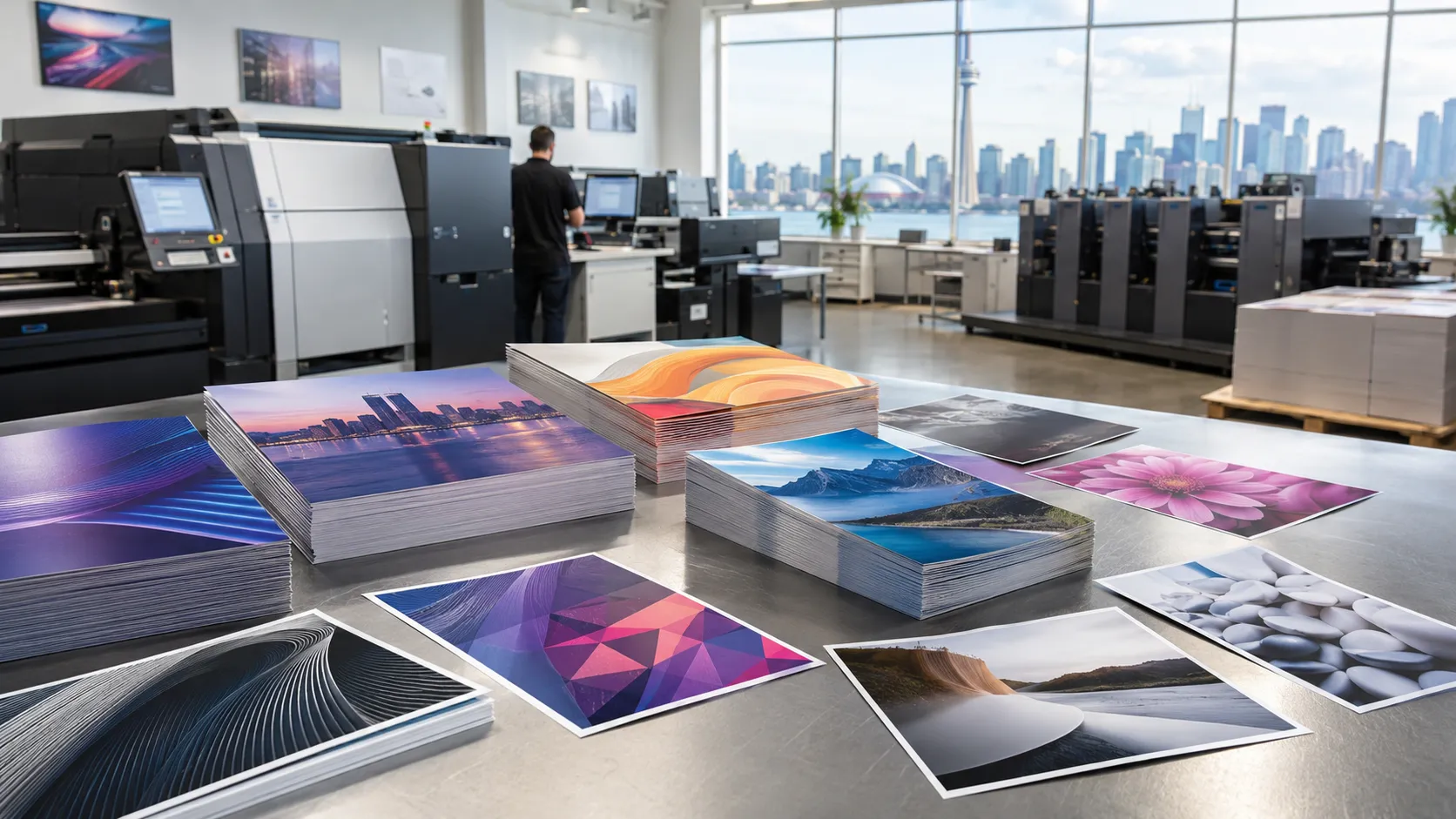
Toronto is home to an extraordinary mix of creative talent and commercial ambition. Creative professionals like designers, photographers, and independent artists share the same city blocks with commercial pros like retailers, real estate professionals, and restaurateurs. But both groups rely on print shops when they need to communicate something important.
Digital printing shops deal with these two broad audiences in Toronto almost every day. But the needs and expectations behind each print order are rarely the same. A branding agency and a local bakery might both order the same brochure size, yet they are asking for completely different things from that print run.
Creative clients want precision, colour integrity, and the freedom to experiment in short print runs. Commercial clients want speed, consistency, and materials that hold up well in a busy working week.
Here, we will discuss how digital printing serves creative and commercial Toronto-based clients differently.

What Digital Printing Really Means for Two Very Different Types of Clients
The technology that drives a modern print job looks the same from the outside, but what each client brings to the table tells a completely different story.
Colour Expectations Vary Significantly Between the Two Groups
Creative clients often work in colour-critical fields. A photographer printing a limited-edition art series, for instance, needs every print to match their monitor exactly. A graphic designer presenting a brand identity relies on colour accuracy to validate their work.
Commercial clients care about colour too, but their tolerance is generally broader. A local retailer needs their logo to look consistent across all materials.
Digital printing providers worth working with understand this distinction clearly and can take a better approach for Toronto businesses. For creative clients, a colour proof is non-negotiable. For commercial clients, speed to market often matters more than pursuing perfection. Both are completely valid priorities.
2. Run Quantity Tells the Real Story Behind Every Order
Creative clients rarely need 5,000 copies of anything. They might want 25 fine-art prints, a short run of handmade-look invitations, or 50 portfolio pieces to share with gallery contacts. A skilled digital printer handles short runs without the costly plate setup that makes offset printing impractical for low-quantity orders.
Commercial clients, on the other hand, often need volume. They might order 500 flyers for a weekend promotion or 1,000 postcards for a direct mail campaign. Digital printing handles both ends of that spectrum without asking clients to choose between quality and affordability. That kind of range is genuinely rare in print.
3. Turnaround Time Is a Shared Priority With Very Different Stakes
A commercial client running a Saturday event needs their flyers by Thursday at the latest. Their deadline is tied directly to revenue. Miss it and the weekend promotion falls flat.
A creative client preparing for an art show might share that same Thursday deadline, but missing it costs them a display opportunity rather than direct sales.
For any digital printing business, understanding which deadline carries which kind of weight helps the entire production process run much more smoothly. When a client explains the real reason behind their urgency, a skilled print shop can often find a way to help.
4. Material Choice Reflects What Each Client Wants to Say
The substrate a client prints on says almost as much as the design itself. Creative clients often use materials that go beyond standard paper. Canvas, vinyl, and textured specialty stocks all carry a visual weight and tactile quality that ordinary coated paper simply cannot match. Commercial clients typically choose materials based on durability and practical budget. For example, a flyer distributed near a busy Toronto intersection needs to survive an afternoon in someone's bag, not win a design award.
Digital printing providers keep a broad range of substrates available precisely because these two Toronto-based client groups need very different things from the same technology.
5. Variable Data Is a Commercial Advantage Creative Clients Rarely Need
Variable data printing is one of the most powerful advantages that digital print brings to commercial clients. A real estate agent can print 200 postcards, each addressed to a different homeowner by name, all in a single run. Or a restaurant can test two versions of a takeout menu with different promotions and see which one performs better. Creative clients rarely need this kind of personalization. Their work is typically fixed and intentional.
For Toronto businesses, this capability changes how printing services get used. It turns a stack of materials into a targeted communication tool that moves people to act.
6. Creative Clients Push the Format Beyond What Templates Allow
One of the most telling differences between creative and commercial clients is the print format itself. A commercial client typically needs a standard business card, a folded brochure, or a simple A4 flyer. A creative client might arrive with a concept that simply does not fit any standard template. These may include an odd-sized art print, a square invitation with a custom bleed, or a double-sided card with a soft-touch finish.
These requests require a print provider who genuinely knows the equipment well. Digital printing facilities that handle both client types in Toronto tend to be better equipped to say yes to unusual requests.
7. File Preparation Reflects Each Client's Level of Print Experience
File preparation is where many first-time print orders run into unexpected trouble. Creative clients with design backgrounds typically arrive with print-ready files. Their colour profiles are already properly set, bleed is built in, and fonts are correctly embedded. Commercial clients, particularly Toronto-based small business owners placing their first order, sometimes submit files that require cleanup before they can go to press.
This friction point comes up very regularly in any digital printing shop. A patient and experienced team always takes the time to explain what needs adjusting and why, instead of simply returning the file without context or guidance.
Business Cards & Postcards: Two Products, Two Very Different Needs
The same two core products serve very different purposes depending on who is ordering them and why.
Business Cards Give Commercial Clients a Reliable, Reorderable Foundation
A business card is often the first printed piece that a commercial client orders. It needs to work consistently across every introduction, every handshake, and every follow-up meeting.
For commercial clients, the priority is a clean, professional result that reflects their brand without excessive fuss. Digital printing produces business cards without plate setup, so reorders can be placed promptly when stock runs low. Full-colour output ensures logos and brand colours come through precisely.
For businesses that need a reliable, affordable card they can reorder on demand, digital printing handles that without asking them to commit to large minimum quantities.
2. Business Cards Give Creative Clients a Physical Extension of Their Work
A creative client treats their business card quite differently. It is not just a source of contact information but a small, physical extension of their work. A graphic designer, photographer, or independent artist needs their card to make someone stop and look twice. Digital printing gives creative clients the flexibility to experiment with layouts, finishes, and colour combinations without committing to thousands of copies. A short run of 50 or 100 cards lets them test an idea, adjust and reprint. Because each print job goes straight from a digital file to press, colour consistency across a short creative run stays remarkably reliable.
3. Postcards Give Commercial Clients a Direct Line to the Right Customer
For commercial clients, a postcard is a direct line to the customer. Real estate professionals use them to reach specific neighbourhoods. Retailers use them to announce seasonal sales. Restaurants use them to share a new menu or a limited promotion. Digital printing makes postcards practical because variable data lets each postcard carry a different name, address or personalized message within a single print run. That kind of targeted outreach was not accessible for small businesses before digital print changed the equation. A well-designed postcard, printed clearly and delivered directly, still earns attention in ways that many digital messages do not.
4. Postcards Give Creative Clients an Invitation That Also Becomes a Keepsake
Creative clients use postcards for a very different kind of outreach entirely. An artist announcing a gallery exhibition or a photographer sharing a preview of a new series both benefit greatly from a postcard that leads with a strong visual. A designer revealing a new brand identity project works in exactly the same way. Digital printing allows these clients to produce a short, high-quality run that serves as both an invitation and a keepsake. The postcard becomes part of the creative work itself. For instance, a fine-art photographer needs colour reproduction to match the original print as faithfully as possible.
The gap between a creative client and a commercial client is often narrower than it first appears. Both want their print to look good. Both want it to arrive on time. Both want to feel that the people handling their order genuinely care about the outcome. What differs is the context, the goal, and the measure of success. A well-run print shop truly understands both conversations fluently. Whether you are a Toronto-based designer working on a gallery series or a retail business owner planning a weekend promotion, the right team always meets you where you are. That is exactly what any good digital printing shop is built to do.
























Sign in to leave a comment.