

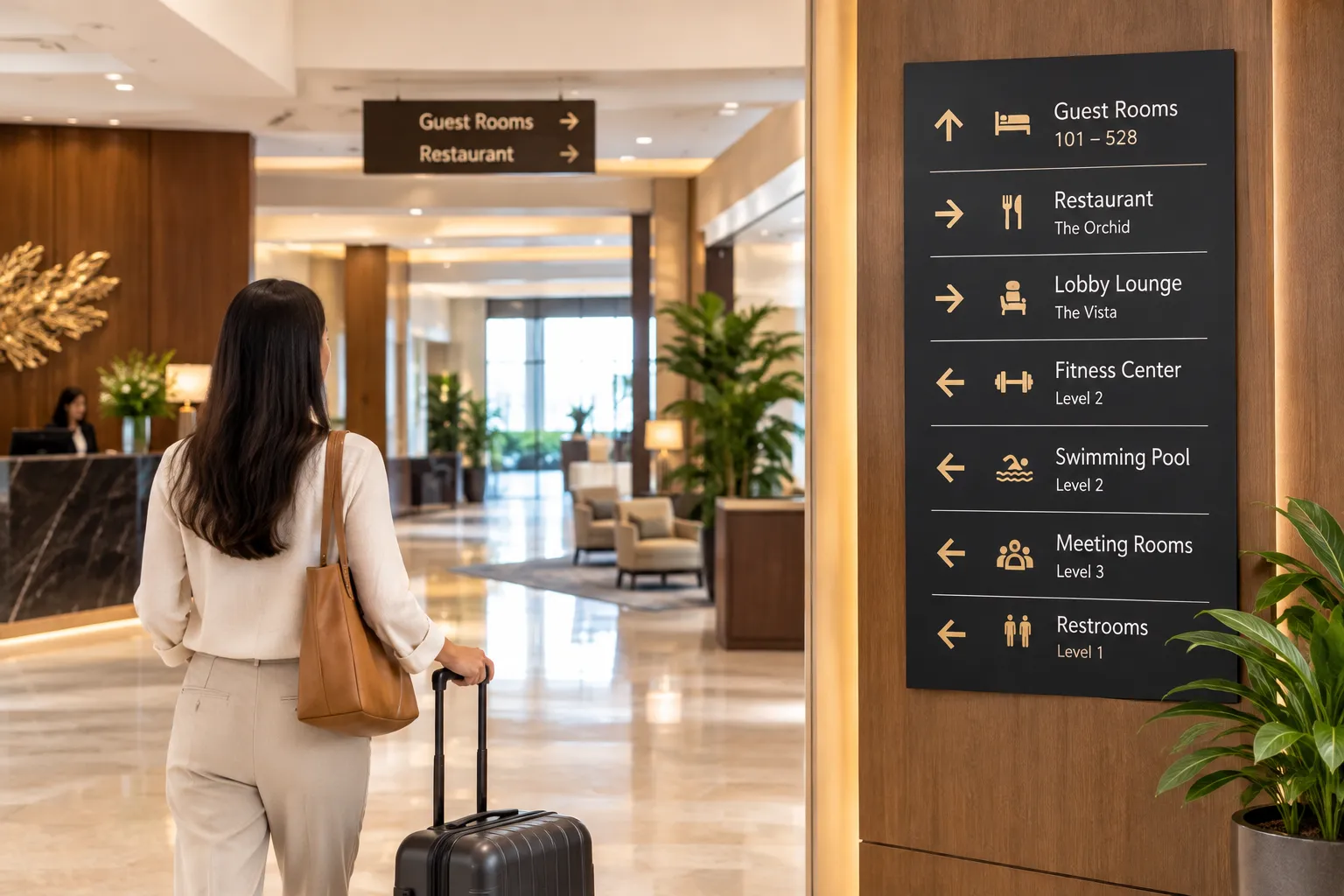
Large hotels often include hundreds of guest rooms, multiple floors, restaurants, conference halls, recreational facilities, and other amenities. Although these spaces offer convenience and comfort, their size and complex layouts can make navigation challenging, particularly for first-time visitors.
Directional signage for hotels helps guests understand where they are, identify destinations, and choose the correct routes without unnecessary confusion. When signs are thoughtfully planned and consistently designed, they make hotel spaces easier to navigate while supporting a more comfortable guest experience.
This guide explains how directional signage works, the different types of signs used in large hotels, and the design principles that make hotel navigation clearer and more accessible.
What Is Directional Signage in Hotels?
Directional signage consists of signs that guide people towards specific destinations within a building or property. In hotels, these signs help guests locate rooms, lifts, restaurants, meeting spaces, restrooms, reception areas, and other facilities.
Unlike identification signs, which label a particular location, directional signs help people decide which way to go.
For example, a sign in a hotel lobby might direct guests towards the lifts, while a sign near the lifts indicates which floors contain guest rooms, conference facilities, or dining areas.
These signs form an important part of a hotel's overall hotel signage system, working together with identification, informational, and safety signage to support clear navigation.
Why Is Directional Signage Important in Large Hotels?
In a small hotel, guests may be able to understand the layout after a brief introduction. In a large property, however, multiple corridors, interconnected buildings, and different levels can make navigation more complicated.
Well-planned directional signage can help address these challenges in several ways.
1. Reduces Guest Confusion
Guests should not have to guess where to go after entering a hotel or leaving a lift. Clear signs provide useful information at important decision points, helping visitors follow routes with greater confidence.
For example, a sign indicating the direction of guest rooms, restaurants, and conference facilities can help visitors make decisions without repeatedly asking staff for assistance.
2. Makes Facilities Easier to Find
Hotels often provide facilities that guests may not immediately notice, such as fitness centres, spas, business lounges, and swimming pools.
Directional signs help make these destinations easier to locate. This is particularly useful when facilities are situated away from the main lobby or on different floors.
3. Supports a More Comfortable Guest Experience
Confusing navigation can create unnecessary frustration, especially for guests who are unfamiliar with the property or travelling on a tight schedule.
A clear wayfinding system allows guests to spend less time searching for destinations and more time enjoying their stay.
4. Helps Staff Provide Better Assistance
When destinations are clearly labelled and routes are easy to follow, staff may receive fewer routine questions about directions. This can allow them to focus more attention on other guest needs.
Signage does not replace personal assistance, but it can make everyday navigation more manageable.
Types of Directional Signage Used in Large Hotels
Different areas of a hotel require different types of signs. A coordinated system uses several signage formats to guide guests throughout the property.
1. Lobby and Reception Directional Signs
The lobby is often the first major navigation point for arriving guests. Signs in this area can direct visitors towards:
- Reception and concierge desks
- Guest lifts and staircases
- Restaurants and cafés
- Conference and event facilities
- Restrooms and waiting areas
These signs should be easy to notice without overwhelming the interior design.
2. Floor Directional Signage
Floor directional signage helps guests navigate corridors, lift lobbies, and different levels of a hotel.
Examples include signs identifying room-number ranges, indicating corridor directions, and showing which floors contain specific facilities.
For instance, a sign near a lift might indicate that guest rooms are located along the left corridor, while meeting rooms are accessible on another level.
Consistent placement and terminology are particularly important in large hotels, where guests may encounter similar-looking corridors on several floors.
3. Room and Corridor Signs
Room-related signs help guests identify room numbers and understand the layout of accommodation areas.
These signs may include:
- Room-number signs
- Corridor direction indicators
- Signs identifying guest-room wings
- Signs marking lifts and staircases
Room numbering should follow a logical pattern wherever possible. A consistent system makes it easier for guests to understand how rooms are arranged.
4. Amenity and Facility Directional Signs
Hotels may have several amenities spread across different sections of the property. Directional signs can guide guests towards destinations such as:
- Restaurants and bars
- Swimming pools and fitness centres
- Spas and wellness facilities
- Business centres
- Event spaces and meeting rooms
Using consistent names across signs, hotel maps, and digital information helps guests recognise destinations more easily.
5. Parking and External Directional Signs
Navigation often begins before guests enter the building. External signs can guide visitors from entrances and parking areas towards reception, guest drop-off points, accessible entrances, and other important destinations.
In hotels with multiple buildings, outdoor paths, or resort-style layouts, external directional signage helps connect different parts of the property.
How Hotel Wayfinding Design Improves Navigation
Effective hotel wayfinding design involves more than placing arrows along corridors. It requires understanding how guests move through a property and identifying where they may need information.
Map the Guest Journey
Start by examining common journeys, such as:
- Entrance to reception
- Reception to guest rooms
- Guest rooms to restaurants
- Lobby to conference facilities
- Guest rooms to emergency exits
Mapping these routes helps designers identify locations where signs are needed.
Place Signs at Decision Points
Signs are especially useful where guests must choose between different routes. These locations may include lift lobbies, corridor intersections, entrances, and transitions between buildings.
A sign should appear early enough for visitors to understand their options before reaching the point where they need to turn.
Establish a Clear Information Hierarchy
Not every destination needs equal prominence on every sign. Important destinations should be easy to identify, while secondary information can be presented in a supporting position.
For example, a lobby sign might prioritise reception, lifts, and guest rooms before listing smaller facilities.
A clear hierarchy reduces visual clutter and helps guests locate relevant information quickly.
Design Principles for Clear Hotel Directional Signs
The appearance and placement of signs influence how easily guests can understand them.
Use Readable Typography and Familiar Symbols
Text should be legible from an appropriate viewing distance. Designers should consider letter size, contrast, lighting, viewing angles, and the needs of guests with visual impairments.
Recognisable symbols can support written directions, particularly in hotels welcoming international visitors. Symbols should be familiar and used consistently.
Maintain Consistent Colours and Terminology
A coordinated visual language helps guests recognise signs throughout the property. Colours, typography, arrows, icons, and destination names should follow a consistent approach.
For example, if a hotel calls a facility the “Wellness Centre” on its lobby directory, it should avoid referring to the same destination as the “Spa Zone” on corridor signs unless the distinction is intentional.
Consider Accessibility
Accessible wayfinding should account for guests with different mobility, sensory, and communication needs.
Depending on the location and applicable requirements, this may include tactile signs, Braille, appropriate contrast, accessible routes, and clear identification of lifts and accessible facilities.
Designers should consult relevant accessibility standards and local regulations rather than relying on visual appearance alone.
The Role of Digital Technology in Hotel Navigation
Digital tools are becoming part of how some hotels communicate directions and property information. They can complement physical signage, particularly in buildings with frequently changing room arrangements or event schedules.
Examples include:
- Interactive directories in hotel lobbies
- Digital displays showing conference-room locations
- QR codes linking to hotel maps
- Mobile-friendly property maps
- Indoor navigation tools where suitable positioning technology is available
Digital wayfinding can make it easier to update information, but it should not be the only navigation option. Physical signs remain important for guests who do not have a smartphone, cannot access a digital tool, or simply prefer printed directions.
A coordinated system combines digital information with clear, dependable physical signage.
Common Directional Signage Mistakes to Avoid
Some signage problems arise when signs are installed without considering the full guest journey.
Common mistakes include:
- Placing signs after guests have already passed a turning point
- Using inconsistent names for the same destination
- Making signs difficult to read from a normal viewing distance
- Providing too much information on a single sign
- Overlooking routes between outdoor and indoor spaces
- Failing to update signs after renovations or layout changes
- Depending entirely on digital navigation
Regular reviews can help identify outdated information, obstructed signs, and confusing routes.
How Wayfinding Design Services Support Hotel Projects
Professional wayfinding design services can help hotels assess their layouts, understand visitor movement, and develop a coordinated signage strategy.
The process may involve reviewing architectural plans, mapping guest journeys, identifying decision points, developing sign schedules, and coordinating signage with interior design and accessibility requirements.
For an existing hotel, a wayfinding review can reveal where guests are likely to become confused. For a new property, planning signage early can help integrate navigation into the building design rather than treating it as an afterthought.
Frequently Asked Questions
1. What is directional signage for hotels?
Directional signage for hotels guides guests towards destinations such as guest rooms, lifts, restaurants, restrooms, meeting rooms, and other facilities. It helps visitors understand routes and make navigation decisions.
2. Why do large hotels need a wayfinding system?
Large hotels often contain multiple floors, corridors, amenities, and buildings. A coordinated wayfinding system helps guests navigate these spaces more easily and reduces uncertainty when moving between destinations.
3. What is the difference between directional and identification signage?
Directional signage tells people where to go, often using arrows and destination names. Identification signage confirms the location they have reached, such as a room number, restaurant name, or restroom label.
4. Where should hotel directional signs be placed?
Signs are commonly placed near entrances, reception areas, lift lobbies, corridor intersections, staircases, and other decision points. Placement should give guests enough information to choose the correct route in advance.
5. Can digital wayfinding replace physical hotel signs?
Digital wayfinding can supplement physical signs, but it should not automatically replace them. A combination of digital tools and clear physical signage can support different guest preferences and accessibility needs.
6. How can hotels make directional signage more accessible?
Hotels can consider readable typography, strong contrast, familiar symbols, clear routes, appropriate sign placement, and tactile or Braille information where required. Accessibility decisions should follow applicable standards and regulations.
Conclusion
Directional signage plays an important role in helping guests navigate large hotels. From lobby directories and floor directional signage to amenity signs and outdoor route markers, each sign should provide clear information at the point where visitors need it.
When hotel wayfinding design is based on guest journeys, consistent terminology, accessibility, and thoughtful placement, it becomes easier for visitors to find destinations with confidence. The goal is not simply to display directions, but to make the entire property feel more understandable and welcoming.

























Sign in to leave a comment.