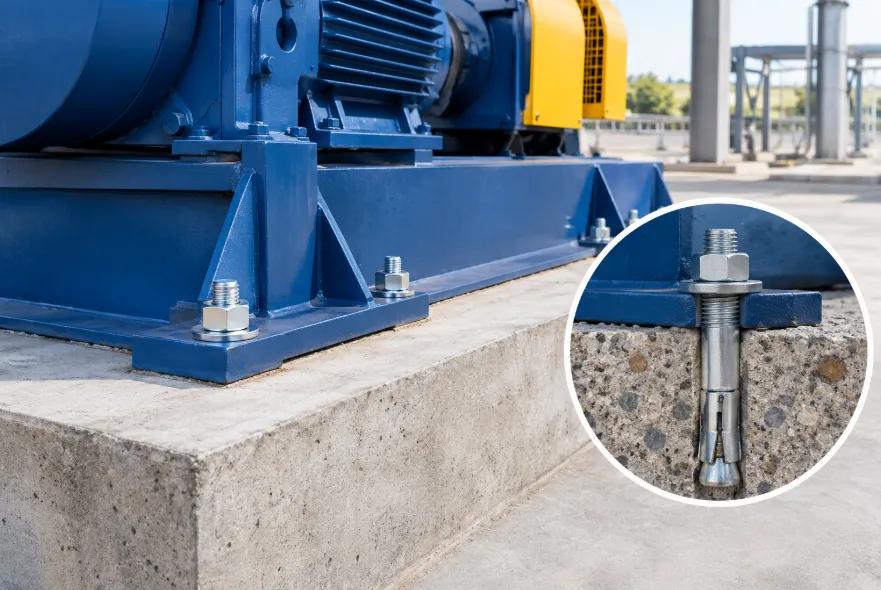
At seven in the morning, Rohan walked to the compressor bay with a torch in one hand and a cup of tea in the other. The new reciprocating compressor had run through the night, loud and steady, just as the commissioning team had promised. Then a technician waved him over to one corner of the base plate, where a faint rattle came from a single nut. Plants in 2026 keep installing heavier, faster machines often on floors poured years ago for lighter loads. Every one of those machines depends on a few steel rods set in concrete. So what actually keeps a machine like this still, shift after shift?
The Hidden Forces Every Machine Pushes Into Concrete
What Anchor Bolts Actually Do Beneath the Base Plate
A machine on a plinth looks passive, but it never really rests. Motors twist against their mounts at startup, and moving parts shake the frame thousands of times an hour. Hot pipes expand and pull on connections. Anchor bolts collect all of these forces and pass them into the foundation. Tension tries to pull the machine upward; shear pushes it sideways, and uplift tries to lift one edge off the plinth.
Think of the bolt as a handshake between steel and concrete. A firm grip holds through every jolt; a weak one loosens a little each time, and nobody notices until the damage shows.
Why Vibration Changes Everything
A static load, such as a storage tank settles into place and stays there. A compressor keeps coming back to the same bolts with the same push, cycle after cycle. The American Concrete Institute treats this difference seriously. It publishes a separate report for foundations that carry dynamic equipment and a companion document covers equipment anchorage to concrete in detail. Repeated loading slowly works a nut loose, wears the grout under the base plate and chips away at concrete near the bolt. None of this happens overnight which makes it easy to miss.
Reading the Load Before Choosing the Bolt
Rohan's team started months before the compressor arrived, they built a simple sheet that listed
- The machine's operating weight,
- Its running speed,
- Its startup torque, and
- The expected thermal movement of the discharge piping
The structural engineer received that sheet before anyone ordered a single bolt, a bolt that matches the load looks unremarkable once installed. A bolt that misreads the load becomes the weakest link in the whole system.
With the loads on paper, the next question came up fast. When should the bolts go in?
Cast Before the Pour or Drilled After, and Why It Matters
How the Main Anchor Bolt Types Grip Concrete
The common anchor bolt types fall into two families.
Cast in bolts go into the formwork before the concrete arrives. They come in J-hook, L-hook, headed and plate foot forms. Once the concrete cures around them, the bent end or head locks mechanically into the mass.
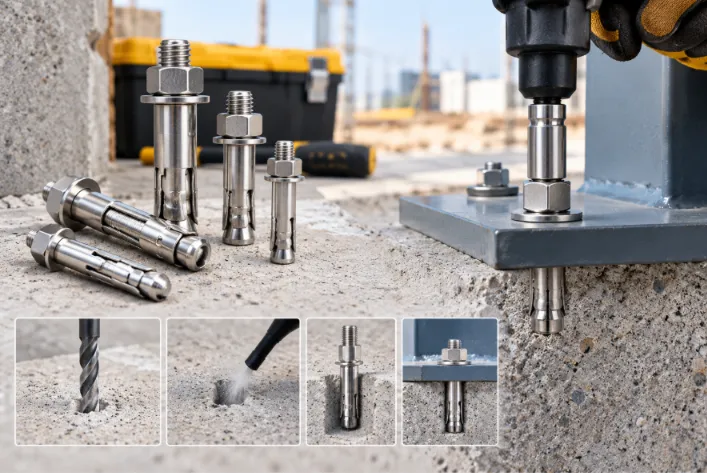
Post installed anchors go into holes drilled after the concrete has hardened. They grip in three different ways:
- Expansion anchors wedge outward against the walls of the hole. Many site teams already know these as wedge anchors.
- Undercut anchors cut a wider cavity at the bottom of the hole and bear against it, much like a cast in head.
- Bonded anchors use an injection mortar that locks a threaded rod along the full depth of the hole.
What the Standards Tell Us
Each family has its own rulebook and that alone tells you they behave differently. ASTM F1554 covers straight, bent and headed bolts used to anchor structural supports to concrete foundations. In India IS 5624 covers cast in foundation bolts from M8 to M72. Post installed mechanical anchors go through qualification testing under ACI 355.2, that testing decides whether an anchor suits uncracked concrete only, or cracked concrete as well.
That last point matters more than it first appears. A slab under heavy equipment can develop hairline cracks over its service life. An anchor qualified only for uncracked concrete has no business in that slab.
Matching the Type to the Site
Rohan made two different calls on the same project.
- The new compressor plinth was still a fresh pour. His crew set cast in concrete anchor bolts in a plywood template that held every bolt in position while the concrete went in.
- The existing pump bay sat on a ten-year-old slab. There, the team scanned for rebar first, then drilled for post-installed anchors qualified for cracked concrete.
In both cases, timing and site conditions made the decision, not habit or preference.
Choosing the type settled one question and opened another. Two bolts that look identical on a pallet can behave very differently once they are in the ground.
Strength on Paper Versus Strength in the Ground
Grade, Coating and Embedment Working Together
Steel grade gets most of the attention, but it tells only part of the story. Three other factors carry just as much weight,
- Embedment depth decides how much concrete resists the pull.
- Edge distance decides whether the concrete near a plinth edge breaks away under load.
- Coating decides how long the bolt holds up against moisture, oil, and the chemicals common in plant environments.
A high-grade bolt set too shallow still fails. The concrete simply gives up before the steel does.
The Numbers Behind Heavy Duty Anchor Bolts
ASTM F1554 offers three grades: 36, 55 and 105. These numbers mark minimum yield strengths of 248, 380 and 724 MPa. The standard also colour-codes the bolt ends blue, yellow and red so crews can tell the grades apart on site, that detail sounds minor until two grades arrive on the same truck and a busy crew grabs the wrong bundle.
Heavy-duty anchor bolts make sense when the loads call for them. Specifying the top grade everywhere adds cost, and it does nothing to fix a shallow embedment or a bolt too close to an edge. The engineer should choose the grade from the load sheet, not from a desire to play safe on paper.
A Procurement Checklist That Holds Up
Before approving any order, the procurement head on Rohan's project checked four things:
- The grade and the governing standard, both written on the purchase order.
- The mill test certificates for the batch
- The galvanising requirement for the plant environment
- A thread length long enough for the levelling nut, the grout gap, the washer and the top nut
One delivery arrived with threads a little too short. It went straight back to the supplier. A specification only protects a project when someone compares it against what actually arrives on site.
With the right bolts in hand most people assume the hard part is over. In practice, the trouble usually starts here.
Where Installations Quietly Go Wrong
Small Errors With Big Consequences
Most anchor problems trace back to a handful of mistakes:
- Misaligned bolt groups, when concrete shifts the bolts during the pour and no template holds them in place
- Bolts too close to edges, which leaves the concrete around them too thin to resist the load
- Hidden voids in the grout, which leave the base plate resting on a few high spots instead of full contact
- Improvised field fixes, when crews heat, bend or cut bolts that do not line up with the machine's holes.
Each of these looks small on the day it happens. Each one grows with every hour the machine runs.
What Steel Erection Safety Rules Teach Us
US safety regulators have studied this problem closely. OSHA names inadequate anchor bolt installation as a primary contributing factor in structural collapses, its rules also bar anyone from repairing, replacing or modifying anchor bolts on site without approval from the project's structural engineer of record.
Those rules govern steel columns, not machinery. Still the lesson carries over directly. A bolt that someone bent to fit is no longer the bolt the engineer designed.
Inspection Habits That Keep Equipment Still
Rohan's team now follows a simple routine:
- Use templates during every pour.
- Check bolt projection height before the concrete sets.
- Retorque all nuts after the machine's first run in period.
- Put bolt and grout inspections on the regular maintenance calendar.
That morning rattle came from one nut the crew had missed during the retorque. Ten minutes with a torque wrench fixed it. Left alone, that loose nut would have shifted its share of the load onto the other bolts. From there, the grout would have cracked, the alignment would have drifted, and the bearings would have worn early. Most anchor failures begin at installation, which also means most of them can be prevented.
Rohan keeps a short list pinned inside the site office now. It fits on one page.
Six Habits That Keep Heavy Equipment Anchored
- Map every load, including vibration, before choosing an anchor.
- Match anchor bolts for concrete to the project stage, a new pour or an existing slab.
- Ask for the governing standard and test certificates with every order.
- Hold bolt positions with a template during concreting.
- Never cut, bend or heat a bolt without the engineer's approval.
- Retorque after commissioning and schedule regular inspections.
What Holds the Machine When Nobody Is Watching
A foundation carries the weight of a machine, but the bolts carry everyone's trust in it. They sit mostly out of sight and that is exactly why they get forgotten. As equipment grows heavier and runs longer hours the room for guesswork keeps shrinking. The fix rarely means expensive hardware, it means careful choices at the right stage and honest checks once the machine starts running, if your most critical machine shifted a few millimetres tomorrow would anyone on site know which bolt to check first?






























Sign in to leave a comment.