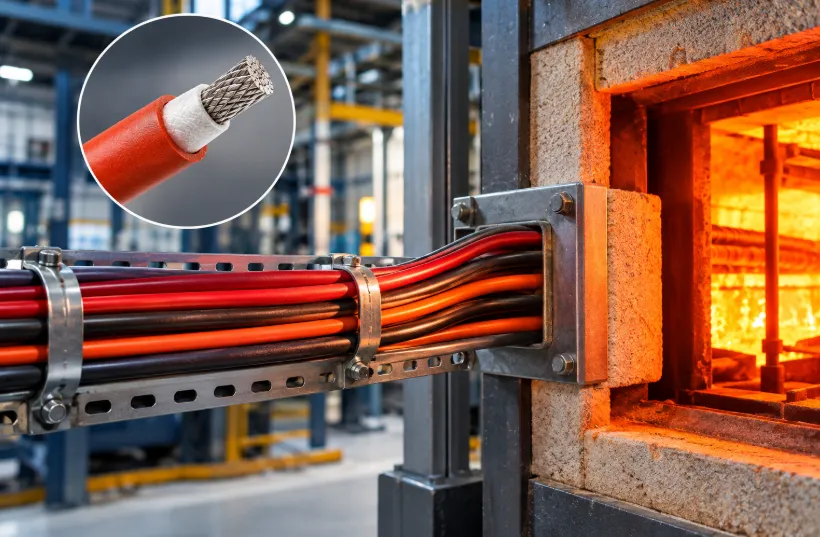

Rajiv had run the electrical maintenance desk at a mid sized forging unit for eleven years, and every summer brought the same complaint from the shop floor. The control panel near furnace bay two would trip without any warning, this usually happened on the hottest afternoons, or right when a batch was mid cycle. His team would do the obvious thing, they opened the panel, checked the connections, tested the breaker, and found nothing wrong, even the wiring looked fine. No burn marks, no visible damage, nothing a quick visual inspection would catch.
It took two summers and one genuinely close call, a small arc near a terminal block, before anyone thought to question the wire itself rather than the components around it. The cable running to that panel was rated for general industrial use, not for the ambient heat load building up inside an enclosure sitting a few metres from a furnace. It was doing its job in April. It was failing quietly by June.
This is a more common story than most buyers realise, and it is becoming more relevant as India's furnace heavy, foundry heavy, and power intensive manufacturing base keeps expanding through 2026. Choosing between ordinary wire and genuine high temperature wires used to be a niche technical decision. For a growing number of plants, it has become a basic reliability question. Here is what actually happens inside a cable under sustained heat, and what separates a wire that survives an Indian summer shop floor from one that quietly gives up.
The Slow Breakdown Nobody Notices Until the Panel Trips
Heat does not usually destroy a cable in one dramatic moment. It wears it down gradually, the same way a rubber band loses its snap after sitting in the sun for months. Inside a standard PVC insulated wire, sustained heat causes the insulation to lose plasticisers, turn brittle, and slowly lose its ability to resist current leakage. The conductor itself does not care much about heat up to a point, but the material wrapped around it does, and that material is usually the first thing to fail.
This is where the actual numbers matter. Under IS 7098, XLPE insulated cables are rated for a maximum continuous conductor operating temperature of 90°C compared to 70°C for standard PVC insulation under IEC 60502-1. That twenty degree gap is the difference between a cable that shrugs off a hot enclosure and one that degrades the moment ambient conditions climb past a typical Indian summer afternoon. Heat resistant wires are built around exactly this gap.
Rajiv's panel wire was PVC insulated, chosen years earlier because it was cheaper and nobody had questioned the ambient temperature inside that particular enclosure. It had been quietly ageing for two summers before anyone noticed.
Not All Insulation Handles Heat the Same Way
Once you start looking past the PVC option, you will notice the differences between insulation types become fairly stark. For example silicone rubber insulation is commonly rated for continuous operation between 150°C and 180°C, and it stays flexible even at low temperatures, which makes it a common choice for motor leads and appliance wiring that needs to bend repeatedly without cracking. PTFE insulated wire, often called Teflon wire goes further still. Under UL1213, it carries a rating of 200°C continuous, with practical operating range extending up to around 260°C for brief spikes.
This is not just a matter of picking the highest number on the datasheet. A high temperature wire built for a furnace adjacent control panel does not necessarily need PTFE. Silicone insulation is often the better fit there, since the real problem is ambient heat buildup inside the enclosure rather than direct proximity to a flame or molten metal. PTFE earns its place in more extreme settings, closer to heating elements, kilns or high temperature process equipment where the cable itself sits near the heat source rather than just around it.
When Rajiv's team finally replaced the failing PVC cable, they did not reach for the most expensive option available. They matched the insulation to the actual ambient temperature inside that specific panel, which turned out to be silicone rated, glass braided high temperature cables, well within budget and well within what the application actually demanded.
Why Two Cables With the Same Rating Can Still Behave Differently
Here is something that trips up even experienced buyers. A cable's temperature rating is not one single number, it usually covers at least two distinct conditions. There is the continuous operating rating, which the cable handles indefinitely under normal load, and there is a short circuit or emergency rating that applies only for brief periods under fault conditions. For XLPE cables under IS 7098, the continuous figure sits at 90°C. In comparison, short circuit tolerance in related HT XLPE technical specifications extends up to 250°C for a matter of seconds, not for continuous use.
Why does this matter for a buyer? Two cables can carry the same headline number on a spec sheet and still perform differently once installed, this totally depends on how that number was tested. Thermal endurance testing under IEC 60216 measures how insulation ages under sustained heat over time not just how it survives a single lab test. A cable that passes a short duration heat test can still fail years earlier than one built with more thermally stable compounds.
Is that difference something a buyer can see before installation? Well, not always which is exactly why sourcing from a manufacturer that tests consistently rather than one that simply prints a number ends up mattering more.
Installation Choices That Quietly Undermine Heat Resistance
Even the most premium cable can underperform if installation habits work against it. Bundling several current carrying cables tightly together raises the effective temperature around each one, since they are all generating and trapping heat in the same confined space a cable rated for 90°C in open air behaves very differently once it is packed into a tray with a dozen others inside a poorly ventilated enclosure.
Ambient temperature inside the enclosure needs to be checked before specifying a cable, not assumed. A panel sitting near a furnace, exposed to direct sun on a rooftop, or positioned near an exhaust duct runs hotter than the surrounding shop floor temperature suggests. Checking enclosure ventilation, spacing cables where load allows and applying a derating factor for bundled installations go a long way toward preventing exactly the kind of failure Rajiv's team dealt with.
Once the new silicone rated cable went in, his team also opened up the panel slightly, added a small vent and rerouted a few cables that had been sitting in a tight bundle for no real reason. The panel has not tripped since, not because the cable alone fixed things but because the cable and the installation were finally working with each other instead of against each other.
Where Manufacturing Quality Enters the Picture
A lot of what separates a dependable high temperature wire from one that fails early comes down to how consistently the insulation is applied during manufacturing. Uneven wall thickness inconsistent curing or variation between batches can mean two lengths from the same product line age at noticeably different rates once they are out in the field. This is less about a single flashy feature and more about whether a manufacturer's process holds up the same way every single time.
At Balaji Cables & Wires, this is the kind of detail our production process is built around, consistent insulation extrusion and material quality across batches of copper wire, control cables, and heat resistant cable ranges, so buyers are not left guessing whether the cable in front of them will behave like the datasheet promises. Before placing an order, it is worth asking any manufacturer, us included, how insulation consistency is tested, not just what temperature number appears on the label.
What This Means for Your Next Wiring Decision
- Match insulation type to the actual continuous operating temperature the cable will face, not the general ambient temperature of the shop floor
- Treat continuous, short circuit, and emergency ratings as three separate figures, not one number.
- Check enclosure ventilation and cable bundling before finalising cable size, since both affect real world heat exposure.
- Ask manufacturers how they test insulation consistency across batches, not only what the headline temperature rating says.
The Real Question Is Not How Hot, It Is How Often
Heat resistance is rarely about surviving one extreme moment. It is about how a cable holds up through hundreds of ordinary hot afternoons, gradually quietly, in enclosures nobody checks twice. Rajiv's panel did not fail because of one freak temperature spike it failed because a cable meant for general use was asked to do a specialised job, summer after summer until it simply could not anymore and at the end it gave up and you got downtime.
The next time a panel in your plant trips on a hot day for no obvious reason, it might be worth asking a slightly different question. Was the wire actually chosen for that spot, or was it just what happened to be on hand?
If you are working through a similar decision for your own plant, we are happy to talk through the specifics, from insulation type to ambient conditions to the load your setup actually carries. You can reach us directly or check our range at https://balajiwires.in whenever you are ready to compare options.



























Sign in to leave a comment.