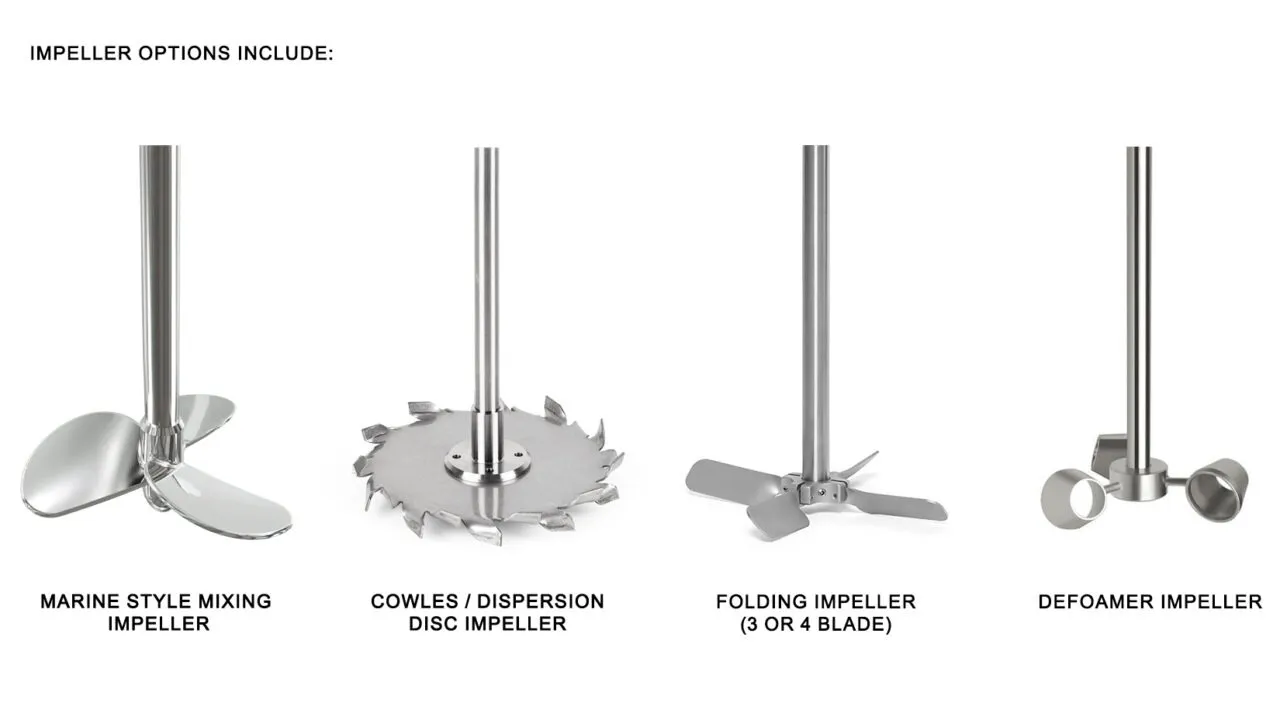

Mixing requirements can change significantly from one batch to another. A low-viscosity liquid may need gentle circulation, while a thicker formulation can require considerably more torque and agitation. IBC tote mixers equipped with variable frequency drive (VFD) control give operators a practical way to adjust mixing speed to match these changing process conditions. Instead of running the mixer at one fixed speed, a VFD allows controlled motor-speed adjustment, helping processors improve batch consistency, manage shear, and adapt the same equipment to different products.
What Does a VFD Actually Control?
A VFD controls the frequency and voltage supplied to an AC motor, which changes the motor's operating speed. Rather than simply switching a mixer on or off, operators can select a defined RPM range appropriate for the process.
This matters because agitator performance is strongly affected by rotational speed. As speed changes, the circulation pattern, shear level, power consumption, and mixing intensity can also change.
For example, a mixer operating at a relatively low speed may provide sufficient turnover for a thin liquid. Increasing the speed can then provide stronger circulation when the formulation becomes more viscous or when faster blending is required.
Why Fixed-Speed Mixing Can Be Limiting
A fixed-speed mixer is designed around a particular operating point. That may work well when every batch has similar viscosity, density, solids content, and processing requirements. However, many production environments do not operate that way.
Different formulations can require different mixing conditions. Even the same product can behave differently as ingredients are added or as temperature changes.
Running too slowly can result in poor circulation, longer blend times, or unmixed material near the bottom and corners of the tote. Running too quickly can introduce excessive shear, create a vortex, entrain air, or consume more energy than necessary.
VFD control gives operators a middle ground. The mixer can be adjusted instead of forcing every batch to operate at the same speed.
Matching Speed to Product Viscosity
Viscosity is one of the most important variables in mixer selection and operation.
A thin liquid generally moves easily around an impeller. A viscous product resists movement and can require greater torque to maintain circulation. If the mixer is operated at an inappropriate speed, the resulting flow pattern may not provide adequate turnover throughout the tote.
A VFD allows the operating speed to be changed as viscosity changes during the batch. For instance, a process may begin at a lower speed while powders or ingredients are being added, then increase speed after incorporation to improve bulk circulation.
However, higher RPM is not automatically better. Mixer speed should remain within the mechanical and process limits of the agitator, motor, shaft, and product.
Controlling Shear for Sensitive Products
Mixing speed also influences shear.
Some formulations benefit from stronger mechanical action, while others can be damaged by excessive shear. A VFD provides a way to establish a lower operating speed when gentle blending is required and increase speed only when additional dispersion or circulation is needed.
This is particularly useful when one mixing system handles multiple products. Instead of designing every batch around the most aggressive mixing requirement, operators can establish different speed settings for different formulations.
That flexibility can also reduce the risk of over-processing.
Improving Ingredient Addition
VFD control becomes especially useful during staged ingredient addition.
Consider a batch where a base liquid is loaded into the tote before powders, concentrates, or other ingredients are introduced. The mixer may initially operate at a moderate speed to establish circulation. Once an ingredient is added, the speed can be temporarily increased to improve dispersion.
After incorporation, the mixer can return to a lower speed for continued blending.
This approach gives operators greater control over the mixing sequence. It also helps avoid relying on one high-speed setting throughout the entire batch.
Supporting Consistent Batch Recipes
VFD control becomes even more valuable when connected to a broader automation strategy.
A PLC and HMI can be configured to associate specific mixer speeds and operating times with individual recipes. Instead of relying entirely on manual adjustments, operators can follow repeatable process steps.
For example, a recipe might specify:
- Load the tote to the required working volume.
- Start agitation at a defined low speed.
- Increase RPM during ingredient addition.
- Return to the target blending speed.
- Maintain agitation for a specified period.
- Stop or reduce speed before discharge.
These settings can help reduce operator-to-operator variation and provide a more repeatable production process.
VFDs Can Also Help Manage Energy Use
Motor power requirements change with operating conditions. Although the exact relationship depends on the mixer and impeller design, agitation power can increase substantially as rotational speed rises.
For many mixer systems, power is strongly influenced by speed, making unnecessary high-speed operation an inefficient approach.
A VFD allows the mixer to run at the speed actually required by the process. If a batch can achieve adequate circulation at a lower RPM, there is little reason to operate continuously at maximum speed.
The result can be better energy management without sacrificing process performance.
Selecting the Right VFD and Mixer Combination
The VFD should not be selected independently from the mixer.
Engineers need to consider motor horsepower, required torque, operating RPM range, impeller geometry, product viscosity, density, solids concentration, and the desired flow pattern.
The motor must also provide adequate torque at the lower speeds where the process may operate. Simply specifying a wide speed range does not guarantee effective mixing throughout that range.
For viscous products, gearbox selection and mechanical drive characteristics can be just as important as the VFD itself.
VFD Control Is Part of the Process Design
A VFD is more than a convenient speed knob. When correctly matched with the motor, gearbox, agitator, and process, it becomes an important control element in flexible mixing operations.
It allows one mixing system to accommodate changes in viscosity, ingredient loading, shear requirements, batch recipes, and production conditions. Combined with appropriate instrumentation and automation, VFD control can also improve repeatability and make process adjustments easier to manage.
For IBC tote mixing, that flexibility is particularly valuable because the same container format may be used for multiple formulations. The best results come from treating speed control as part of the complete mixing system rather than as an add-on component.























Sign in to leave a comment.