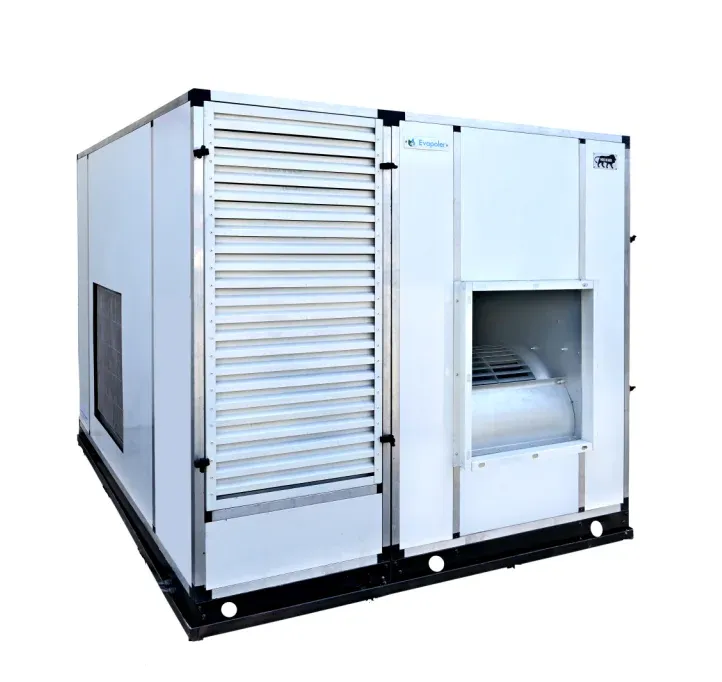

Factories, workshops, warehouses and production facilities often face a difficult cooling challenge. Large floor areas, heat-producing machinery, poor air circulation and high outdoor temperatures can make conventional cooling expensive and difficult to scale.
For these environments, industrial evaporative air coolers offer a practical approach to cooling and ventilation. Instead of continuously recirculating the same indoor air, evaporative cooling systems can introduce fresh outdoor air, cool it through water evaporation and distribute it across large working areas.
This combination of cooling, fresh-air circulation and energy efficiency makes evaporative air cooling particularly useful for industrial environments.
Why Factory Cooling Is Different From Conventional Air Conditioning
Cooling a factory is not the same as cooling a residential room or a small commercial office.
Manufacturing facilities may have large ceiling heights, frequently opened doors, heat-generating equipment, welding areas, production lines and significant air leakage. In such conditions, refrigerated air conditioning may require substantial cooling capacity to maintain a comfortable indoor temperature.
Factories also need ventilation. Simply lowering the temperature is not always enough when workers are exposed to dust, fumes, odours or heat generated by industrial processes.
An industrial cooling strategy therefore needs to consider three factors together:
- Fresh-air movement
- Heat reduction
- Efficient air distribution
Evaporative cooling can address these requirements in a single system when correctly designed for the building and climate.
How Industrial Evaporative Cooling Works
Evaporative cooling uses a natural physical process. When hot air passes through water-saturated cooling pads, a portion of the water evaporates. This evaporation absorbs heat from the air and lowers its temperature.
The cooled air is then distributed through the facility using an industrial fan system.
Unlike refrigerated air conditioning, evaporative cooling does not depend on a compressor and refrigerant cycle for the cooling process. This can result in significantly lower electrical consumption in suitable operating conditions.
The effectiveness of the system depends on factors such as outdoor temperature, relative humidity, airflow, cooling-pad performance, air changes and building design.
1. Better Factory Ventilation Through Fresh Air
One of the biggest advantages of industrial evaporative air coolers is their ability to support high-volume fresh-air circulation.
Factories often require continuous air movement because doors may remain open and production processes can generate heat, dust, fumes or odours.
A properly designed evaporative cooling system can draw outdoor air, cool it and distribute it throughout the working area. This creates continuous air movement instead of relying entirely on recirculated indoor air.
For facilities where ventilation is an important requirement, this approach can complement existing exhaust and air-handling systems.
2. Improved Worker Comfort in Hot Working Areas
High temperatures can make physically demanding work more difficult. Workers operating near furnaces, machinery, production lines or other heat sources may experience significant thermal discomfort.
Evaporative cooling can help reduce the temperature of incoming air while creating a continuous airflow across occupied areas.
The result is not simply colder air. Air movement itself can improve perceived comfort by helping remove heat from the human body.
This can be particularly valuable in:
- Manufacturing plants
- Fabrication workshops
- Warehouses
- Automotive facilities
- Textile factories
- Packaging units
- Foundries
- Large production halls
- Industrial workshops
The cooling strategy should still be designed around the actual heat load and working conditions rather than assuming the same system will work equally well in every facility.
3. Lower Electricity Consumption Than Refrigerated Cooling
Energy consumption is one of the major concerns when cooling a large industrial building.
Refrigerated air-conditioning systems use compressors, condensers and other refrigeration components that can require considerable electrical power, particularly when large spaces need continuous cooling.
Evaporative cooling uses water evaporation as the primary cooling mechanism. Because it does not rely on the same refrigeration cycle, its electrical demand can be considerably lower in suitable climates and applications.
Some industrial evaporative cooling systems can consume up to 80% less electricity than refrigerated air conditioning, depending on operating conditions, system design and the specific comparison being made.
For large facilities, reducing cooling energy demand can have a meaningful impact on operating costs.
4. Suitable for Large Industrial Spaces
Traditional room-based air conditioning becomes increasingly challenging as the area to be cooled becomes larger.
A factory may have thousands of square feet of open floor space and a high ceiling. Installing enough conventional air-conditioning capacity to cool the entire volume can require significant capital investment and operating expenditure.
Industrial evaporative coolers are designed for high-volume air delivery.
Depending on the equipment and system design, high-static-pressure fans can move cooled air over considerable distances. This makes them suitable for applications where air needs to travel across large production areas.
Instead of attempting to create the same temperature throughout an enormous enclosed space, a facility can use strategically positioned cooling and airflow systems to improve conditions in occupied working zones.
5. Helps Manage Heat From Industrial Processes
Many industrial processes produce considerable heat.
Examples include:
- Welding
- Metal cutting
- Casting
- Plastic processing
- Textile production
- Automotive manufacturing
- Food processing
- Machinery operation
When heat accumulates inside a production area, simply increasing the number of conventional air-conditioning units may not be the most practical solution.
A combination of fresh-air supply, exhaust ventilation and evaporative cooling can help move hot indoor air out while supplying cooler outdoor air.
The exact configuration should be determined through an assessment of the facility's heat sources, airflow requirements and ventilation pattern.
6. Cost-Effective Cooling for High-Air-Volume Applications
Industrial cooling is not only about equipment purchase price. Businesses need to consider the total cost of ownership.
This includes:
- Initial equipment cost
- Electrical consumption
- Water consumption
- Maintenance
- Replacement components
- Installation
- Expected operating life
Evaporative cooling can provide a lower-cost alternative to refrigerated cooling for suitable industrial applications because the cooling mechanism is comparatively simple and electricity demand can be substantially lower.
However, the economics depend on local climate, water availability, operating hours, building characteristics and required indoor conditions.
7. Pre-Filters Can Help Improve Incoming Air Quality
Industrial facilities can experience significant dust exposure, particularly in manufacturing and processing environments.
Industrial evaporative cooling systems can be configured with pre-dust filters to reduce the amount of airborne particulate matter entering the cooling system.
This can provide two benefits.
First, it can help improve the quality of incoming air. Second, reducing dust reaching the cooling pads can help extend pad service life and maintain system performance.
Filtration requirements should be selected according to the type and concentration of contaminants present in the facility.
8. High Airflow Helps Improve Air Distribution
Cooling equipment is only effective when cooled air reaches the areas where it is required.
Industrial evaporative coolers can use high-efficiency centrifugal fans and high-static-pressure configurations to support long-distance air delivery.
This is particularly useful in facilities with:
- Long production lines
- High ceilings
- Large floor areas
- Multiple workstations
- Large machinery
- Open warehouse layouts
Air distribution should be planned rather than simply placing coolers wherever floor space is available.
The position of air outlets, exhaust fans, doors, machinery and worker areas can all influence system performance.
9. Evaporative Cooling Can Support Sustainable Building Operations
Energy efficiency is becoming an important consideration for industrial businesses because cooling can represent a significant portion of facility energy consumption.
Evaporative cooling uses the natural process of water evaporation instead of relying primarily on mechanical refrigeration.
This can reduce electricity requirements in appropriate climatic conditions and help businesses pursue more energy-efficient cooling strategies.
For companies looking to reduce operational energy consumption without completely redesigning their industrial facility, evaporative cooling can be considered as part of a broader ventilation and thermal-comfort strategy.
When Is Evaporative Cooling Most Effective?
Evaporative cooling generally performs best in hot and relatively dry conditions because the air has greater capacity to absorb additional moisture.
Performance can be lower in areas with high outdoor humidity.
Before selecting an industrial evaporative cooling system, businesses should evaluate:
- Outdoor temperature and humidity
- Factory floor area
- Ceiling height
- Number of workers
- Heat generated by machinery
- Required airflow
- Existing exhaust systems
- Number and location of doors
- Dust and contaminant levels
- Water availability
- Required indoor comfort conditions
This assessment helps determine whether evaporative cooling is appropriate and what airflow capacity is required.
Evaporative Cooling vs Refrigerated Air Conditioning
The two technologies solve different cooling problems.
| Factor | Evaporative Cooling | Refrigerated Air Conditioning |
|---|---|---|
| Cooling method | Water evaporation | Refrigeration cycle |
| Fresh-air capability | Well suited to high fresh-air applications | Usually designed around conditioned air |
| Energy consumption | Generally lower in suitable climates | Generally higher |
| Large open spaces | Suitable for many applications | Can be expensive to scale |
| Humidity control | Limited | Stronger humidity control |
| Outdoor climate dependency | High | Lower |
| Typical application | Factories, workshops, warehouses | Offices, controlled environments |
This does not mean evaporative cooling is a replacement for air conditioning in every situation.
For environments requiring precise temperature and humidity control, refrigerated HVAC may remain the better option. For large industrial spaces where fresh-air circulation and economical cooling are priorities, evaporative cooling can be highly effective.
Choosing the Right Industrial Evaporative Cooler
Selecting a system based only on the physical size of a cooler can result in poor performance.
The system should be selected based on airflow requirements, static pressure, building layout and heat load.
Important specifications can include:
- Air delivery capacity
- Static pressure
- Fan type
- Motor efficiency
- Cooling-pad quality
- Water distribution system
- Filtration
- Control system
- Protection features
- Maintenance requirements
For larger or specialized facilities, customized cooling capacity may be required rather than a standard off-the-shelf configuration.
Example: Industrial Evaporative Cooling for a Large Factory
Consider a manufacturing facility with a large production floor, high ceiling and multiple heat-producing machines.
Installing conventional air conditioning across the entire building could require substantial cooling capacity.
An alternative approach could combine:
- Industrial evaporative coolers
- Fresh-air intake
- Mechanical exhaust
- Strategic air distribution
- Localized cooling near high-heat workstations
The objective is not necessarily to make every part of the factory feel like an air-conditioned office.
Instead, the system can focus on continuously moving fresh, cooler air through occupied areas while helping remove accumulated heat.
This approach can provide a more practical balance between worker comfort, ventilation and operating cost.
What Should Businesses Consider Before Installation?
A professional site assessment should come before selecting equipment.
The assessment should identify where heat is generated, where workers spend most of their time, how air currently moves through the building and where hot air can be exhausted.
The number and capacity of cooling units should then be determined according to the required airflow and facility conditions.
Poorly positioned equipment can create uneven cooling, while insufficient exhaust can reduce the effectiveness of a fresh-air cooling system.
Good system design is therefore just as important as the cooler itself.
The Role of Industrial Evaporative Coolers in Modern Factories
Modern factories need cooling systems that balance productivity, worker comfort, ventilation and operating cost.
Industrial evaporative cooling provides an interesting solution because it combines high-volume airflow with water-based cooling.
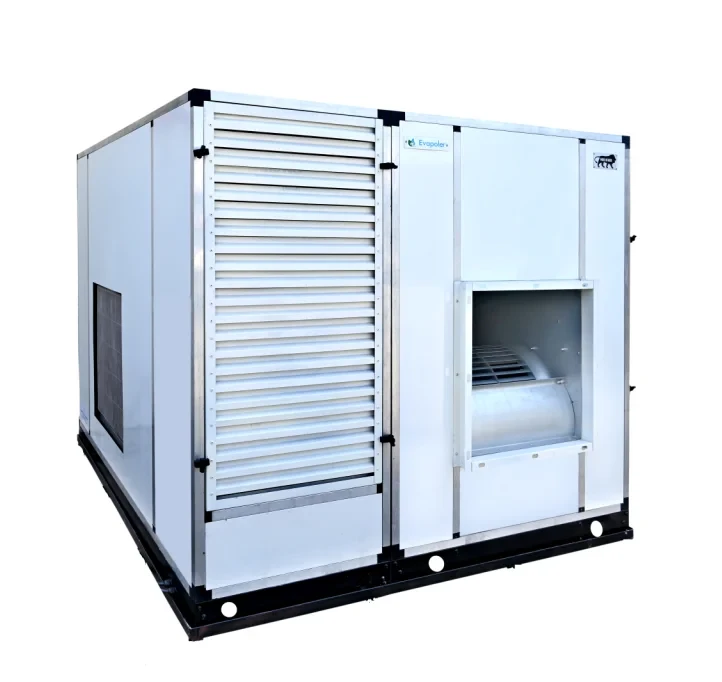
For suitable climates and applications, systems such as the EVA 500-HS industrial evaporative cooler can be configured for high-static-pressure air delivery, fresh-air cooling and large-area industrial applications.
Industrial evaporative cooling systems can also be customized for different airflow requirements and facility layouts, making them suitable for applications ranging from workshops to large manufacturing environments.
Conclusion
Factory cooling requires more than simply lowering indoor temperature. Large industrial facilities need continuous airflow, fresh-air circulation, heat management and an economically sustainable cooling strategy.
Industrial evaporative air coolers can address these requirements by using water evaporation to cool incoming air while delivering high volumes of fresh air.
When the technology is matched with the right climate, building design and ventilation strategy, it can help improve worker comfort while reducing the energy burden associated with large-scale cooling.
For factories, warehouses and workshops looking for an efficient alternative to conventional refrigerated cooling, evaporative air cooling is worth evaluating as part of a complete industrial ventilation strategy.
Frequently Asked Questions
Are evaporative air coolers suitable for factories?
Yes. Industrial evaporative air coolers are commonly considered for factories, workshops, warehouses and other large spaces where high-volume fresh-air circulation and economical cooling are required.
Do industrial evaporative coolers use less electricity than air conditioning?
They can. Evaporative cooling generally requires significantly less electricity than refrigerated air conditioning in suitable climatic and operating conditions because it uses water evaporation rather than a conventional refrigeration cycle.
Can evaporative coolers provide fresh air?
Yes. Industrial evaporative cooling systems can be designed to draw outdoor air, cool it and distribute it throughout the facility. This makes fresh-air circulation one of their key advantages.
Are evaporative coolers suitable for humid climates?
Their cooling performance generally decreases as outdoor humidity increases. A site-specific assessment of temperature and relative humidity should be completed before selecting evaporative cooling for a particular location.
Can evaporative cooling replace air conditioning?
Not in every application. Evaporative cooling is particularly suitable for large industrial areas where fresh-air cooling and energy efficiency are priorities. Refrigerated air conditioning remains more appropriate where precise temperature and humidity control is required.
How do I select an industrial evaporative cooler?
Selection should consider the factory's floor area, ceiling height, heat load, required airflow, static pressure, ventilation pattern, climate and operating conditions. A professional assessment can help determine the appropriate capacity and configuration.

























Sign in to leave a comment.