


Festive lighting increases foot traffic for retail businesses by creating strong visual appeal that draws attention from passers-by, encourages spontaneous entry, and extends dwell time in-store. Well-designed seasonal lighting improves the perceived ambience of a retail space, signals promotional activity, and triggers positive emotional responses that directly influence purchasing decisions during peak shopping periods.
When shoppers are choosing between two stores on the same high street, the one that looks alive — warmly lit, visually layered, and seasonally relevant — almost always wins the first step through the door. Festive lighting is not simply decoration. It is a commercial tool, and retail businesses that treat it as one consistently outperform those that don't during key seasonal windows.
Why Visual Appeal Drives Retail Entry Decisions
Retail psychology has long established that a customer's decision to enter a store is made within seconds of passing it. The storefront is the first touchpoint — and lighting is the most immediate visual signal it sends.
According to research by the Lighting Industry Association (LIA) in the UK, appropriate lighting can increase retail sales by up to 12% by improving product visibility and creating an inviting atmosphere. During the festive season, that effect is amplified. Shoppers are emotionally primed to respond to warmth, colour, and spectacle.
A high street shop with thoughtfully layered festive retail displays — window illuminations, entrance archways, and interior accent lighting — communicates that something special is happening inside. That perception alone is enough to convert a casual browser into a paying customer.
The Commercial Impact of Festive Lighting on Retail Performance
The numbers behind seasonal decorating are difficult to ignore. The UK retail sector generates a significant portion of its annual revenue in the final quarter of the year — the British Retail Consortium consistently reports that October through December accounts for a disproportionate share of full-year trading. Stores that invest in visible, well-executed seasonal displays are positioned to capture that spending at street level before digital competitors even enter the picture.
Footfall data from Springboard, a UK retail footfall analytics company, has shown that decorated and illuminated retail environments attract measurably higher footfall during November and December compared to stores with minimal seasonal presence. The effect is particularly pronounced in shopping centres and high streets where consumers are making real-time comparisons between adjacent stores.
Dwell Time and Average Transaction Value
Drawing customers in is only part of the equation. Festive lighting environments extend dwell time — and longer dwell time correlates directly with higher average basket value. When shoppers feel comfortable and engaged in a space, they browse more widely and are more receptive to cross-selling and promotional signage.
Strategic interior lighting that highlights product displays, promotional areas, and seasonal collections guides the customer journey through the store without any member of staff needing to intervene. Done well, it is one of the highest-return passive sales tools available to a retailer.
How Christmas Decorations for Shops Build Brand Visibility
There is a branding dimension to festive decoration that many retail operators underestimate. Christmas decorations for shops are not just seasonal — they are a live expression of brand identity. The colours, materials, scale, and style of a display communicate whether a brand is premium, playful, contemporary, or traditional.
A department store using bespoke illuminated installations with coordinated colour palettes sends a fundamentally different brand signal to a discount retailer with generic tinsel. Both may attract customers, but the premium execution builds brand equity that outlasts the season itself. Shoppers remember exceptional displays and associate that emotional memory with the brand long after the lights come down.
For mall operators and brand managers, this is especially relevant. A cohesive lighting scheme across a retail environment elevates the entire proposition, not just individual stores. It creates a destination experience — a reason to visit the physical location that cannot be replicated online.
Social Media Amplification
Striking festive displays generate organic social media content. Shoppers photograph visually impressive lighting installations and share them, providing earned media coverage to the retail location at no additional cost. In the UK, Instagram and TikTok activity around Christmas retail displays has become a meaningful secondary channel for footfall generation — consumers actively travel to locations they have seen featured in their social feeds.
This is not accidental. Designing a display with a focal point that rewards photography — a statement installation, a light tunnel, an animated feature — builds shareability directly into the retail experience.
Practical Considerations for Retail Lighting Installations
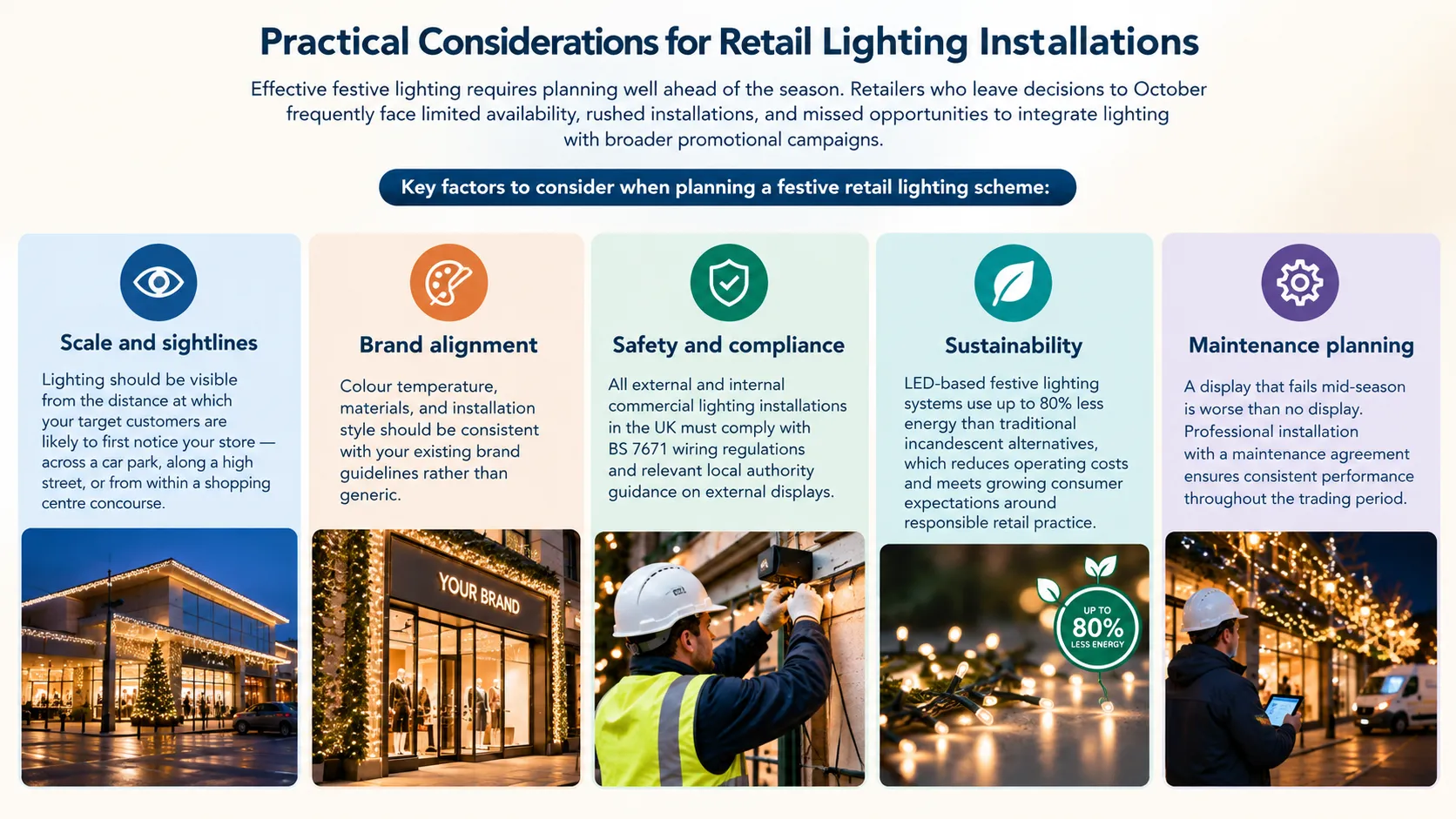
Effective festive lighting requires planning well ahead of the season. Retailers who leave decisions to October frequently face limited availability, rushed installations, and missed opportunities to integrate lighting with broader promotional campaigns.
Key factors to consider when planning a festive retail lighting scheme:
- Scale and sightlines: Lighting should be visible from the distance at which your target customers are likely to first notice your store — across a car park, along a high street, or from within a shopping centre concourse.
- Brand alignment: Colour temperature, materials, and installation style should be consistent with your existing brand guidelines rather than generic.
- Safety and compliance: All external and internal commercial lighting installations in the UK must comply with BS 7671 wiring regulations and relevant local authority guidance on external displays.
- Sustainability: LED-based festive lighting systems use up to 80% less energy than traditional incandescent alternatives, which reduces operating costs and meets growing consumer expectations around responsible retail practice.
- Maintenance planning: A display that fails mid-season is worse than no display. Professional installation with a maintenance agreement ensures consistent performance throughout the trading period.
Customer Engagement Starts Before the Door Opens
The conversation around customer engagement in retail often focuses on in-store experience, loyalty programmes, and staff interaction. But engagement begins at the moment a potential customer becomes aware of your store's presence. Festive lighting is one of the most powerful pre-entry engagement tools available.
An illuminated storefront in a busy retail environment functions like a silent, permanent invitation. It signals warmth, activity, and relevance. For shoppers who are already in a seasonal mindset — and during the Christmas period, most are — that invitation is more persuasive than almost any other form of point-of-sale communication.
Retailers who align their lighting schemes with specific promotional events — a Black Friday window, a Christmas Eve countdown display, a New Year sale announcement — create additional reasons for repeat visits and sustained footfall across the full festive trading window rather than just a single peak day.
Choosing the Right Festive Lighting Partner
The difference between a display that genuinely drives commercial outcomes and one that simply ticks a seasonal box largely comes down to the expertise of the team behind it. Bespoke design, structural safety, installation quality, and post-installation support all affect the final result — and the final result is what shoppers actually see.
For retail businesses across the UK looking to make a meaningful impact this season, S-lite Group delivers professionally designed and installed festive decoration solutions built around the specific commercial objectives of retail environments — from individual shop fronts to large-scale mall installations.
Frequently Asked Questions
Does festive lighting actually increase retail sales?
Yes. According to research carried out by the Lighting Industry Association, adequate lighting can boost retail sales by 12%. For the holiday season, proper seasonal lighting promotes impulse entry, increased dwell time, and average purchase amount due to creation of a stimulating shopping experience.
When should retailers start planning their festive lighting installations?
The retail sector is recommended to start planning holiday lighting projects not later than mid-summer, preferably in either July or August. Proper early planning will guarantee that the customized designs can be provided in time as well as help avoid shortages in September and October.
What types of festive lighting work best for high street shops?
Window lighting, arches at entrances, and interior lit displays are some of the most efficient ways for high street stores. The best method is one which combines the advantage of attracting customers by exterior visibility along with interior lighting to guide customers through their purchase process.
How does festive lighting support brand identity?
Christmas lighting conveys the brand image with its size, color scheme, and quality of design. The benefit for a premium brand is in a unique and cohesive lighting installation, whereas for a family store, warmth and interactivity may be more important.
Are there energy efficiency requirements for commercial festive lighting in the UK?
There are no particular energy efficiency requirements concerning festive lighting, however, all commercial electrical installations should conform to the BS 7671 standards. LED lighting is highly advised – it saves up to 80% energy compared to conventional alternatives and fits into the current trend of sustainable retail practices among customers.
















Sign in to leave a comment.