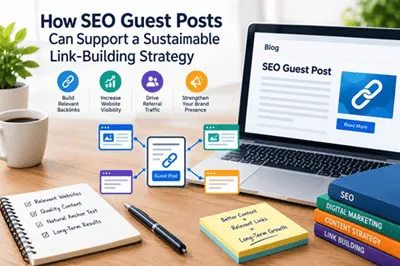

Guest posting remains a useful way for businesses, marketers, and website owners to build online visibility while creating relationships with relevant websites. When approached strategically, publishing useful content on third-party websites can contribute to referral traffic, brand exposure, and a stronger website authority profile.
A successful guest posting strategy starts with relevance. Instead of publishing the same article across multiple unrelated websites, businesses should look for websites whose audience matches their industry. For example, a web development company can contribute articles about website performance, technical SEO, conversion optimization, or digital marketing.
Why Guest Posting Still Matters
Search marketing has become more competitive, and simply publishing content on your own website is often not enough to reach new audiences. Guest contributions provide an opportunity to introduce a brand to readers who may not have discovered it through traditional search.
A well-written guest article can generate several benefits:
- Increased brand visibility
- Referral traffic from relevant websites
- Opportunities to demonstrate industry knowledge
- Relationships with publishers and website owners
- Additional opportunities for natural backlinks
- Greater exposure to potential customers
The quality of the publication is more important than simply collecting a large number of links. A relevant article published on a genuine website can provide considerably more value than content placed on unrelated or low-quality sites.
Choosing the Right Guest Posting Opportunities
Before submitting an article, examine the website carefully. Look at its existing content, audience, publishing frequency, and overall topical relevance.
Businesses searching for publishing opportunities can use platforms and websites where publishers clearly explain their submission requirements. For example, marketers looking to digital marketing submit guest post content can find websites that accept articles related to SEO, digital marketing, technology, web development, and related topics.
The objective should be to contribute something genuinely useful rather than writing an article solely to obtain a backlink.
Create Content People Actually Want to Read
A guest post should stand on its own even if the reader never clicks the author's link. Practical guides, industry insights, case-study-style articles, tutorials, and actionable tips generally provide more value than thin promotional content.
Before submitting an article, consider whether it answers a genuine question or solves a specific problem. Strong headlines, clear formatting, useful examples, and original observations can make the article more valuable to both readers and publishers.
Use Backlinks Naturally
Links should support the context of the article rather than interrupt it. An overly optimized anchor text or repeated commercial keywords can make content feel unnatural.
A better approach is to place a relevant link where readers would reasonably expect additional information. The surrounding paragraph should also make sense without the link.
Guest posting should therefore be viewed as part of a broader digital marketing strategy rather than simply a link-building shortcut.
Build a Sustainable Strategy
Businesses can make guest posting more effective by maintaining a list of relevant publications, developing several content topics, and creating original articles for each website. Tracking referral traffic and engagement can also help determine which publications are actually reaching a useful audience.
Ultimately, guest posting works best when the focus remains on relevance, useful information, and genuine audience value. Backlinks can be a benefit, but the larger opportunity is building visibility and establishing a brand as a useful source of information within its industry.






















Sign in to leave a comment.