

Open six browser tabs. Copy the specifications into a spreadsheet. Discover that two vendors measure the same thing in different units, that a third hides its pricing behind a form, and that the fourth describes a feature in a way nobody on your team understands. Congratulations, you are comparing complex products. This is the work guided selling software for B2B is meant to shorten.
When a buyer can ask a knowledgeable person which option fits their case, or be walked to the right page, the comparison stops being a research project. Here is how it works, where it helps most, and what a team needs to prepare.
Why Comparing Complex Products Takes So Long
Complex products do not compare easily, for reasons that have little to do with the buyer’s effort.
- Specification sheets are written for the people who built the product. They list what exists, not what matters to a particular buyer.
- Vendors use different terms for similar things. One calls it a module, another a tier, a third a package.
- Each stakeholder cares about something different. Finance reads one set of pages, IT reads another, and they rarely compare notes.
- Information does not always agree. Gartner’s 2025 survey found that 69% of B2B buyers noticed discrepancies between what a company’s website says and what its sellers say.
Earlier Gartner research found that buyers spent roughly 15% of the buying journey simply reconciling conflicting information. That is time spent untangling, not deciding.
What Guided Selling Software for B2B Does During a Comparison
In its classic form, guided selling asks a buyer a short series of questions and narrows the options to those that suit. That works well for catalogues with clear rules.
For products with many variables, a conversation does the same job with more flexibility. A good salesperson asks what the buyer is trying to achieve, which constraints are fixed, and which are negotiable. Then they point to the two options worth a closer look and explain the trade-off in plain terms.
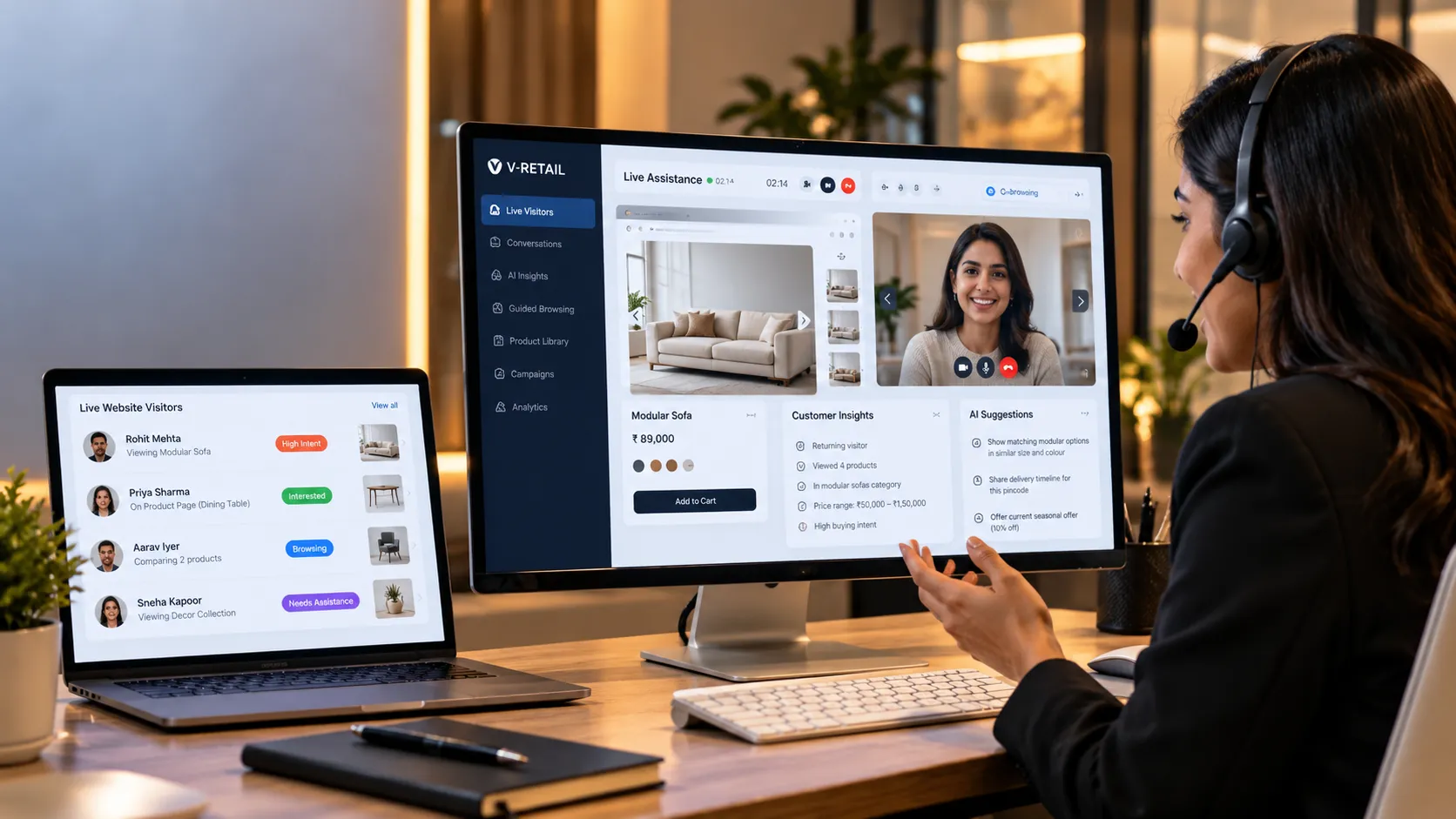
V-Retail brings that conversation to the website. Visitors can connect with a sales representative through live chat, voice or video while they are comparing. Through remote assistance, the rep can guide them to the relevant sections of the site, so the buyer reaches the information that matters to their requirement instead of reading everything.
The shift is small and significant. The buyer stops interpreting alone and starts deciding with help.
Guided Selling for High Tech: Where Comparisons Get Hardest
Technology products are among the hardest to compare. The details change quickly, and the consequences of a poor choice last for years.
Typical sticking points include:
- Compatibility with existing systems and software versions
- Licensing models that scale differently
- Security and compliance requirements that vary by region
- Integration effort, which is rarely obvious from a feature list
- Support terms that sound similar but differ in practice
Guided selling for high tech works best when the person helping can handle these specifics. A rep who knows the product well can say, “Given your current setup, you probably want the second option, and here is why.” That kind of statement is hard to extract from a spec sheet.
Gartner’s March 2026 research adds a useful point. It found that confident buyers are twice as likely to report a high-quality deal as buyers with low decision confidence, and it ties that confidence to value clarity: a clear understanding of how a solution improves results in the buyer’s own role and business. Speeding up a comparison is valuable, but the real prize is a buyer who feels sure.
Human Guidance or AI Guided Selling Software?
Both have a place, and the choice depends on the question being asked.
Automated tools are good at narrowing a large set of options against clear criteria. Some teams use ai guided selling software for that first pass. Gartner’s 2025 survey found that buyers generally prefer to research on their own, but want seller input for tasks needing contextual judgement, such as deciding whether a product fits their company.
That suggests a sensible division of labour:
- Automation handles routine filtering and common questions
- A person handles fit, trade-offs, exceptions and reassurance
- The handoff between the two should be quick and should not make the buyer repeat themselves
V-Retail is positioned around this idea. Technology supports the representative with information, including analysis of conversation and visitor behaviour that produces contextual prompts, while the representative stays in charge of the relationship.
An Illustrative Example
The following is a made-up scenario to show the mechanics, not a customer result.
An operations manager is choosing between two industrial monitoring systems. She has spent three evenings on the vendors’ sites and has a spreadsheet with 40 rows. She is stuck on one question: whether either system works with her existing control software.
On your site, she opens a chat. The rep sees she has looked at both product pages and the integration notes. He asks which control software she uses, answers in two minutes, and walks her to the compatibility page for the system that fits. She now has a shortlist of one, and a reason for it she can show her team.
The comparison that might have run for another fortnight ended in a single conversation.
Preparing for Guided Selling Implementation
The software does not know your products as well as your own people do. Preparation makes the difference.
Build a comparison map before you begin:
- List the five questions buyers ask most. Your reps already know them.
- Match each question to a page. If the answer is hard to find, fix the page.
- Write the honest trade-offs. Where is your product stronger, and where is a competitor a better fit? Buyers respect straight answers.
- Decide when to hand over to a human. Set clear rules for when automated help should give way to a person.
- Train reps on the comparison, not just the product. They should be able to explain your position against the alternatives.
How to Tell Whether Comparisons Are Getting Faster
Choose a few measures and review them monthly:
- Time from first website visit to a meaningful conversation
- Number of conversations needed before a buyer names a preferred option
- Questions that keep coming up, which point to unclear pages
- Share of conversations that end with a clear next step
The conversation analytics in V-Retail identify customer requirements, frequently raised concerns and product interest across interactions, which makes these patterns easier to see.
Help Your Buyers Reach a Decision They Trust
A buyer who has to compare alone will take longer, and may choose someone else. Book a V-Retail demo to see how your team can step in during the comparison and help your buyers reach a confident shortlist sooner.





















Sign in to leave a comment.