

A cartoon preschooler is now part of the product pipeline
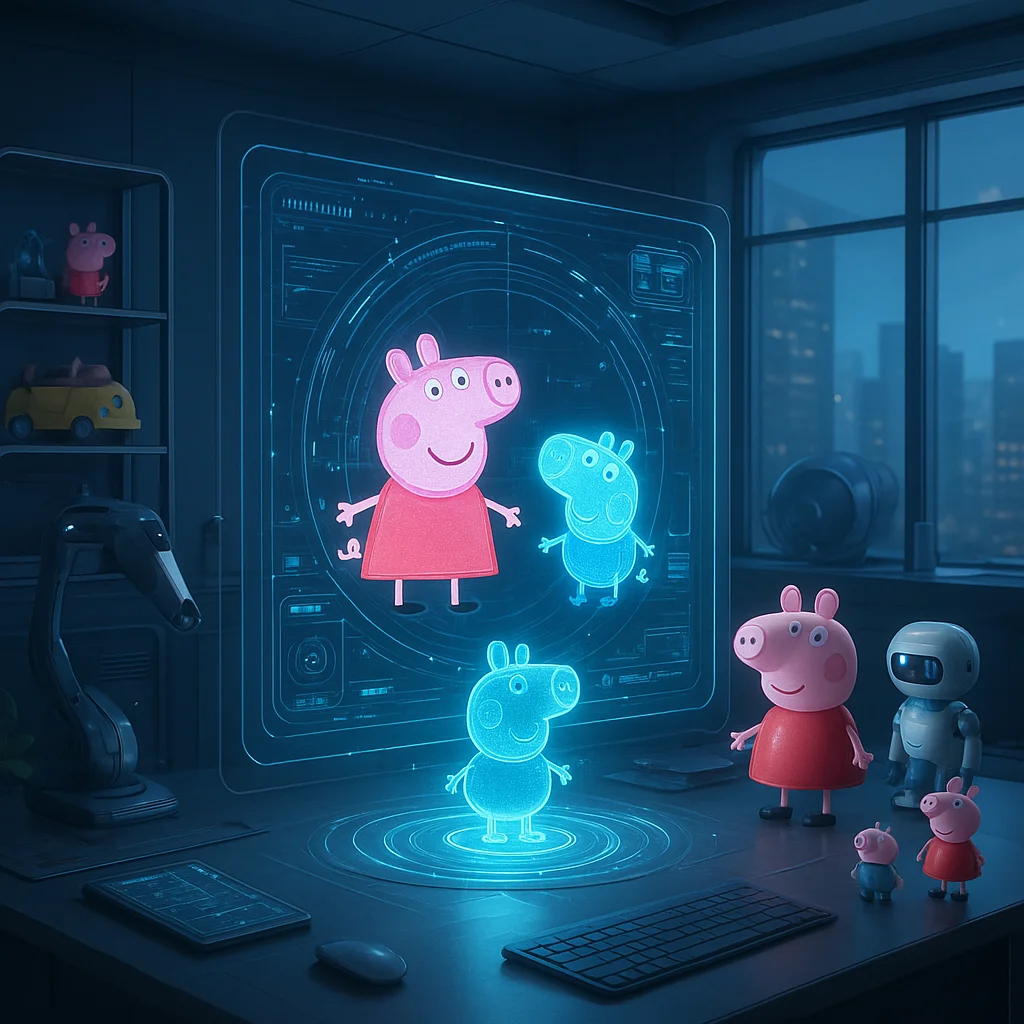
When a chief executive says an AI version of Peppa Pig can help design toys, the remark sounds at first like a publicity line. Yet the idea lands at a very specific moment for the toy business. Hasbro has spent the past few years under pressure to modernize its product engine, simplify operations, and make better use of the intellectual property it owns across preschool, gaming, collectibles, and entertainment. In that context, an AI Peppa Pig is not merely a mascot with a chatbot wrapper. It is a signal that character IP, generative systems, and consumer-product development are beginning to merge inside one workflow.
Peppa Pig matters because the brand is unusually adaptable. It lives in television, YouTube clips, mobile apps, books, apparel, live events, and a wide range of toys for very young children. That gives Hasbro a large archive of visual references, story patterns, dialogue styles, and play behaviors to train or condition internal creative tools around. The result, if managed well, is not a machine replacing toy designers. It is a machine helping teams explore more concepts, test more play patterns, and localize ideas faster.
What makes this story significant for the AI and automation field is the move from generic enterprise AI to character-specific AI. Many companies use copilots for email, coding, or analytics. Far fewer are building branded AI agents anchored to a franchise universe. Hasbro appears to be exploring exactly that possibility: a system where Peppa’s tone, world, and audience knowledge become inputs into ideation. Readers who want a broader overview of this shift can compare it with Hasbro’s CEO Leverages AI Peppa Pig to Redefine Toy Design, which frames the concept as a larger reinvention of toy development rather than a one-off experiment.
The real disruption is not that AI can draw a toy. It is that branded AI can compress the distance between story, character, and shelf-ready product.
That compression has commercial value. It shortens concept cycles, improves franchise consistency, and gives executives a new way to test whether a product feels authentic to the brand before expensive prototyping begins.
Why Hasbro would do this now
To understand why this is happening, one must look at Hasbro’s business arc since its 2019 acquisition of Entertainment One, the deal that brought Peppa Pig and other assets into the company. The purchase gave Hasbro stronger direct access to family entertainment IP, but it also increased expectations that the company could convert screen-based franchises into higher-margin consumer products. Later, Hasbro sold parts of eOne while retaining strategic franchises including Peppa Pig, underscoring that not all entertainment assets were equally central. Peppa stayed important because it is global, preschool-safe, and commercially resilient.
Meanwhile, the toy sector itself has become more data-intensive. Retailers want better forecasting. Parents discover products through social media and streaming ecosystems, not only through store aisles and television ads. Product windows have narrowed, especially for trend-led categories. Add to this the rise of generative AI after 2022, and executives across media and consumer goods began asking a similar question: if machines can summarize fan feedback, generate concept art, cluster preferences, and simulate variants, why should toy design remain a mostly linear process?
Hasbro’s management has also been vocal in recent years about digital transformation, operational discipline, and extracting more value from its brand portfolio. Reuters and company earnings materials have repeatedly shown how major toy groups are balancing cost control with selective innovation. An AI tool built around Peppa Pig fits that logic because it sits at the intersection of efficiency and brand monetization. It can support ideation while also deepening the utility of owned IP.
There is another reason, less visible but very practical. Preschool brands generate enormous amounts of structured and semi-structured feedback. Parents review products. Children respond measurably to characters, colors, sounds, and routines. Educators and child-development specialists assess age appropriateness. This creates an unusually rich signal environment for machine learning systems. A generic AI model may know how to generate a toy concept. A Peppa-tuned model can be nudged toward what a three-to-five-year-old audience actually recognizes and enjoys.
For readers tracking how the company’s experimentation is being discussed in adjacent coverage, How Hasbro’s CEO Uses AI Peppa Pig to Revolutionize Toy Design in 2026 is useful as a companion piece, especially on the operational framing around leadership strategy.
What an AI Peppa Pig likely does inside toy development
The phrase “AI Peppa Pig” can be misleading because it suggests a single magical system. In practice, Hasbro is more likely dealing with a stack of tools and models. One layer would handle language: promptable ideation, character-consistent dialogue, packaging copy drafts, and scenario generation. Another layer would handle image generation and visual variation, producing rough sketches of figurines, playsets, colorways, accessories, or packaging fronts. A third layer could be analytics, clustering consumer feedback and matching proposed concepts to historical sell-through patterns or age-band preferences.
That means the AI is probably less an autonomous designer and more a franchise-aware copilot. It can answer questions such as: what new muddy-puddle play mechanic feels true to Peppa? Which accessory set is more aligned with preschool motor skills? How can a toy concept reflect the show’s humor without becoming too complex or too noisy? Those are not trivial prompts. They connect narrative DNA to manufacturing constraints.
A plausible internal workflow might look like this:
- Step 1: Brand and design teams define guardrails, including character voice, age rating, safety constraints, target cost, and category.
- Step 2: The AI generates multiple concepts, moodboards, and scenario descriptions based on those guardrails.
- Step 3: Human designers shortlist viable ideas, rejecting anything off-brand, unsafe, or operationally unrealistic.
- Step 4: Consumer-insights teams compare concepts against historical purchase data, retailer feedback, and franchise performance.
- Step 5: Physical prototyping, child testing, and compliance review proceed through conventional channels.
Notice what remains stubbornly human: judgment, safety, ergonomics, emotional intuition, and manufacturing trade-offs. Preschool toys must survive drop tests, choking-hazard reviews, battery regulations, and parental scrutiny. No serious toy company would hand final authority to a model. The AI is strongest earlier in the funnel, where speed and breadth matter more than certification.
There is also a localization advantage. Peppa Pig is a global brand, and toy preferences differ by market. Teams in India, the UK, the US, and continental Europe often need slightly different packaging cues, activity assumptions, and price architecture. An AI layer can produce market-sensitive variants faster than a traditional manual process. For a company trying to reduce friction between central brand control and local market execution, that is a meaningful automation gain.
Generative AI creates leverage not by replacing the toy inventor, but by multiplying the number of usable first drafts a team can test before spending real tooling money.
This matters because tooling and inventory mistakes are expensive. A weak concept caught at the prompt stage is far cheaper than a weak concept discovered after molds are cut and retailer commitments are made.
The data case: speed, portfolio breadth, and franchise consistency
Executives like AI for one simple reason: it promises throughput. In toy design, throughput means more ideas examined per quarter, more variants tested against cost targets, and more confidence that a franchise product line hangs together visually and narratively. Hasbro, Mattel, Spin Master, and LEGO all operate in a market where character brands and evergreen play systems must coexist with trend-driven launches. The companies that win are often the ones that can move quickly without diluting brand identity.
Publicly available market data helps explain the attraction. Industry trackers such as Circana have shown that licensed toys continue to be a major force in many markets, especially when entertainment tie-ins remain visible across streaming and digital channels. Statista has also consistently placed the global toy market in the tens of billions of dollars, with strong competition for shelf space and attention. In that environment, a tool that can increase concept velocity even modestly has strategic value.
Consider the operational benefits Hasbro may be seeking:
- Faster concept sprints: what took weeks of sketching and internal review can begin with dozens of AI-assisted concepts in hours.
- Better archive utilization: decades of Peppa scenes, props, catchphrases, and visual motifs can be indexed and reused systematically.
- More disciplined line extensions: AI can flag when a proposed toy drifts too far from known franchise cues.
- Earlier retailer conversations: rough but coherent mockups can be shown internally sooner, improving planning cadence.
- Lower creative dead-end costs: teams can discard weak concepts before they consume engineering and sourcing resources.
Still, the data case is not one-sided. Generative systems can create a false sense of abundance. More concepts do not automatically mean better concepts. In fact, one common failure mode is what product teams call “synthetic sameness” — outputs that look polished but feel derivative. That is especially dangerous in children’s products, where novelty, tactile play, and emotional resonance matter more than surface aesthetics. The cautionary angle is explored neatly in Common Mistakes in Hasbro’s CEO Using AI Peppa Pig for Toy Design in 2026, which highlights how easy it is to confuse speed with insight.
Another limitation is legal and ethical. IP-specific models must be tightly governed. If Hasbro uses external model providers, questions arise about data handling, rights management, and whether outputs might inadvertently echo third-party designs. The company would also need rigorous review to ensure age-appropriate content and to avoid embedding bias in market assumptions. For a preschool franchise, trust is non-negotiable.
What changed recently and why 2026 feels different
The reason this conversation has more weight in 2026 than it would have had two years ago is that enterprise AI has matured from demo culture into workflow integration. In 2023 and 2024, many consumer brands were experimenting with image generators, chatbots, and internal copilots in a fragmented manner. By 2025 and 2026, the emphasis shifted toward domain-specific systems: AI for legal review, AI for customer support, AI for code migration, and now AI for branded product ideation. The novelty is no longer the model itself. The novelty is the organizational embedding.
Hasbro is not alone in exploring AI-adjacent capabilities. Across media, gaming, and retail, companies have been building franchise-aware assistants, synthetic voice pilots, and recommendation engines that understand branded universes rather than generic prompts. Silicon Valley has pushed the model layer, but the more interesting implementation work often happens inside industry-specific teams, including those in Indian IT services, where workflow orchestration and enterprise integration are strong competencies. That matters because a toy company does not need the world’s largest model. It needs a reliable, auditable system connected to design software, asset libraries, compliance checkpoints, and planning tools.
By 2026, three developments have made the AI Peppa concept more plausible:
- Improved multimodal models: text, image, and structured data can now interact more smoothly in one interface.
- Better governance tooling: enterprises have stronger permissioning, audit logs, and brand-safety filters than they did in the first generative AI wave.
- Higher executive tolerance for experimentation: boards increasingly expect AI plans tied to measurable productivity or revenue goals.
Recent corporate discourse also shows a sharper distinction between consumer-facing AI and internal AI. A talking Peppa assistant for families would raise one set of child-safety and privacy issues. An internal Peppa-aligned ideation tool for designers is a different product entirely. The latter is easier to control and easier to justify. That distinction is often lost in headlines, but it is central to understanding what Hasbro’s leadership is likely trying to accomplish.
Another recent shift is retailer discipline. Big-box partners and online marketplaces want clearer evidence that a product line can perform. AI-generated concept families, if used properly, can help sales teams present tighter assortments and more coherent merchandising stories. In a cautious retail climate, coherence can be as important as creativity.
The risks: creativity, safety, labor, and brand dilution
Every automation story in the creative industries eventually runs into the same objection: if a machine helps too much, do the outputs become thinner, safer, and less surprising? That concern is not romantic nostalgia. It is operationally real. Toy design depends on embodied experience: how a child grips an object, how a sound effect feels after the twentieth repetition, how a parent reacts to clutter, how a playset survives rough handling. These are sensory and social judgments that datasets only approximate.
For Hasbro, the first risk is brand flattening. Peppa Pig has a distinct rhythm and emotional simplicity. An AI system trained to be “on-brand” might overfit to familiar motifs and keep producing minor variations on muddy puddles, family cars, and house playsets. That can stabilize franchise identity, but it can also narrow imaginative range. The best toy lines usually add one fresh mechanic or context that children did not know they wanted.
The second risk is safety by assumption. Generative outputs can look plausible while ignoring manufacturing realities. A beautiful concept may include detachable micro-parts, unstable structures, or impossible material combinations. Human review must remain severe and early. No amount of prompt engineering replaces product safety engineering.
The third risk is workforce tension. Designers may worry that AI reduces their role to curation. In practice, the healthier model is augmentation: AI handles combinatorial exploration; humans supply taste, empathy, and physical-world judgment. Companies that communicate this badly create defensive cultures. Companies that communicate it well often discover that designers use AI most effectively when they are trained to critique it, not obey it.
There is also a reputational angle. Parents may accept AI-assisted design if the resulting toys are better, safer, and more engaging. They may react differently if AI becomes a marketing gimmick or if data practices appear opaque. For a children’s brand, trust compounds slowly and breaks quickly.
If Hasbro wants AI to strengthen Peppa Pig, it must treat the model as a disciplined studio tool, not as a substitute for child psychology, industrial design, or parental trust.
That is the key governance principle. AI can accelerate the front end of creativity, but the back end still belongs to people who understand children, materials, compliance, and culture.
What this means for the wider AI and automation sector
The broader significance goes beyond one toy company. If Hasbro can make a franchise-specific AI useful, other consumer brands will follow with their own character, mascot, or universe-based systems. Think of what this means for animation studios, game publishers, education brands, and even sports properties. Their most valuable asset is often not merely content. It is a recognizable world with rules, tone, and recurring symbols. AI becomes more commercially potent when it is grounded in that world.
For AI vendors, this points to a growing market for verticalized creative automation rather than general-purpose chat alone. The winning stack may include asset retrieval, rights management, safety filters, design-software connectors, approval workflows, and analytics dashboards. That is not a single model sale. It is an enterprise platform opportunity. Indian service integrators, already strong in enterprise automation and cloud transformation, are well placed to build these orchestration layers for global brands.
There is a lesson here for smaller firms too. You do not need a Peppa-sized franchise to borrow the pattern. A mid-sized toy maker or children’s publisher can still create an internal AI assistant anchored to its style guides, past products, retailer notes, and compliance rules. The value comes from structured institutional memory. AI is useful when it helps teams remember what worked, what failed, and why.
For readers interested in the practical implementation angle, How to Get Started with Hasbro’s AI-Powered Peppa Pig Toy Design in 2026 offers a process-oriented companion view. The framing is narrower, but it reflects an important truth: the hard part is not generating ideas. The hard part is embedding them into a repeatable operating model.
That operating model will likely define the next phase of automation in creative industries. The winners will not be those with the flashiest demos. They will be those with the cleanest governance, the most usable data pipelines, and the clearest division of labor between machine assistance and human accountability.
What to watch next
Over the next 12 to 18 months, several indicators will reveal whether Hasbro’s AI Peppa approach is substantive or mostly symbolic. First, watch for evidence of shorter product cycles in preschool categories. That could appear in earnings commentary, retailer presentations, or leadership interviews discussing concept throughput and line refresh cadence. Second, look for tighter franchise integration across toys, digital content, and merchandising. If AI is truly working as a connective layer, products should feel more synchronized with story beats and character moments.
Third, monitor whether the company expands the model beyond Peppa Pig. If the architecture proves useful, it could be adapted for other Hasbro-owned or controlled brands where lore, character voice, and fan expectations are central. A preschool franchise is a relatively controlled environment. Older-skewing brands would test the system under more complex creative demands.
Fourth, pay attention to governance disclosures. As regulatory interest in AI transparency grows across markets, large consumer brands may need to explain how internal models are trained, what data is used, and how outputs are reviewed. Even when not legally required, voluntary clarity can become a reputational advantage.
The final takeaway is simple. Hasbro’s CEO talking about an AI Peppa Pig is not just a quirky headline. It is a case study in how automation is moving closer to the heart of brand creation. The toy industry, long seen as tactile and analog, is now absorbing the same AI pressures that transformed software, marketing, and media production. Some experiments will be shallow. A few will become standard practice.
My view is that this one has real strategic logic, provided Hasbro keeps the machine in its proper place. Use AI to expand the option set. Use people to decide what deserves to exist in a child’s hands. That balance, more than any model benchmark, will determine whether AI-designed toys become smarter products or merely faster noise.





























Sign in to leave a comment.