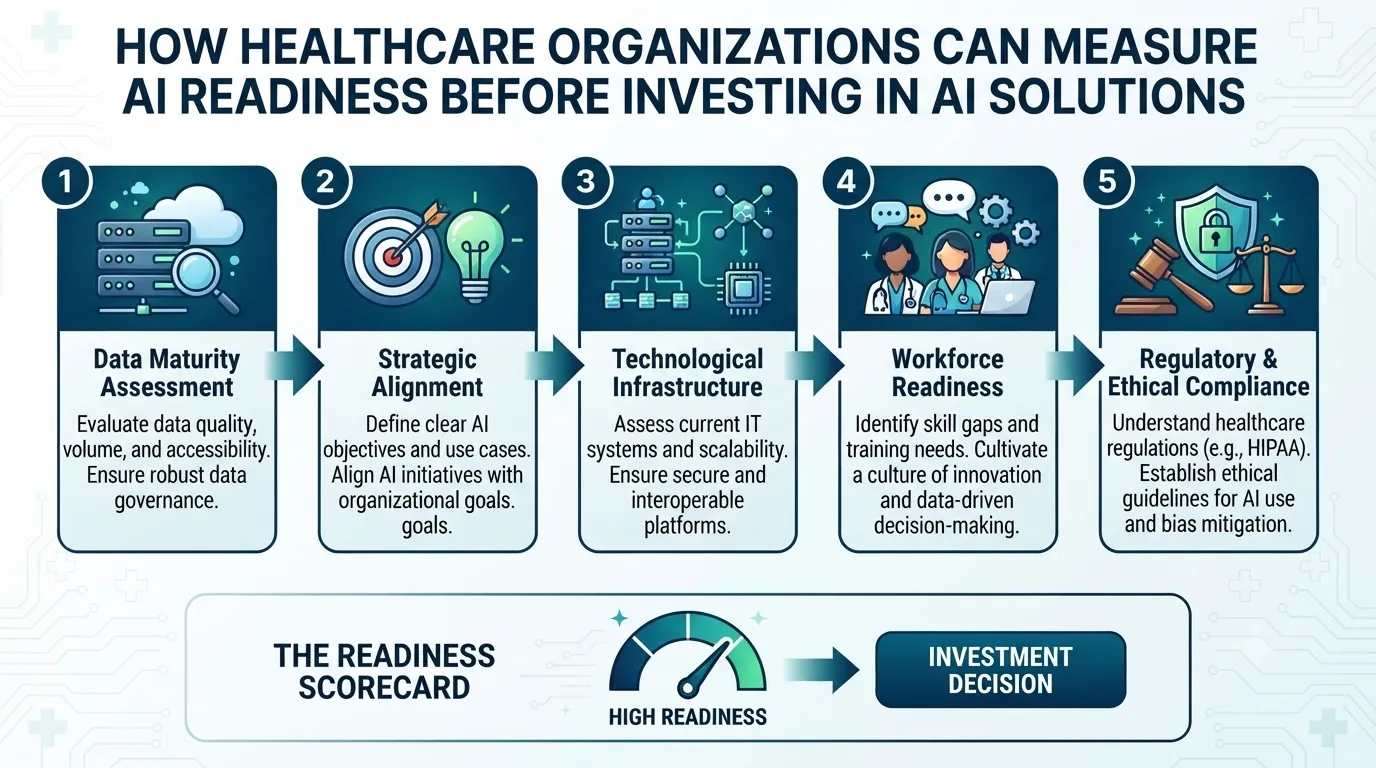

Why Measuring AI Readiness Matters in Healthcare
Artificial intelligence is transforming healthcare by supporting clinical decision-making, automating administrative workflows, improving patient engagement, and enabling more efficient healthcare operations. Hospitals, health systems, and healthcare organizations are increasingly exploring AI solutions to reduce operational costs, improve patient outcomes, and deliver more personalized care.
However, investing in AI technology does not automatically guarantee successful implementation. Many healthcare organizations begin AI projects without evaluating whether their existing infrastructure, data systems, security frameworks, and workforce are prepared to support AI at scale.
This is where AI Readiness in Healthcare becomes essential. AI readiness involves assessing an organization's ability to adopt, integrate, operate, and scale artificial intelligence solutions effectively. It goes beyond purchasing AI software or running a pilot project. Healthcare leaders must evaluate their technical capabilities, data quality, regulatory responsibilities, and organizational requirements before committing significant resources to AI investments.
A structured AI readiness assessment helps healthcare organizations identify implementation gaps, prioritize investments, and establish a practical roadmap for sustainable AI adoption.
What Is AI Readiness in Healthcare?
AI Readiness in Healthcare refers to the level of preparedness an organization has for implementing and scaling artificial intelligence solutions across its clinical, administrative, and operational environments.
It includes several interconnected areas:
- Data readiness: Availability, quality, accessibility, and governance of healthcare data.
- Technology readiness: Infrastructure, software architecture, cloud capabilities, and computing resources.
- Interoperability: Ability to connect AI solutions with EHRs and other healthcare systems.
- Security and compliance: Protection of sensitive patient information and appropriate regulatory controls.
- Clinical and operational readiness: Alignment between AI capabilities and real-world workflows.
- Organizational readiness: Leadership support, employee skills, governance, and change management.
An organization may have advanced software and extensive patient data but still face significant barriers to AI adoption if its systems are disconnected; data quality is inconsistent, or employees lack the necessary training.
Therefore, healthcare leaders should measure AI readiness across multiple dimensions instead of relying on a single technology assessment.
1. Evaluate the Quality and Accessibility of Healthcare Data
Healthcare data is the foundation of most AI applications. Clinical records, diagnostic information, medical images, laboratory results, insurance information, and patient engagement data can support AI-driven insights and automation.
However, the availability of data does not necessarily mean that it is ready for AI implementation.
Healthcare organizations should assess whether their data is accurate, complete, consistent, accessible, and appropriately governed. Inconsistent data formats, duplicate patient records, missing information, and fragmented systems can reduce the effectiveness of AI applications.
Key Questions for Data Readiness
Healthcare leaders should evaluate:
- Is patient data stored across multiple disconnected systems?
- Are clinical records complete and consistently structured?
- Can authorized teams access the data required for specific AI use cases?
- Are data quality checks and governance processes in place?
- Can historical data be used appropriately for AI development and evaluation?
For example, a hospital planning to implement an AI-based clinical documentation solution may need to assess the quality of its existing EHR records, clinical terminology, and documentation workflows.
The objective is to determine whether the organization's data environment can support the intended AI application.
Improving data quality and establishing suitable data governance processes should be considered before scaling AI investments.
2. Assess Existing IT Infrastructure and Technical Capabilities
AI solutions require an appropriate technical environment for development, integration, deployment, and monitoring. Healthcare organizations should evaluate their existing infrastructure before selecting an AI platform or commissioning custom AI software.
The assessment should include application architecture, cloud or on-premises infrastructure, storage, computing capacity, networking, and system performance.
The infrastructure requirements will vary depending on the AI application. A conversational assistant for administrative support may have different technical requirements from a medical imaging model or a real-time clinical decision support system.
Infrastructure Assessment Checklist
Healthcare organizations can examine:
- Existing application architecture and system dependencies.
- Cloud infrastructure and scalability requirements.
- Data storage and processing capabilities.
- API availability for software integration.
- System reliability and performance monitoring.
- Backup, recovery, and business continuity processes.
Organizations should also consider the operational costs of running AI solutions, including infrastructure, software licensing, integration, maintenance, and monitoring.
A clear understanding of existing technical capabilities helps healthcare decision-makers identify which infrastructure improvements are necessary before deployment.
3. Measure EHR Integration and Interoperability Readiness
Healthcare AI solutions rarely operate independently. Many applications must exchange information with electronic health records, laboratory systems, patient portals, hospital information systems, and other clinical platforms.
This makes interoperability an important component of AI Readiness in Healthcare.
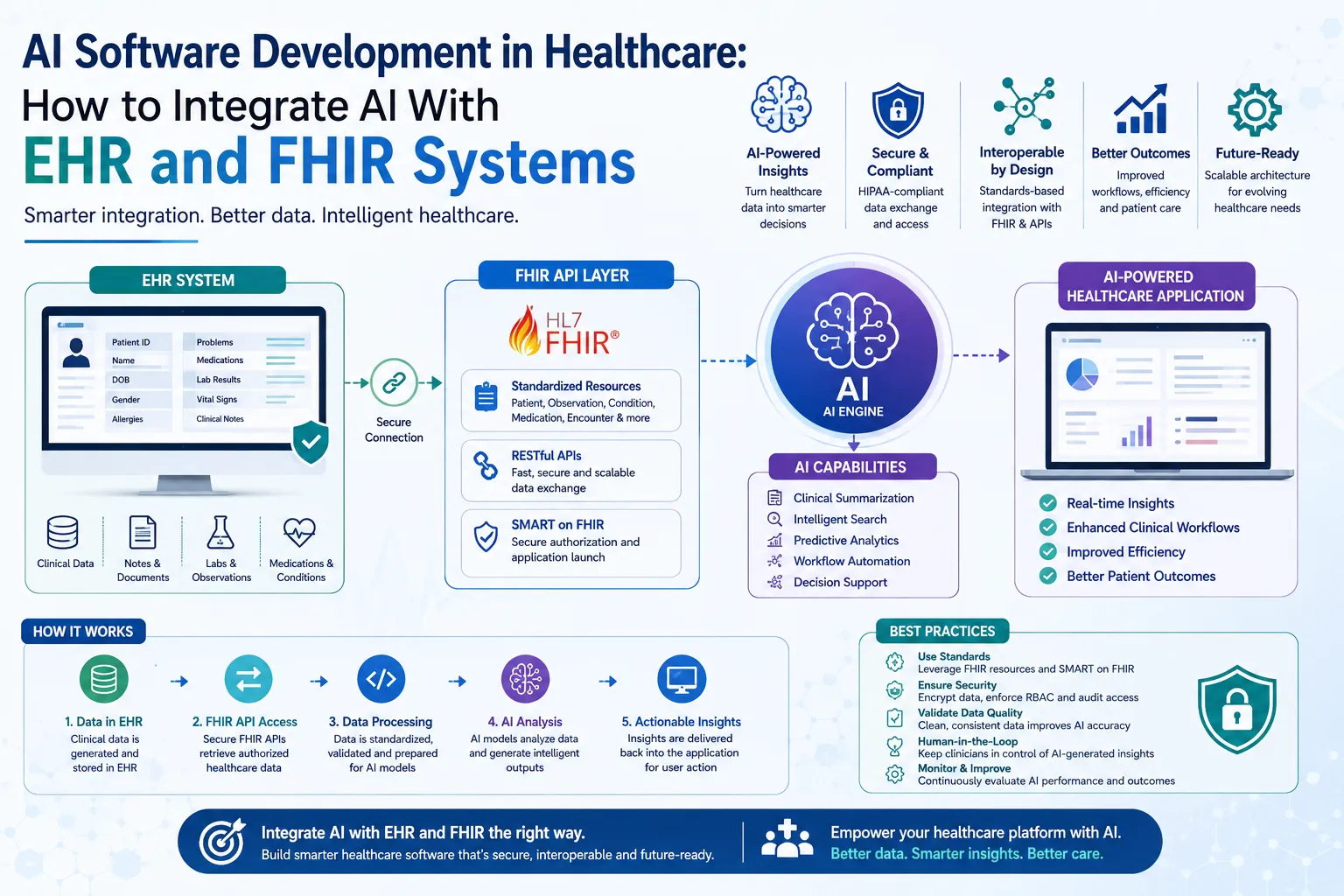
Healthcare organizations should determine whether their existing systems can exchange data with the proposed AI solution through secure and reliable integration mechanisms.
Standards such as HL7 and FHIR can support healthcare data exchange, depending on the systems and use cases involved. However, adopting an interoperability standard alone does not guarantee seamless integration. Organizations must also evaluate implementation details, data mapping, authorization, workflow compatibility, and vendor-specific requirements.
Questions to Evaluate Interoperability
- Does the existing EHR provide suitable APIs?
- Can the AI solution access the required clinical information?
- Is data mapping required between different systems?
- How will information be returned to the clinical workflow?
- Are integration permissions and security controls properly configured?
For example, an AI-powered patient engagement platform may need to retrieve relevant patient information and send appropriate updates to the healthcare organization's existing systems.
A comprehensive interoperability assessment helps reduce integration risks and supports more efficient AI deployment.
4. Review Security, Privacy, and Compliance Requirements
Healthcare organizations manage highly sensitive information, making security and privacy essential considerations in AI investment decisions.
Before implementing an AI solution, organizations should assess how patient information will be collected, processed, stored, transferred, and accessed. The specific legal and regulatory requirements depend on the organization's location, services, data flows, and applicable laws.
For organizations operating in the United States, HIPAA requirements may be relevant when protected health information is involved. Other jurisdictions may have additional privacy and healthcare regulations.
Important Security Considerations
Healthcare leaders should review:
- Data encryption and access controls.
- Identity and authentication management.
- Audit logging and monitoring.
- Third-party vendor security practices.
- Data retention and deletion requirements.
- Appropriate contractual and regulatory safeguards.
- AI model governance and risk management.
Organizations should also establish clear rules regarding the use of patient data in AI development, testing, and production environments.
Security should not be treated as a final deployment activity. It needs to be incorporated into the AI implementation lifecycle from the planning stage.
5. Assess Clinical Workflow and Operational Readiness
An AI solution may perform well in a technical demonstration but still fail to deliver value if it does not align with healthcare workflows.
Clinical teams, administrative staff, and healthcare professionals need to understand how AI will affect their daily responsibilities. Organizations should evaluate whether the proposed solution addresses a clearly defined problem and whether its outputs can be incorporated into existing processes.
For instance, an AI documentation tool may reduce manual administrative work, but its usefulness depends on how easily healthcare professionals can review, correct, and incorporate generated information into their documentation processes.
Workflow Readiness Questions
Healthcare organizations should ask:
- Which workflow problem is the AI solution expected to address?
- Who will use the system?
- How will AI outputs be reviewed and validated?
- What happens when the system produces an incorrect or incomplete result?
- Will AI introduce additional steps for healthcare professionals?
- How will the organization measure operational improvements?
Clinical validation and appropriate human oversight are particularly important when AI outputs could influence patient care.
A workflow-focused assessment helps organizations evaluate practical usability rather than focusing exclusively on model performance.
6. Evaluate AI Governance and Risk Management
AI governance establishes the policies, responsibilities, and oversight mechanisms required to manage AI solutions throughout their lifecycle.
Healthcare organizations should develop governance processes that address the intended use of AI, risk assessment, performance monitoring, accountability, and ongoing evaluation.
The governance requirements will differ according to the AI system's intended purpose and potential impact. A scheduling assistant and a clinical decision support application should not necessarily be evaluated using identical risk controls.
Components of AI Governance
A healthcare AI governance framework may include:
- Defined ownership and accountability.
- AI use-case approval processes.
- Risk classification and assessment.
- Model validation and performance evaluation.
- Monitoring for unexpected behavior or performance changes.
- Data privacy and security oversight.
- Human review and escalation procedures.
Organizations should establish measurable governance responsibilities before AI solutions are deployed at scale.
Effective governance helps healthcare leaders understand how AI systems will be managed, evaluated, and improved over time.
7. Measure Workforce Skills and Organizational Readiness
Successful AI adoption requires more than technology. Healthcare organizations must also consider whether employees have the skills, training, and support required to use AI solutions effectively.
Different teams may need different capabilities. IT professionals may focus on integration and infrastructure, while clinical teams may require training on appropriate system use, limitations, and review procedures.
Leadership support is equally important because AI implementation can involve changes to existing processes, responsibilities, and performance measurement.
Organizational Readiness Assessment
Healthcare organizations can evaluate:
- Leadership alignment with AI objectives.
- Availability of technical and clinical expertise.
- Employee training requirements.
- Change management processes.
- Communication and feedback mechanisms.
- Internal ownership of AI implementation.
For example, an organization introducing an AI-powered patient communication solution should ensure that relevant employees understand the system's purpose, limitations, and escalation procedures.
Training and change management should be planned alongside technical implementation rather than added only after deployment.
8. Establish Clear AI Use Cases and Business Objectives
Healthcare organizations should identify specific business or clinical objectives before investing in AI solutions.
A broad goal such as "implement AI across the hospital" does not provide sufficient direction for evaluating technology, costs, or outcomes.
Instead, healthcare leaders should define measurable use cases that address existing operational or clinical challenges.
Examples of AI Use Cases
| Use Case | Potential Objective |
| AI medical coding | Support coding workflows and reduce manual effort |
| Patient engagement AI | Improve communication and access to relevant information |
| Clinical documentation AI | Support documentation efficiency |
| Predictive analytics | Identify patterns to support operational planning |
| Healthcare chatbots | Assist with routine patient inquiries |
| AI interoperability | Improve information exchange between connected systems |
The actual benefits, risks, and implementation requirements depend on the selected technology and its deployment context.
Organizations should assess each use case based on expected value, feasibility, integration complexity, and risk.
9. Create an AI Readiness Scoring Framework
A structured scoring framework can help healthcare leaders compare readiness across different organizational dimensions.
However, an AI readiness score should be treated as an internal assessment tool rather than a universal industry benchmark. Organizations should define their own evaluation criteria based on their use cases, risk profile, and strategic objectives.
Example AI Readiness Assessment
| Assessment Area | Key Evaluation Criteria |
| Business Alignment | Defined objectives and measurable outcomes |
| Data Readiness | Quality, accessibility, governance |
| Governance | Oversight, risk management, monitoring |
| Infrastructure | Scalability, performance, reliability |
| Interoperability | APIs, EHR integration, data exchange |
| Security | Access controls, encryption, privacy |
| Workforce | Training, expertise, change management |
Organizations can assign internal maturity levels such as:
- Initial: Significant gaps require attention.
- Developing: Some capabilities exist, but improvements are needed.
- Established: Core capabilities are available for the selected use case.
- Scale-Ready: The organization has evaluated key requirements for broader implementation.
These categories should be supported by documented evidence rather than subjective assumptions.
The assessment results can then be used to create a prioritized AI implementation roadmap.
10. Develop a Practical AI Implementation Roadmap
Measuring AI readiness is only the first step. Healthcare organizations must use the assessment findings to determine what should happen next.
A practical roadmap should identify readiness gaps, required investments, responsible teams, implementation milestones, and evaluation criteria.
For example, an organization may discover that its infrastructure is adequate for a limited pilot but that its data integration capabilities need improvement before enterprise-wide deployment.
The roadmap can be organized into several stages:
Stage 1: Readiness Assessment
Evaluate data, infrastructure, security, interoperability, governance, and workforce capabilities.
Stage 2: Use-Case Prioritization
Identify AI applications based on organizational objectives, feasibility, and risk.
Stage 3: Pilot Planning
Define the scope, evaluation criteria, workflow requirements, and safeguards for a controlled implementation.
Stage 4: Validation and Evaluation
Assess system performance, usability, security, and operational outcomes using appropriate measures.
Stage 5: Production Readiness
Review integration, monitoring, support, governance, and operational requirements before scaling.
This phased approach allows healthcare organizations to address critical gaps before committing to broader AI deployment.
Conclusion: Build Readiness Before Scaling AI Investments
AI Readiness in Healthcare is a strategic and technical assessment that helps organizations understand whether they can implement AI solutions responsibly and effectively.
Healthcare leaders should evaluate data quality, infrastructure, interoperability, security, governance, workforce capabilities, and business objectives before investing in AI technology.
A successful AI implementation requires more than selecting an advanced platform. It depends on the organization's ability to integrate the solution into existing systems, support users, monitor performance, and manage evolving requirements.
By conducting a structured AI readiness assessment, healthcare organizations can identify implementation gaps, prioritize investments, and develop a practical roadmap for AI adoption.
Build Your AI-Ready Healthcare Future with Emorphis Health
Preparing your healthcare organization for AI adoption requires the right combination of software architecture, data integration, interoperability, and technical expertise.
Emorphis Health helps businesses explore custom healthcare software development, and AI integration solutions aligned with their operational and technology requirements.
Explore Healthcare Software Development Solutions and discover how your organization can prepare for the next stage of digital healthcare innovation.



























Sign in to leave a comment.