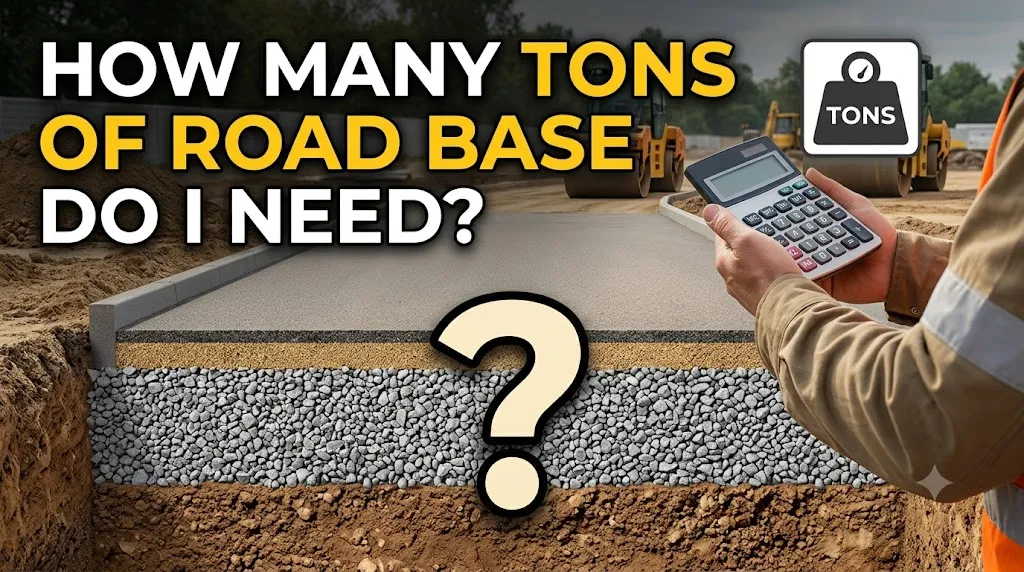

So, you have a driveway, walkway, parking area, or some other project coming up. You know you need road base material in California, but then comes the annoying question... how much should we actually order?
Order too little and you may have to stop the job halfway through. Order way too much and now you have a pile of leftover material sitting around. Nobody wants either one.
The good news is that figuring it out is not as hard as it sounds. We just need a few basic measurements and a little bit of planning.
Start With the Area You Need to Cover
First, grab the length and width of the area.
For a simple rectangular space, multiply:
Length × Width = Area
Let us say we are working on a driveway that is 30 feet long and 12 feet wide.
30 × 12 = 360 square feet
Easy enough.
If the area has an odd shape, split it into smaller rectangles or squares, work out each section, and add them together. It does not have to be perfect down to the last inch.
Now Think About the Depth
This is where things get interesting.
A road base layer might be fairly shallow for one project and much deeper for another. A light walkway does not have the same needs as a driveway that will see cars and trucks.
Measure the depth you plan to install. Keep in mind that the material will be compacted, so the loose pile you receive will not stay at exactly the same volume once it is placed and packed down.
For example, suppose our 360-square-foot driveway needs a 4-inch base.
Four inches is one-third of a foot.
So:
360 × 0.33 = about 119 cubic feet
That gives us an estimated volume of material needed before converting it to tons.
Cubic Feet Are Not Tons
Here is where many people get stuck.
You have your measurements in square feet and cubic feet, but the supplier may sell the material by the ton. So we need to convert the volume into an estimated weight.
The exact number of tons can vary because road base is not always the same. Material type, moisture, compaction, and the actual mix of aggregate can all affect the weight.
That is why a simple online calculator can give you a useful starting point, but it should not be treated as the final order amount.
If you are unsure, give the supplier your length, width, and planned depth. It is much easier to get a practical estimate that way.
Do Not Forget Extra Material
This little detail can save a lot of frustration.
Your measurements might say you need a certain amount, but real jobs rarely go exactly according to the sketch. The ground may have a low spot. Some material may spread farther than expected. You may need a little more depth in one section.
Adding a small amount extra can help cover those surprises.
We would rather have a little material left than run short when the crew is ready to compact the base.
What About Irregular Areas?
Not every project is a neat rectangle.
Maybe the driveway curves around the house. Maybe you are preparing a large area with several sections. No problem.
Break the project into smaller shapes and measure each one separately. Add the areas together, then use the planned depth to work out the total volume.
And if the measurements are making your head spin... take a step back. A rough sketch on paper can actually make this much easier.
Getting the Right Amount for Your Project
The amount of road base you need depends on more than the size of the area. The intended use matters too.
A path for foot traffic may need a different base than a driveway or parking area. Soil conditions can also change how much preparation is needed.
Before ordering, have these numbers ready:
- Length of the area
- Width of the area
- Planned base depth
- Type of project
- Any areas with unusual ground conditions
With those details, a supplier can help you work out a more useful estimate.
When you are ordering road base material in California, it also helps to talk through delivery needs at the same time. Knowing how much material you need is only half the job... you also need to know where and when it should arrive.
Frequently Asked Questions
1. How do I calculate road base for a driveway?
Measure the driveway's length and width, calculate the area, then multiply it by the planned base depth. Convert the resulting volume into an estimated tonnage.
2. How deep should road base be?
The right depth depends on the project, traffic, soil, and finished surface. A driveway and a simple walkway may not need the same base thickness.
3. Should I order extra road base?
A small amount of extra material can be helpful because actual site conditions may differ from your measurements. Ask your supplier how much allowance makes sense for your project.
4. Can I calculate road base for an irregular area?
Yes. Divide the area into smaller sections, calculate each section separately, and add the measurements together.




























Sign in to leave a comment.