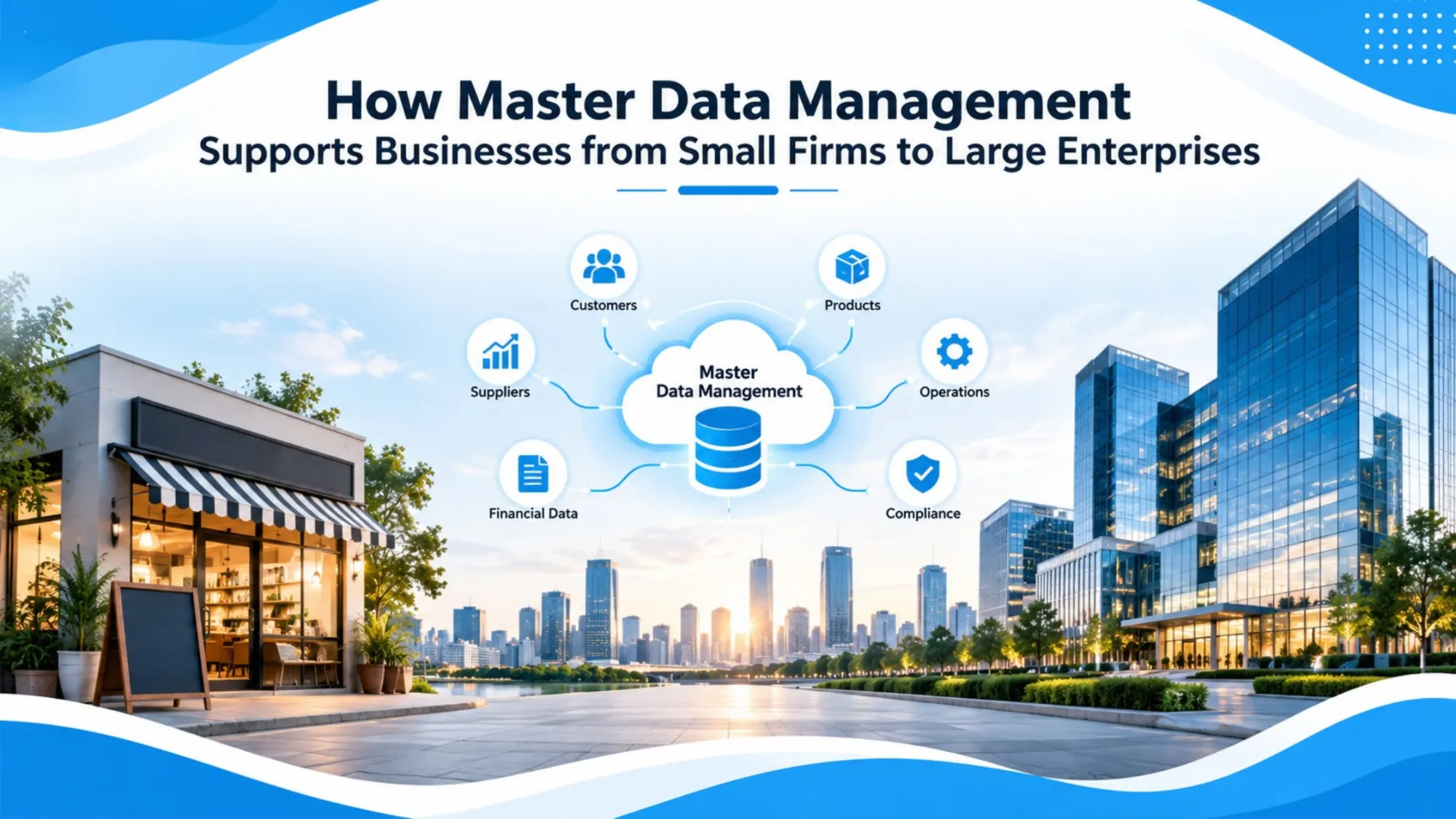

A growing business can quickly lose control of its data. Customer details may differ between systems, product records can be duplicated, and employees may spend hours correcting information that should have been accurate from the start. The problem becomes harder to manage as a company adds applications, customers, departments, and locations.
Master Data Management for businesses provides a structured way to keep key records consistent across systems. With data management outsourcing solutions support, companies can also manage larger data volumes without putting the entire workload on internal teams.
What Is Master Data Management, and Why Does It Matter for Businesses?
Master Data Management, or MDM, is a structured way to manage the core information a business relies on every day. This can include customer, employee, product, supplier, and location records.
Without a clear approach, each department or application may maintain its own version of the same information. MDM establishes common rules for identifying, updating, validating, and sharing important records across systems.
For example, a customer should not have different addresses in the sales, billing, and customer service systems.
When employees can trust the records in front of them, they spend less time checking and correcting routine tasks. MDM is therefore useful at different stages of business growth, not only in large enterprises.
How Data Challenges Change as Businesses Grow
Data problems usually start small. A small business may rely on spreadsheets and a handful of applications. Things get more complicated as a company adds departments and applications. Sales, accounting, inventory, marketing, and customer service may each use separate systems. If those systems do not follow the same data standards, teams can end up working with conflicting information.
For example, a growing retailer may store customer details in its CRM, billing system, and ecommerce platform. If each system uses a different format, employees may struggle to determine which information is current.
Thousands or millions of records may be spread across departments, locations, databases, and applications. Strong data quality management becomes necessary to maintain data consistency across systems.
How MDM Creates a Single, Consistent View of Business Data
MDM brings information from different sources into a consistent structure. It can identify duplicate records, standardize formats, validate information, and establish trusted master records while supporting consistent rules for how those records are maintained.
Imagine two departments have entered the same customer under slightly different names. Instead of treating them as separate customers, an MDM process can identify the match and consolidate the records.
Employees can then work from the same customer, product, or supplier information instead of checking several systems.
They spend less time checking different systems to find the right record, while departments can work from the same information.
The goal is a master record that different applications can use without creating another version of the same customer or product.
What MDM Looks Like for a Small Business
Small businesses may not have complex data environments, but good data practices are still important. Establishing basic MDM practices early can prevent data problems from becoming more expensive and time-consuming as the company grows.
A business can set consistent formats for customer names, addresses, product codes, supplier details, and other important records. A small distributor could begin by standardizing customer names, addresses, supplier records, and product codes across its CRM and accounting system.
Cleaner records also make routine reporting easier because employees spend less time checking and correcting information before using it.
For a smaller company, MDM does not need to be a large technology project. A focused approach to data quality management can improve operational data efficiency while creating a solid foundation for future expansion.
How MDM Helps Growing Companies Scale Without Creating Data Silos
As a company adds customers, locations, products, and software, keeping the same information aligned across systems becomes harder.
A business might begin with one CRM and an accounting system. Later, it may add an ecommerce platform, a second sales application, or systems for new locations. If each system handles customer and product information differently, keeping records aligned becomes increasingly difficult.
Scalable data management addresses this problem by establishing common rules for creating, updating, and maintaining key records. New applications can follow those standards rather than creating their own versions of business information.
Shared standards also make cross-department work easier. Sales may rely on customer records maintained by another team, while finance may need accurate product and supplier information to complete its work.
When growth creates a temporary need for additional resources, outsourced data management services can also help businesses handle larger data volumes without placing the entire workload on internal employees.
Why Large Enterprises Need Strong Data Governance and Control
Large enterprises need more than accurate records. They need clear ownership and rules for how important information is created, changed, reviewed, and corrected.
This is where enterprise data governance becomes important. Governance establishes responsibilities and standards across departments and systems. It can determine who owns particular data, who can update it, what validation rules should be followed, and how data quality issues should be handled.
For example, an enterprise may have multiple teams working with customer or product information. Without clear ownership, errors may remain unresolved because no one knows which team is responsible for correcting them.
MDM provides a practical foundation for these governance practices. It helps organizations apply agreed standards to core records while maintaining accountability across a complex data environment.
How Accurate Master Data Improves Efficiency and Decisions
Accurate master data has a practical effect on day-to-day work. When employees can trust the information in their systems, they spend less time searching for records, checking conflicting details, or correcting avoidable errors.
Accurate master data can also support smoother workflows. Automated processes are more dependable when the information they use is complete and consistent.
Reporting creates another reason to maintain reliable master data. Reports built from duplicate, outdated, or conflicting records may give decision makers an inaccurate view of sales, customers, inventory, or other business activities.
Reliable master data also gives reporting and analytics teams cleaner information to work with. Instead of questioning the quality of the underlying information, decision makers can spend more time using it to understand performance and plan their next steps.
Where Data Management Outsourcing Fits Into an MDM Strategy
Not every business has enough internal resources to manage large volumes of data. Data management outsourcing can provide additional support without replacing the company's overall MDM strategy.
External teams can help with data cleansing, validation, standardization, migration, record maintenance, and high-volume data processing. This support can be useful during system migrations, database consolidation, acquisitions, or periods of rapid growth.
For example, a company moving information from several older systems into one platform may need significant data cleansing and standardization before the migration. An external team can handle much of this work while internal employees remain responsible for business rules, priorities, and data ownership.
In this way, outsourced data management for business growth can strengthen an MDM program by adding extra capacity and improving internal teams' capabilities.
Building an MDM Approach That Evolves With Business Growth
MDM does not have to be implemented all at once. A business can develop its approach as its data needs become more complex.
Start by identifying the most important information, such as customers, products, suppliers, or locations. Next, establish clear standards for creating and maintaining those records. Existing information can then be cleaned, duplicates can be consolidated, and ownership can be assigned.
Once the business adds more applications, those systems should follow the same data rules. Regular data quality checks can help identify problems before they affect other departments.
Enterprise data governance can become more detailed as the organization adds locations, systems, and business processes. This gradual approach supports scalable data management without unnecessarily complicating MDM from the start.
From Better Data to a More Scalable Business
Reliable master data becomes more important as a business grows. Small firms can use MDM to establish consistent records early, growing companies can use it to keep expanding systems aligned, and enterprises can use it to strengthen governance and data ownership.
The goal is more than keeping databases clean. Consistent master data helps employees work with fewer interruptions, supports dependable reporting, and gives decision-makers greater confidence in the information behind their decisions.
Whether managed internally or supported by data management outsourcing solutions, a well-planned MDM approach gives businesses a stronger foundation for growth without making their data environment unnecessarily difficult to manage.



















Sign in to leave a comment.