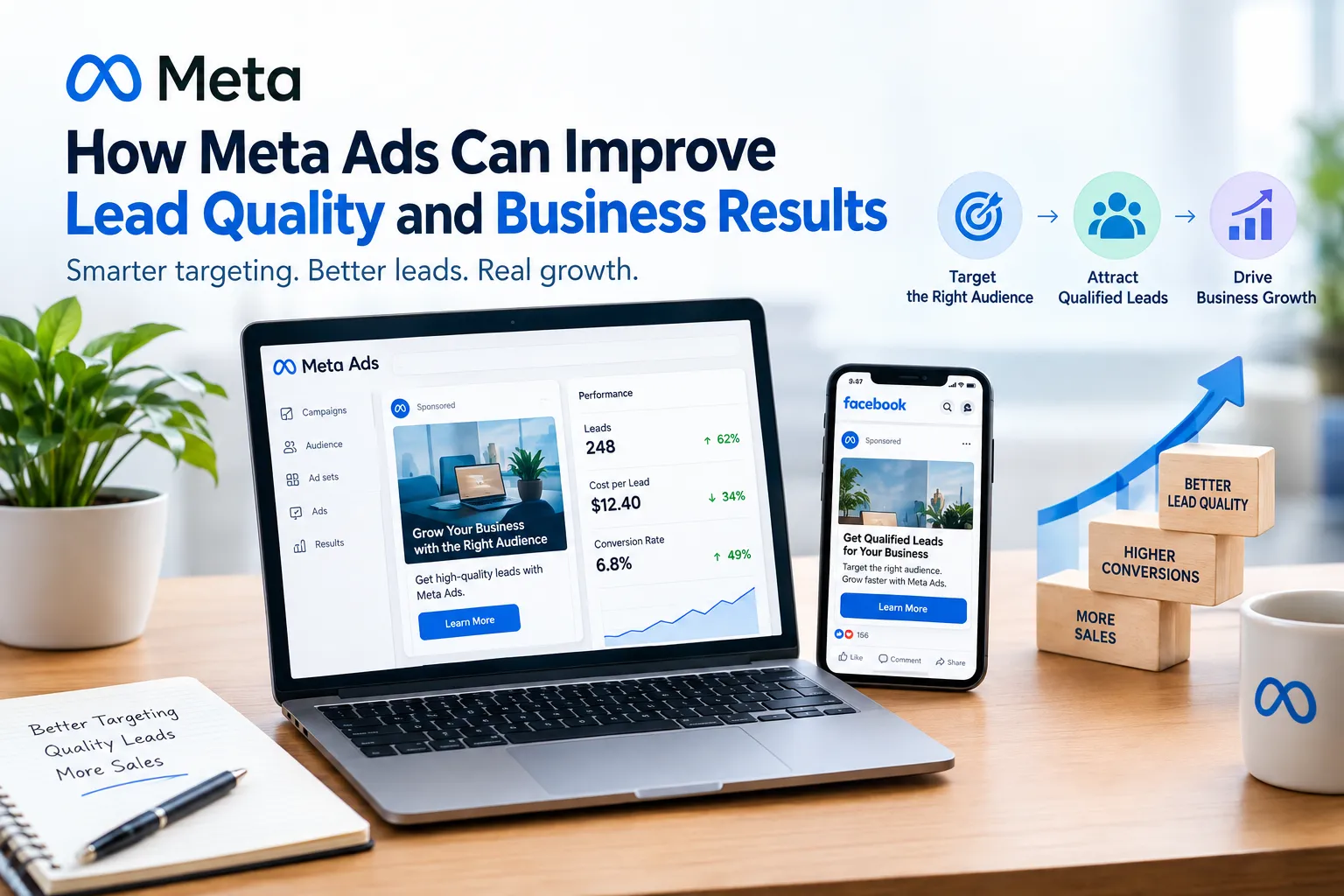

Generating a large number of leads is no longer enough for businesses competing online. A campaign may produce hundreds of form submissions, but if most prospects are unqualified, the sales team still has little to show for the advertising investment. This is why businesses are increasingly focusing on paid social lead quality rather than simply measuring lead volume.
Meta Ads, which include advertising across Facebook and Instagram, provide businesses with powerful targeting, creative, audience, and optimization capabilities. When these features are used strategically, Meta Ads lead generation can attract prospects who are more likely to need, afford, and act on a company’s products or services.
For businesses looking to improve marketing efficiency, the goal is not just to generate more leads. It is to create a system that consistently brings the right people into the sales pipeline.
1. Why Lead Quality Matters More Than Lead Volume
A lead becomes valuable when there is a realistic opportunity to convert that person into a customer. Someone who submits a form accidentally or has no interest in purchasing may technically count as a lead, but they do not contribute much to business growth.
Poor-quality leads can create several problems. Sales teams spend time contacting people who are unlikely to buy, follow-up costs increase, and marketing reports may give the impression that campaigns are performing better than they actually are.
Quality-focused advertising takes a different approach. Instead of asking, “How many leads did we generate?” businesses should also ask:
Are these leads relevant to our offer? Do they meet our customer requirements? Are they responding to follow-up? Are they moving toward a sales conversation?
This shift makes Facebook advertising for quality leads more focused on actual business outcomes rather than surface-level metrics.
2. Use Meta's Targeting to Reach the Right Audience
One of the major strengths of Meta advertising is its ability to reach specific audience segments. Businesses can build campaigns around factors such as demographics, interests, behaviors, geographic areas, customer data, and engagement patterns.
However, precise targeting does not automatically guarantee high-quality leads. The audience strategy must be connected to the company's ideal customer profile.
For example, a local service company should consider where its customers are located, what type of service they need, and which characteristics indicate genuine purchase intent. A B2B company may need to focus on professional roles, business interests, or specific customer segments.
Businesses can also use existing customer information to develop audiences and create lookalike-style targeting strategies where available. This can help Meta identify people who share characteristics with existing customers.
The important principle is simple: better audience inputs can create better advertising signals.
3. Create Ads That Pre-Qualify Prospects
Ad creative does more than attract attention. It can also help determine who clicks and who decides to engage.
If an advertisement makes an offer extremely broad or vague, it may attract a large number of people who are curious but not genuinely interested. More specific messaging can reduce irrelevant responses.
For example, instead of saying:
“Need marketing help? Contact us today.”
A business could communicate something more specific:
“Looking to increase qualified local leads through SEO and paid advertising?”
The second message gives users a clearer understanding of the service and intended audience.
This is an important part of Facebook advertising for quality leads because the advertisement itself becomes a basic qualification mechanism. Prospects who recognize their problem and understand the offer are more likely to take meaningful action.
Landing pages should continue this message. The headline, offer, benefits, proof, and call to action should align closely with what the advertisement promised.
4. Optimize Meta Ads for Meaningful Conversions
Choosing the right campaign objective and optimization strategy can have a significant impact on Meta Ads lead generation.
Businesses sometimes optimize campaigns purely for inexpensive conversions. While low cost per lead can look attractive, cheaper leads are not necessarily better leads.
Suppose Campaign A generates 200 leads at a low cost, but only five become serious opportunities. Campaign B generates 80 leads at a higher cost, but 20 become qualified sales opportunities. Looking only at cost per lead could make Campaign A appear stronger.
This is why businesses should evaluate deeper metrics such as qualified lead rate, appointment rate, opportunity rate, customer acquisition cost, and revenue generated.
When enough reliable data is available, connecting lead outcomes back to advertising activity can help improve campaign optimization. Instead of teaching the system to find people who simply submit forms, businesses can work toward identifying audiences that are more closely associated with valuable outcomes.
5. Improve Paid Social Lead Quality With Better Follow-Up
Advertising performance does not stop when someone submits a form. The follow-up process can have a major influence on whether a lead becomes a customer.
A strong campaign should have a clear process for contacting new prospects quickly and consistently. Depending on the business, this could include automated emails, CRM workflows, phone calls, appointment scheduling, or personalized sales outreach.
Lead forms can also include qualifying questions. Businesses should avoid asking unnecessary questions, but a few relevant fields can help distinguish between casual interest and genuine buying intent.
For example, a service business might ask about the type of service required, project timeframe, location, or approximate budget. These questions provide useful information for sales teams and can improve paid social lead quality.
The key is to create a balance. Too few questions may produce unqualified leads, while too many questions can reduce conversion rates.
6. Measure Business Results, Not Just Advertising Metrics
The most effective Meta advertising strategies connect marketing activity with real business performance.
Metrics such as impressions, clicks, click-through rate, and cost per lead are useful for diagnosing campaign performance. But they should not be the final measurement of success.
Businesses should increasingly connect advertising data with downstream results. If a lead becomes an appointment, sales opportunity, or customer, that information provides much stronger evidence of campaign value.
This approach also makes it easier to identify which audiences, advertisements, offers, and landing pages are producing meaningful results.
For example, one campaign may generate a high number of leads but very few qualified opportunities. Another may generate fewer leads but produce customers at a sustainable acquisition cost. The second campaign may provide more useful information for long-term growth.
This is where a data-driven approach to Meta Ads lead generation becomes especially valuable.
Build a Smarter Meta Ads Strategy With Dexora Digital
Meta advertising can be a powerful growth channel, but generating more leads should not be the only objective. Businesses need campaigns designed around the quality of prospects, relevance of messaging, conversion experience, follow-up, and measurable business outcomes.
A successful strategy brings these elements together. It starts with understanding the ideal customer, builds audiences around that profile, creates specific messaging, uses conversion-focused landing pages, and continuously evaluates which leads actually contribute to revenue.
For businesses investing in Facebook advertising for quality leads, this approach can turn Meta from a simple traffic-generation channel into a more structured customer acquisition system.
At Dexora Digital, a data-driven approach can help businesses evaluate their digital marketing campaigns, identify opportunities for improvement, and build strategies focused on sustainable growth. Whether the objective is stronger Meta Ads lead generation, better conversion rates, or improved paid social lead quality, the focus should always remain on generating meaningful business results—not simply increasing the number of leads.























Sign in to leave a comment.