How Much Does a Marketing Agency Cost in 2027?

If you have asked three agencies for a quote, you already know the problem. One said $1,500 a month. One said $6,000. One said it depends, and sent a deck. None of them explained what the number buys, and all of them wanted a six-month commitment.
This is a plain answer to the question, with the ranges most small businesses in the US actually see in 2027, what sits behind each range, and the options that did not exist three years ago.
The Short Answer
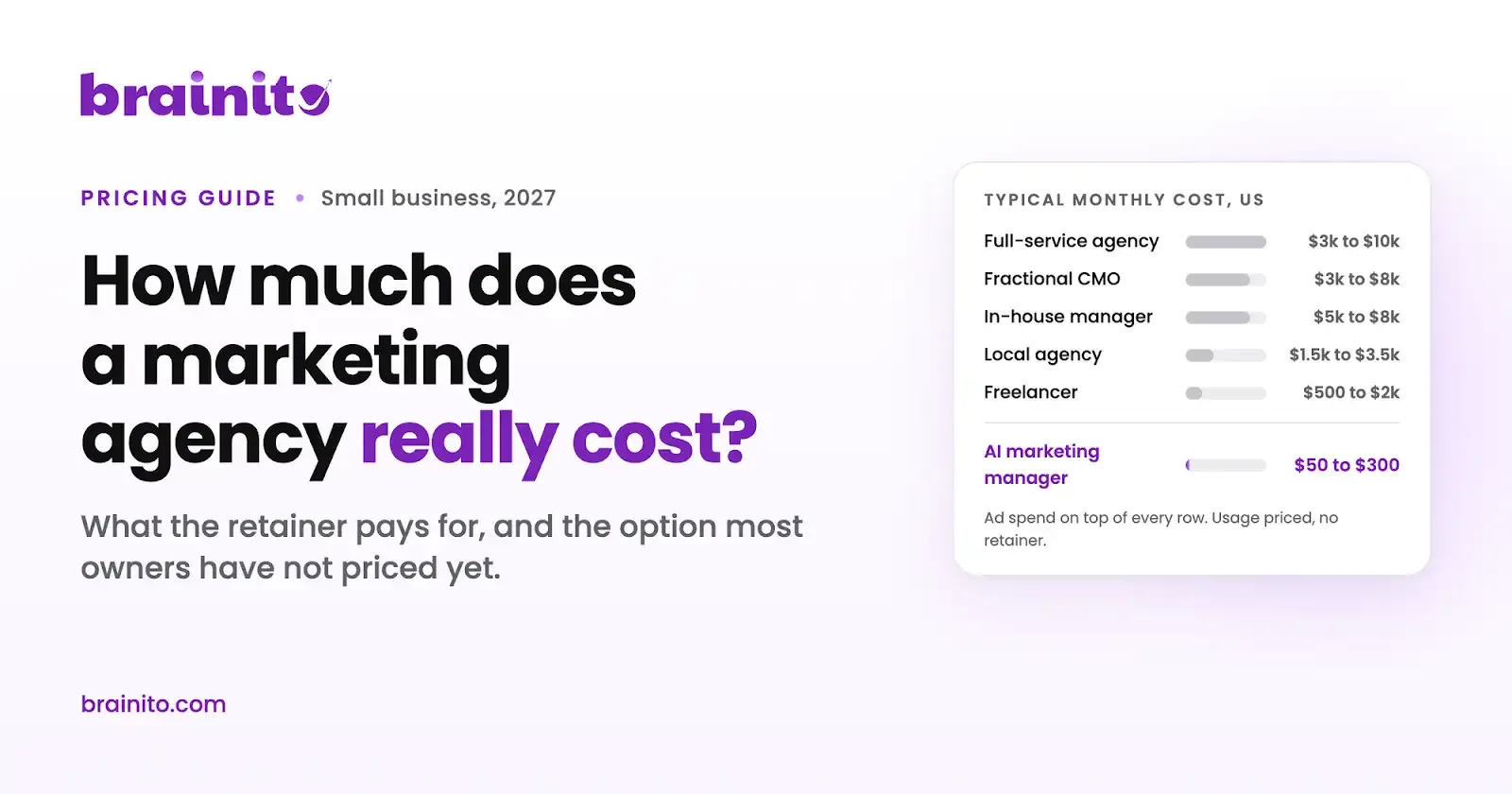
| How you buy marketing | Typical monthly cost | What you get |
|---|---|---|
| Freelancer, one channel | $500 to $2,000 | One person doing one thing well, part time |
| Small local agency, retainer | $1,500 to $3,500 | A few channels, a monthly report, a shared account manager |
| Mid-sized agency, full service | $3,000 to $10,000 | Strategy plus execution across channels, a dedicated team |
| Fractional CMO | $3,000 to $8,000 | Senior strategy a few days a month, execution extra |
| In-house marketing manager | $5,000 to $8,000 fully loaded | One full-time person, plus their tool stack |
| AI marketing manager, usage priced | $50 to $300 | One accountable person using an AI workspace, paid by what runs |
Ad spend is on top of every row. The tools an agency uses are usually inside the fee, which matters later.
What the Agency Number Is Made Of
An agency retainer is mostly people. A $3,000 a month retainer at a typical small agency breaks down to roughly 20 to 25 hours of staff time once you remove margin and management, which is about one person for a little over half a week. That time is split across a strategist who sees you monthly, an account manager who emails you weekly, and a junior who does the actual posting and ad changes.
The second ingredient is the tool stack. Agencies pay for the same subscriptions you would: SEO suites, schedulers, reporting dashboards, email platforms, design tools. A small agency commonly spends $800 to $2,000 a month on tools and spreads it across clients. You are paying a slice of it whether you know it or not.
The third ingredient is the commitment. Most agencies ask for three to twelve months because the first month is setup and they lose money on it. That is reasonable from their side. From your side it means the real price of trying an agency is the whole contract, not the first invoice.
What Changed the Math
Three years ago the agency price was defensible because the work took that many hours. Writing posts, building landing pages, designing ad variations, assembling reports: a person did each of those, and people cost what they cost.
Most of those hours are gone. Copy, images, ad variations, landing pages, audits and reports now come out of software in minutes. A single marketer with the right workspace produces what a team of four produced in 2023. Agencies know this. Some have cut prices. Many have kept the retainer and widened the margin, which is why quotes vary so much for what looks like the same service.
The second change is pricing. Marketing software used to be sold by the seat and by the month, which is why the agency's tool stack cost so much and why a small business could not run one itself. Usage pricing changed that. A business can now pay for the audit it runs and the posts it schedules, and nothing else, which makes doing the work in-house with one person realistic for the first time.
The Option That Did Not Exist: An AI Marketing Manager
The new row in the table is the one most owners have not priced yet, because it does not look like an agency and does not look like a hire.
It works like this. One person, often the owner, a part-time marketer or a freelancer, takes responsibility for the number: enquiries, bookings, orders. That person runs the whole loop inside one workspace: a website audit with evidence, a plan built from it, a site that gets built or fixed, social posts with approvals, Google and Meta ads reporting side by side, email automation, analytics across channels, and a check on whether AI assistants are recommending the business yet. The software does the hours. The person does the judgment.
The cost is usage. Brainito, which is the workspace my company built for exactly this, sells credits in packs starting at $5, and a typical small business runs $50 to $300 a month depending on how much it publishes. Dashboards are free to look at. There is no contract, no seat and no setup month.
That is not a claim that software replaces an agency. It is a claim that the agency's hours were the expensive part, and the hours are now cheap. What you still need, and should pay for, is a person who will own the outcome. That person is far cheaper when they are not also funding a team of four.
When Each Option Makes Sense
Hire a full-service agency when you spend more than $15,000 a month on ads, run in several markets, or need a brand built from nothing. At that scale a dedicated team earns its fee.
Hire a freelancer when you have one clear job, such as Google Ads or a redesign, and you can manage the rest yourself.
Hire a fractional CMO when you have a team doing the work and nobody setting direction. Pay for strategy, not for hours.
Run it with an AI marketing manager when you are a local or small online business spending under $5,000 a month on ads, you can name one person to own the number, and you would rather pay for work than for a retainer. This is most businesses reading this article.
Questions to Ask Any Agency Before You Sign
- How many hours of actual work does this fee buy each month, and who does them?
- Which tools are included, and do I keep access to the accounts and data if we part ways?
- Which number will you report on, and what happens to the fee if it does not move?
- Why is the minimum term what it is?
- What part of this work is now done by software, and is the price reflecting that?
An honest agency will answer all five without flinching. Several will not, and that tells you what the quote was really for.
The Bottom Line
A marketing agency costs between $1,500 and $10,000 a month for most small businesses in 2027, and ad spend sits on top. That price pays for hours and tools that have mostly stopped being expensive. If you have a person who can own the number, the same outcome is now available for a few hundred dollars a month in usage. Price the work, not the retainer, and the right choice usually becomes obvious.
About the Author
Nidhi Mevada is the founder of Brainito, a credit-based marketing platform for small businesses and the freelancers and agencies that serve them. It brings a 77-factor website audit, an AI website builder, social media, paid ads and analytics reporting, email automation and more than 300 free marketing tools into one workspace, priced by usage from five dollars.




Sign in to leave a comment.