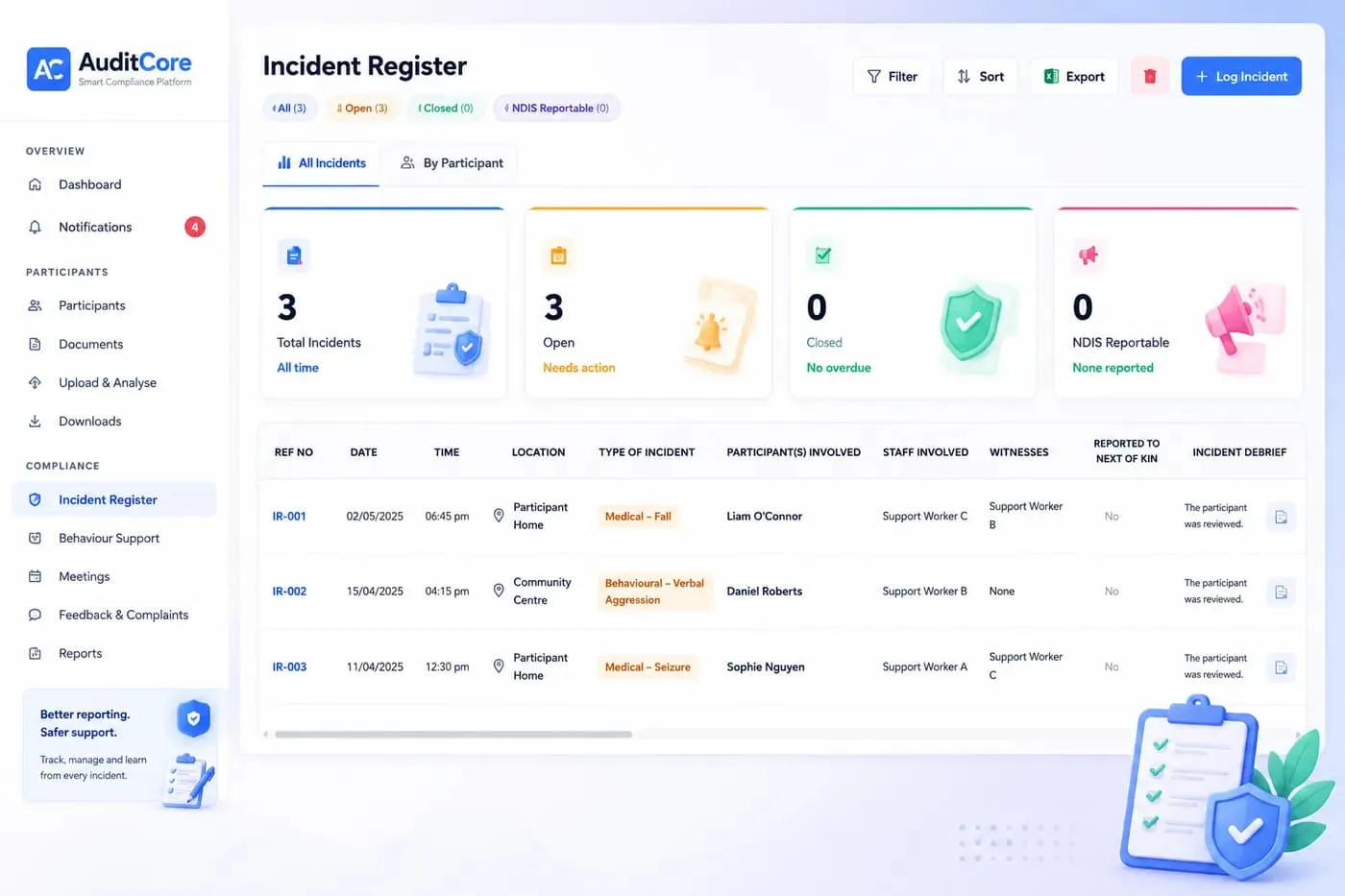

For many NDIS providers, compliance becomes difficult when information is spread across spreadsheets, emails, shared folders and paper records. Using ndis compliance software can help bring some of these activities together, but the bigger goal should be to create a compliance process that staff can actually follow consistently. Good compliance management is less about creating more paperwork and more about making responsibilities, evidence and follow-up actions clear.
Start by Mapping Your Current Process
Before changing systems or introducing new tools, take a close look at how compliance is currently managed.
Write down the key activities that happen throughout the month. This might include reviewing participant records, checking worker documentation, monitoring incidents, managing complaints, completing risk assessments and tracking corrective actions.
Then ask a simple question:
Who is responsible for each activity, and how do they know when it needs to be completed?
This exercise often reveals gaps that are easy to overlook.
For example, a manager may assume that a team member is monitoring a particular requirement, while the employee assumes someone else is responsible. The problem is not necessarily a lack of effort. It is a lack of clearly defined ownership.
Keep Important Information in One Place
One of the biggest sources of administrative pressure is having to search through multiple locations for basic information.
A provider might have participant records in one system, training records in a spreadsheet, incident information in another folder and corrective actions buried in emails.
This makes routine reviews unnecessarily difficult.
Where practical, important compliance information should be organised so that authorised staff can quickly understand:
- What needs to be done
- Who is responsible
- When it is due
- What evidence is required
- Whether it has been completed
- Whether follow-up is still required
The objective is not necessarily to put everything into one giant database. It is to create a clear system where important information does not become difficult to find.
Create a Compliance Calendar
Many compliance tasks are predictable.
Some need to happen monthly, others quarterly, annually or whenever a particular event occurs.
Creating a compliance calendar can help prevent important tasks from being forgotten.
For example, a provider might schedule regular reviews for:
- Worker training
- Policy reviews
- Risk assessments
- Incident trends
- Complaints
- Participant documentation
- Internal audits
- Corrective actions
- Emergency procedures
The calendar should identify both the task and the person responsible for completing it.
This is more useful than simply having a list of compliance requirements because it turns those requirements into actual actions.
Review Records Regularly Instead of Waiting for an Audit
One of the most effective habits a provider can develop is regular record sampling.
There is rarely a need to review every record every month. Instead, select a reasonable sample and look for recurring problems.
Check whether information is:
- Complete
- Current
- Consistent
- Properly documented
- Easy to locate
- Supported by appropriate evidence
If the same issue appears repeatedly, investigate the underlying reason.
For example, if several records are missing the same type of information, the solution may not be to remind staff repeatedly. The organisation might need to improve the form, change the workflow or provide more practical training.
Make Incident Reporting More Useful
Incident reporting should not become a process where staff simply complete a form and move on.
Every incident can potentially provide information about how services and processes could be improved.
Providers should look for patterns across incidents.
Are similar incidents happening repeatedly? Are particular locations, activities or processes involved? Do several incidents point toward the same training or communication issue?
This type of analysis can help management move from simply recording incidents to preventing similar problems in the future.
Track Corrective Actions Properly
Identifying a problem is only the beginning.
A provider may conduct an internal review and discover that a particular procedure is not being followed consistently. If the finding is recorded but nobody follows up, the compliance process has not really solved the problem.
Every corrective action should ideally have:
A clear description of the issue
An assigned owner
A target completion date
Evidence of completion
A follow-up review where appropriate
This creates accountability and makes it easier for management to see which issues remain outstanding.
Make Policies Easier for Staff to Use
Compliance documents should be useful to the people who rely on them.
Long policies can be difficult for employees to navigate when they need an answer quickly.
Where appropriate, providers can support policies with practical resources such as checklists, short procedures, decision guides and workflow instructions.
For example, instead of expecting a worker to search through a lengthy document to understand what to do after an incident, a simple step-by-step process can make the required action much clearer.
Policies still need to contain the necessary information, but usability matters too.
Use Technology to Reduce Repetitive Administration
Technology can be valuable when it removes repetitive manual work.
For example, a suitable system may help providers track compliance tasks, maintain records, monitor outstanding actions and identify upcoming reviews.
The key is to avoid assuming that technology automatically creates compliance.
A provider still needs good processes, responsible staff and appropriate oversight.
When selecting a technology solution, consider whether it actually solves a problem your team experiences.
Ask:
- Will it reduce duplicate data entry?
- Can staff find information more easily?
- Does it provide useful reminders?
- Can management see outstanding actions?
- Is evidence easier to organise?
- Are access controls appropriate?
- Can the system support the organisation as it grows?
These questions are often more useful than simply comparing feature lists.
Train Staff on the Process, Not Just the Policy
Even a well-designed compliance system can fail if employees do not understand how to use it.
Training should focus on practical situations employees are likely to encounter.
For example, instead of simply telling staff that incidents must be reported, explain what qualifies as an incident, what information should be recorded, who should be notified and what happens after the report is submitted.
Give staff an opportunity to ask questions.
This can reveal misunderstandings that may otherwise remain hidden until a problem occurs.
Review Compliance Trends at Management Level
Compliance information becomes much more valuable when management regularly reviews it.
Rather than looking at individual issues in isolation, leaders can monitor broader trends.
For example:
- Are incidents increasing or decreasing?
- Are corrective actions being completed on time?
- Are training requirements being missed?
- Are complaints showing a recurring theme?
- Are internal audits identifying the same problems repeatedly?
These trends can help management decide where resources and attention are needed.
Make Continuous Improvement Part of Normal Operations
Compliance should not be treated as a box-ticking exercise.
Every review, complaint, incident or audit finding can provide an opportunity to improve the organisation.
The important thing is to close the loop.
Identify the issue, determine what needs to change, make the change and then check whether it worked.
This approach creates a much stronger compliance culture than simply accumulating policies and documents.
Choose Tools Based on Your Actual Needs
As a provider grows, manual compliance management can become increasingly difficult.
At that point, ndis compliance software may help centralise information, track responsibilities, manage actions and provide better visibility across ongoing compliance activities. However, the right solution depends on the provider's size, processes and specific requirements. Technology should support the organisation's compliance framework rather than replace good judgement, staff accountability or regular management oversight.
Final Thoughts
Simplifying compliance does not mean reducing the importance of compliance. It means removing unnecessary complexity so staff can focus on doing the right things consistently. Clear responsibilities, organised records, regular reviews, practical training, effective corrective actions and sensible use of technology can make compliance easier to manage throughout the year. When these practices become part of normal operations, audits become less about last-minute preparation and more about demonstrating how the organisation operates every day.























Sign in to leave a comment.