
If you’re wondering how often your roof actually needs cleaning, the honest answer is: it depends on the roof.
There’s no rule saying every home needs professional roof cleaning every two or three years. A roof in a sunny, open location may stay relatively clean for years, while one surrounded by trees and shade can develop moss and lichen much sooner.
The type of roofing material matters too. Different surfaces respond differently to moisture, organic growth and cleaning methods.
So rather than following an arbitrary schedule, it makes more sense to combine your roof type, local conditions and what you can actually see on the roof.
How Often Should Different Roof Types Be Cleaned?
Here’s a practical starting point:
| Roof type | Typical cleaning frequency | Why |
| Concrete tiles | About every 3–5 years | Can collect moss, algae, dirt and lichen |
| Clay tiles | About every 4–6 years | Generally durable but can develop organic growth |
| Slate | Condition-based, often 5+ years | Cleaning needs to be handled carefully |
| Metal | About every 5–10 years | Usually less prone to moss but can collect dirt and debris |
| Flat roofs | About every 2–4 years | Debris, algae and drainage issues need closer attention |
| Shaded or tree-covered roofs | About every 2–3 years | Moisture and limited sunlight encourage faster growth |
These aren't fixed deadlines. If your roof is still clean and healthy, there may be no reason to clean it simply because the calendar says it's time.
Likewise, if moss has started spreading across the tiles, waiting another year because you're "not due" for cleaning doesn't make much sense.
Concrete Tile Roofs: Usually Every 3–5 Years
Concrete tiles are commonly seen on UK homes and are generally robust. However, their surface can hold moisture and provide somewhere for moss, algae and lichen to establish.
For many concrete tile roofs, three to five years is a reasonable interval for professional cleaning.
But location can make a big difference. A north-facing roof beneath trees may need attention sooner than a south-facing roof exposed to plenty of sunlight.
Before arranging a roof tile cleaning service, it's worth checking whether the growth is widespread or limited to a few areas. That can help determine whether the whole roof actually needs cleaning.

Clay Tile Roofs: Don't Clean Them Just for the Sake of It
Clay tiles can last for decades when properly maintained, so cleaning should be approached with some restraint.
A typical clay-tiled roof might only need professional cleaning every four to six years, and sometimes considerably less often.
The condition of older tiles is particularly important. If the tiles are already weathered or fragile, an unnecessarily aggressive cleaning process can create problems.
For this reason, the question shouldn't simply be, "How often can clay tiles be cleaned?" It should be, “Does this roof need cleaning, and what is the safest way to do it?”
Slate Roofs: Let Condition Dictate the Schedule
Slate doesn't fit neatly into a standard cleaning timetable.
If your slate roof has some natural weathering but isn't experiencing problematic moss or debris accumulation, routine cleaning may not be necessary.
Instead, keep an eye out for:
- Heavy moss growth
- Lichen spreading across the slates
- Leaves accumulating in areas of poor drainage
- Loose or damaged slates
- Blocked gutters or valleys
If cleaning is required, the approach needs to be appropriate for slate. Older slate roofs especially shouldn't be treated like concrete tiled roofs.
A professional inspection can be more valuable than automatically booking a cleaning service every few years.
Metal Roofs: Often Less Frequent Cleaning
Metal roofing doesn't usually encourage moss growth in the same way as textured tiles.
For that reason, many metal roofs can go five to ten years or more without requiring a full professional clean.
That doesn't mean they can be ignored. Dirt, leaves, bird debris and algae can still accumulate, particularly around drainage points.
Pay attention to signs of:
- Rust or corrosion
- Damaged protective coatings
- Debris collecting against the roof
- Blocked gutters or outlets
- Persistent staining
Here, regular inspection can be more useful than sticking to a fixed cleaning cycle.
Flat Roofs: Keep an Eye on Debris and Drainage
Flat roofs are another case where maintenance shouldn't be based on appearance alone.
Leaves and debris can collect on the surface and around drainage outlets. Algae can also become noticeable on some flat roofing materials.
A two-to-four-year cleaning or maintenance interval can be a useful guide, but the roof should be checked more frequently.
If water is regularly sitting on the roof after rainfall, that's not simply a cleaning issue. It could indicate a drainage or roofing problem that needs investigating.
Your Location Can Make a Big Difference
Roof type gives you a starting point, but the surroundings of your home may be even more important.
You may need to arrange roof cleaning services more frequently if your roof:
- Sits beneath large trees
- Gets very little direct sunlight
- Is heavily shaded
- Is surrounded by damp vegetation
- Regularly collects leaves
- Develops moss or lichen quickly after previous cleaning
This is particularly relevant in the UK, where damp conditions can encourage organic growth on many roofing surfaces.
On the other hand, a roof that's exposed to sunlight and has good airflow may remain relatively clean for much longer.
Don't Confuse Moss With a Reason to Clean the Entire Roof
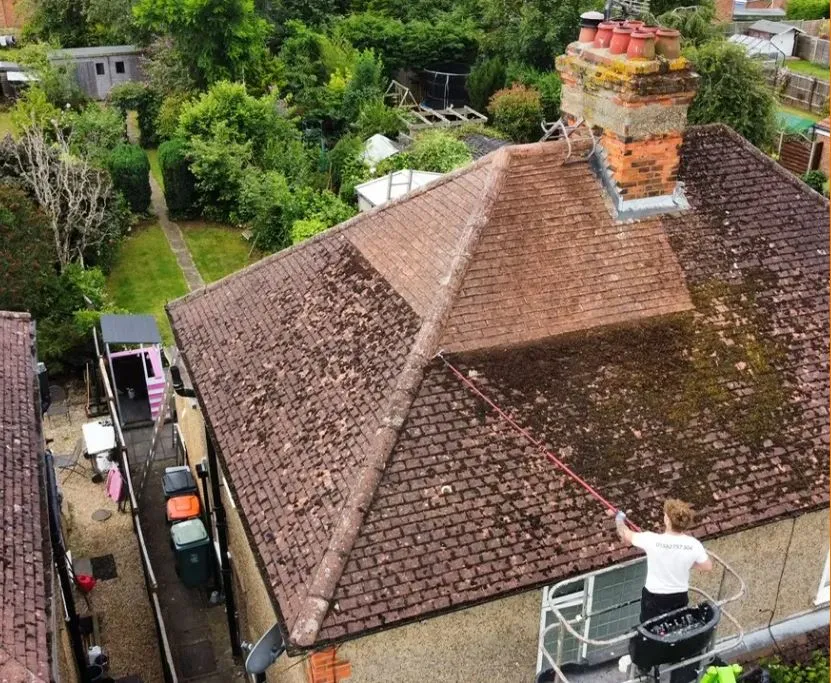
Seeing a small amount of moss doesn't necessarily mean the entire roof needs immediate cleaning.
Look at how much growth there is and where it is located.
A few isolated patches may require a different response from heavy growth covering a large section of the roof.
It's also worth checking whether moss is growing around gutters, valleys or areas where moisture tends to remain. These areas can tell you more about why the growth is occurring.
The goal of roof maintenance isn't to make every tile look brand new. It's to keep the roof functioning properly and prevent avoidable problems.
Is Annual Roof Cleaning Necessary?
For most homes, annual professional roof cleaning isn't automatically necessary.
If someone recommends yearly cleaning, ask why.
A sensible recommendation should take into account:
- The roofing material
- The age and condition of the roof
- The amount of moss or organic growth
- The property's surroundings
- Previous cleaning history
- Whether the roof has any existing defects
A reputable roof cleaning company should be able to explain the reasoning behind the recommended frequency rather than simply offering a yearly package.
When Should You Bring in Roof Cleaners?
You don't have to wait until the next scheduled clean if you notice a change.
Consider getting the roof assessed when you see:
Moss spreading:
Small patches are becoming widespread or increasingly thick.
Persistent lichen or algae:
Staining is becoming extensive rather than isolated.
Heavy debris:
Leaves and organic material are repeatedly accumulating.
Blocked drainage:
Gutters, valleys or outlets are struggling to clear rainwater.
Rapid regrowth:
Moss returns unusually quickly after previous treatment.
At that point, experienced roof cleaners can assess whether cleaning is appropriate and recommend a suitable approach for the roofing material.

A Simple Maintenance Schedule to Follow
If you want something practical, use this as a starting point:
Every few months:
Look at the roof from ground level and check for obvious moss, debris, damaged tiles and gutter problems.
Once a year:
Take a closer look at areas that are shaded or beneath trees. If anything has changed noticeably, consider an inspection.
Every 2–5 years:
For many tiled roofs, consider professional cleaning based on their condition rather than automatically booking it.
Every 5+ years:
Some slate and metal roofs may need little or no cleaning if they remain in good condition.
Any time you notice a problem:
Don't wait for the next scheduled maintenance date. Have the issue assessed.
So, How Often Do You Really Need Roof Cleaning?
For most homeowners, the best answer isn't “every X years.”
It's “when the roof's condition indicates that cleaning is worthwhile.”
As a broad guide, concrete and clay tiled roofs may need attention every few years, while metal and slate roofs can often go longer. Homes surrounded by trees or affected by heavy shade may need more frequent maintenance.
If you're looking for roof cleaning in UK, use the schedule as a guide, not a rule. A trustworthy contractor should inspect the roof, consider its material and surroundings, and tell you whether cleaning is actually needed.
Good roof maintenance isn't about cleaning as often as possible. It's about cleaning at the right time, using the right approach for the roof you have.























Sign in to leave a comment.