

How OIG Checks and Sanction Checks Support Healthcare Compliance
Healthcare organizations must manage relationships with employees, physicians, contractors, vendors, suppliers, and other third parties. As these networks grow, maintaining a consistent compliance screening process can become increasingly important.
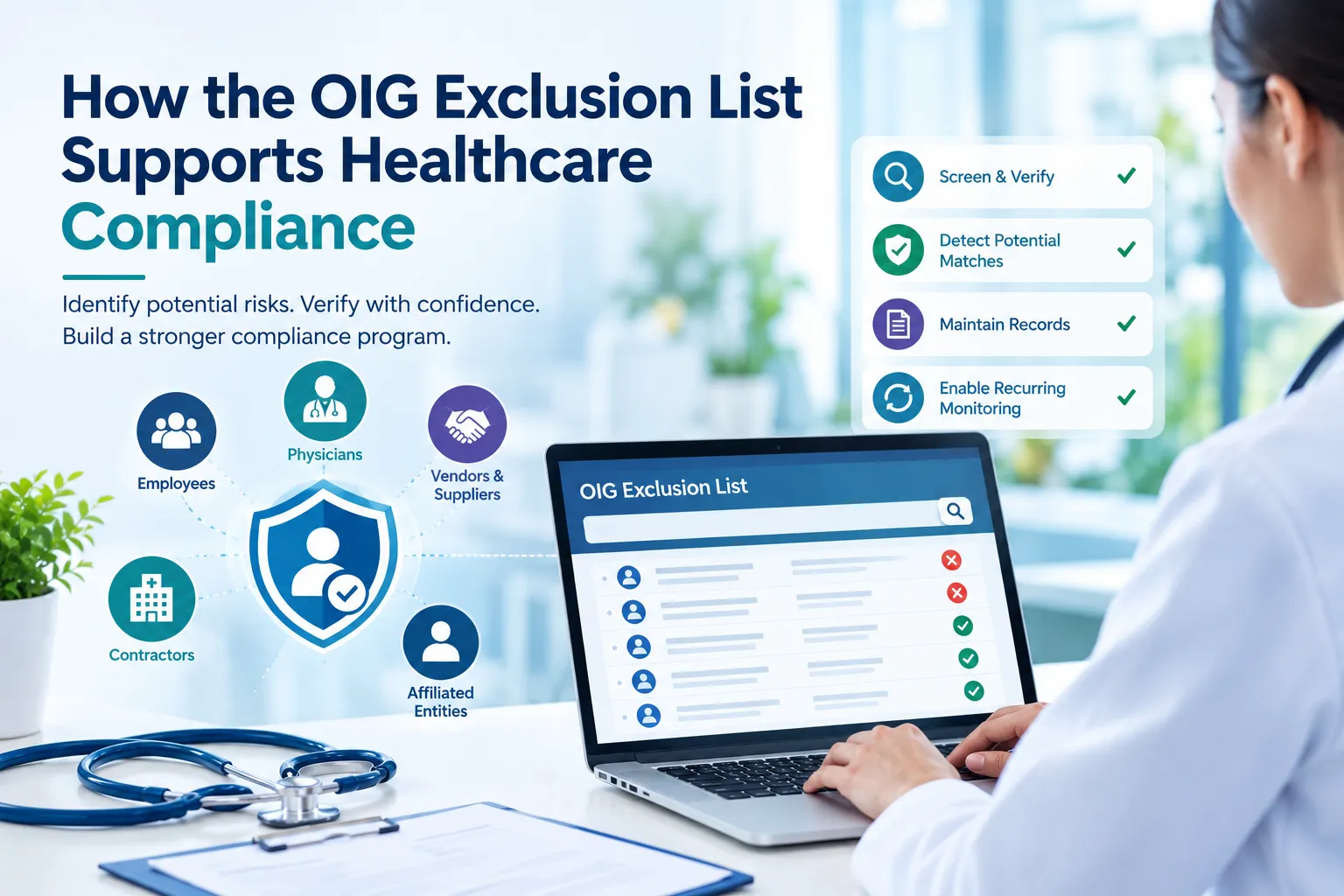
Exclusion and sanction screening can help organizations identify potential regulatory concerns involving individuals and entities. The process may include checking the federal OIG exclusion database as well as other applicable federal and state sources.
Organizations beginning this process can review the Exclusions List OIG to better understand the federal exclusion database and its relevance to healthcare compliance.
What Is an OIG Check?
An OIG check is a search used to determine whether an individual or entity appears on the HHS-OIG List of Excluded Individuals and Entities (LEIE).
The LEIE contains records of individuals and entities excluded from participation in federal healthcare programs under applicable federal authorities.
Healthcare organizations may perform OIG checks during activities such as:
- Employee onboarding
- Provider credentialing
- Contractor onboarding
- Vendor management
- Compliance reviews
- Recurring monitoring
The exact screening process can vary depending on the organization's operations and compliance requirements.
Why Go Beyond a Single Database?
Although the OIG exclusion database is an important federal source, healthcare compliance screening may involve additional databases.
Organizations may need to consider applicable federal and state exclusion or sanction sources based on their business activities, geographic footprint, contractual obligations, and compliance procedures.
Broader screening can help an organization create a more comprehensive approach to identifying potential concerns.
What Are Sanction Checks?
Sanction checks involve reviewing applicable databases and sources for information indicating that an individual or entity may be subject to a sanction, exclusion, debarment, or other regulatory restriction.
The sources relevant to an organization can vary.
Depending on the screening program, organizations may consider sources such as:
- HHS-OIG exclusion information
- Federal exclusion or debarment sources
- State exclusion and sanction lists
- Other applicable government databases
- Professional or regulatory information
The goal is to identify potential records that require further review.
OIG Checks and Sanction Checks Are Not Always the Same
An OIG check generally focuses on the HHS-OIG exclusion database.
Broader sanction screening can include multiple sources.
For example, a healthcare organization might conduct an OIG check for a new employee while also including the individual in a broader sanction-screening workflow.
Using clearly defined procedures can help compliance teams understand what each screening activity is designed to accomplish.
Who May Need Screening?
The appropriate screening population depends on the organization's risk assessment, policies, contracts, and applicable requirements.
Potential screening populations can include:
- Physicians
- Nurses and clinical staff
- Employees
- Contractors
- Vendors
- Medical suppliers
- Staffing agencies
- Billing providers
- Laboratories
- Consultants
- Other third parties
Organizations should define their screening population and apply the process consistently.
Handling Potential Matches
A potential match requires investigation.
For example, two people can have the same name but different dates of birth, addresses, professions, or other identifying characteristics.
When a potential match appears, a compliance team can:
- Review the database record.
- Compare available identifiers.
- Determine whether the record belongs to the screened party.
- Document the investigation.
- Follow applicable internal procedures based on the outcome.
This distinction between a potential match and a confirmed match is important for maintaining an accurate compliance process.
Using Technology for OIG Checks
As employee and vendor populations increase, manually conducting and documenting every search can become time-consuming.
Technology can support the administrative side of screening by helping organizations manage lists, conduct recurring searches, organize results, and retain reports.
Venops provides screening technology intended to help healthcare organizations manage exclusion and sanction screening workflows.
An Exclusion screening process can also be structured around recurring monitoring rather than relying exclusively on one-time searches.
Why Recurring Screening Matters
Exclusion and sanction information can change over time. An individual who does not appear on a database during an initial search could potentially appear later.
For this reason, organizations may establish recurring screening procedures.
The frequency of screening should be determined according to applicable requirements, organizational policies, and the organization's compliance approach.
Automated systems can help manage recurring screening by reducing repetitive manual tasks and maintaining organized records.
Importance of Documentation
Documentation provides evidence of the organization's screening activities.
Useful records may include:
- Person or entity screened
- Screening date
- Sources checked
- Search results
- Potential matches
- Investigation notes
- Clearance results
- Follow-up actions
A centralized recordkeeping process can make it easier for authorized compliance personnel to review historical screening activity.
Creating a Consistent Screening Workflow
A practical workflow can be divided into several stages.
Identify the population
Determine which individuals and entities need to be screened.
Select relevant sources
Identify federal and state databases applicable to the organization.
Conduct initial screening
Screen relevant parties before or during onboarding according to established procedures.
Monitor periodically
Perform recurring searches at the organization's defined intervals.
Investigate potential matches
Review additional identifiers and documentation when a possible match appears.
Maintain records
Document screening and clearance results in an organized system.
This structure can help make screening more consistent across departments.
The Role of Human Review
Automation can make screening workflows more efficient, but it does not eliminate the need for appropriate human review.
A potential match may require additional research and comparison of identifiers. Compliance personnel may need to determine whether the database record actually corresponds to the employee, provider, contractor, or vendor being screened.
Technology and human review therefore serve complementary roles.
Conclusion
OIG checks and broader sanction checks can support healthcare organizations in maintaining structured compliance screening processes.
An OIG check focuses primarily on the federal OIG exclusion database, while broader sanction screening can involve additional applicable sources.
Organizations can strengthen their workflows by clearly defining screening populations, selecting relevant sources, conducting recurring searches, investigating potential matches, and maintaining appropriate documentation.
Healthcare organizations can also explore CMS Open Payments as a separate compliance-related data resource when applicable to their operations.
Frequently Asked Questions
1. What is an OIG check?
An OIG check is a search of the HHS-OIG exclusion database to identify whether an individual or entity appears in the LEIE.
2. Are OIG checks and sanction checks identical?
No. An OIG check generally focuses on the OIG exclusion database, while sanction screening may include multiple federal and state sources.
3. What should happen after a potential match is found?
The organization should investigate the potential match using available identifiers and documentation before reaching a final determination.
4. Should vendors be included in screening?
Organizations should determine which vendors and other third parties require screening based on their compliance policies, applicable requirements, and business relationships.
5. Can sanction screening be automated?
Technology can support recurring screening, reporting, and record management, while potential matches may require human investigation.


























Sign in to leave a comment.