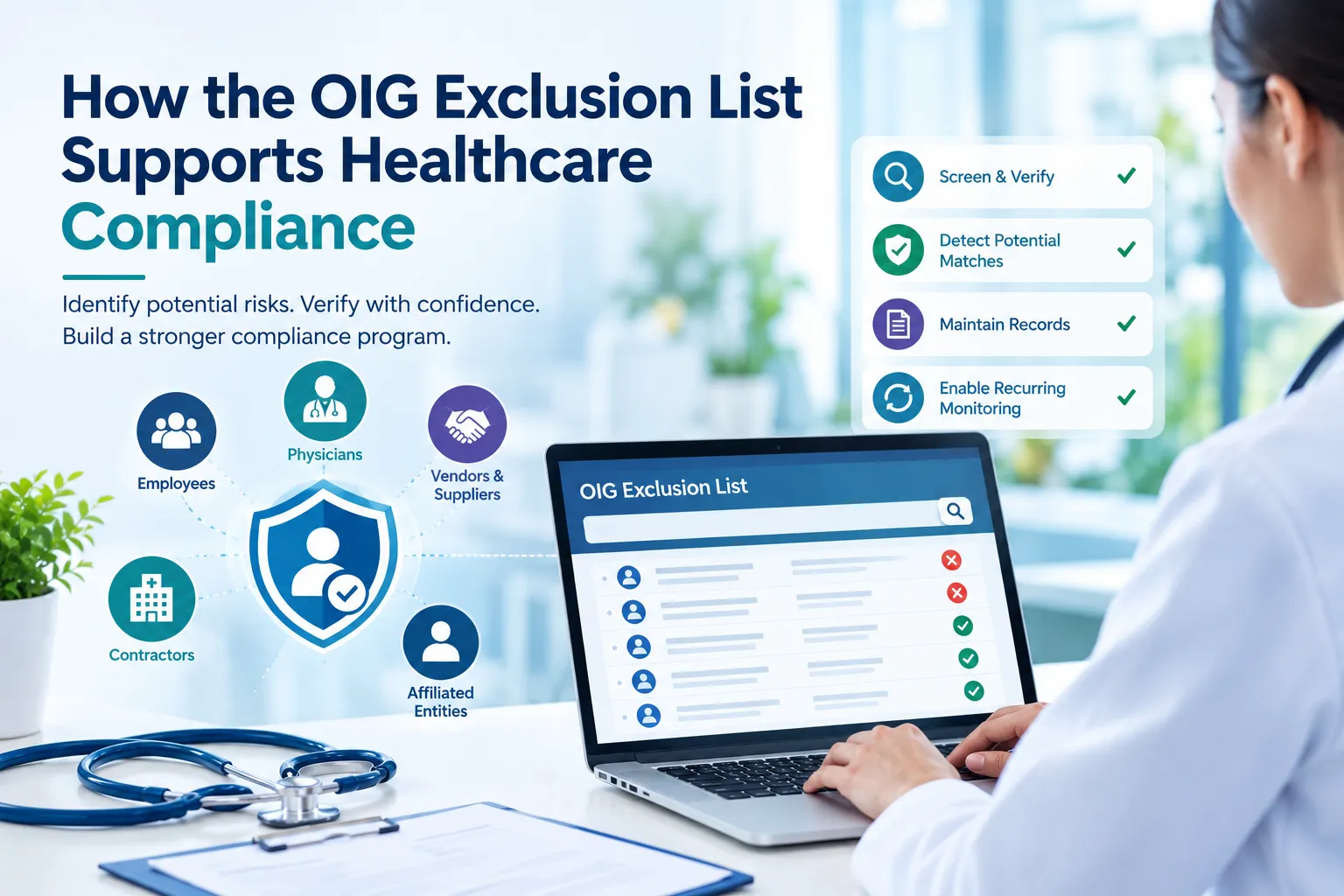

Healthcare organizations operate within a highly regulated environment where employees, physicians, contractors, suppliers, and vendors can all contribute to compliance risk. One important area of oversight is determining whether individuals or entities are excluded from participating in federally funded healthcare programs.
The Exclusions List OIG is an important resource for organizations seeking to identify parties who may be excluded by HHS-OIG. Understanding how the list works, how to search it, and why recurring monitoring matters can help organizations build stronger compliance procedures.
What Is the OIG Exclusion List?
The OIG exclusion list is commonly associated with the List of Excluded Individuals and Entities (LEIE) maintained by the HHS Office of Inspector General.
The LEIE contains information about individuals and entities excluded from participation in federal healthcare programs. HHS-OIG provides a searchable database and downloadable information that organizations can use when performing exclusion checks.
Exclusions can arise from different circumstances, including certain healthcare-related crimes, fraud, patient abuse or neglect, and other qualifying misconduct.
For healthcare organizations, the list provides an important starting point for identifying potential compliance concerns.
Why Should Organizations Check the OIG List?
An organization may have relationships with hundreds or thousands of individuals and third parties. Relying only on initial hiring or contracting checks may leave a gap because exclusion status can change after the relationship begins.
Routine screening can help organizations:
- Identify newly excluded individuals
- Review vendors and affiliated entities
- Support regulatory compliance
- Reduce potential financial exposure
- Maintain documented due diligence
- Establish a consistent compliance process
Venops notes that providers and contracting entities have an affirmative responsibility to routinely verify exclusion status and maintain records of screening activities.
Who Should Be Screened?
The appropriate screening population depends on the organization's operations and compliance requirements. However, healthcare organizations commonly consider a broad range of people and entities.
These may include:
- New employees
- Existing employees
- Physicians
- Nurses and other practitioners
- Contractors
- Temporary staff
- Vendors
- Suppliers
- Business associates or affiliated entities
- Other parties connected to healthcare operations
Vendor screening is particularly important because third parties may provide essential services while remaining outside an organization's traditional workforce.
OIG Exclusion vs. a Background Check
An OIG exclusion check is not the same thing as a general employment background check.
A background check may focus on criminal history, identity verification, employment history, or other information. Exclusion screening specifically addresses whether an individual or entity appears on applicable exclusion or sanction sources.
For healthcare organizations, both types of due diligence may have a role, depending on the organization's risk management program.
A comprehensive compliance process can therefore combine appropriate onboarding procedures with recurring exclusion and sanction screening.
How Should Organizations Handle Potential Matches?
One of the most important principles of exclusion screening is that a name match should not automatically be treated as a confirmed exclusion.
Different individuals may have similar names. Additional identifiers can be important when determining whether a potential match actually belongs to the person or entity being screened.
Venops explains that its screening process includes clearance investigations for potential exclusion matches so that possible matches can be objectively reviewed.
A practical process may include:
- Identify the potential match.
- Compare available identifying information.
- Review the relevant source information.
- Conduct a clearance investigation.
- Determine whether the match is confirmed or false.
- Document the result.
- Take appropriate compliance action when necessary.
This approach can reduce the risk of acting on incomplete information.
Why Recurring Monitoring Matters
The OIG exclusion list is not static. Individuals and entities can be added or removed over time. This means that a person who was clear during onboarding could potentially become excluded later.
Recurring screening provides an additional layer of oversight.
Venops offers automated monthly screening that rechecks names from a previous screening report against updated exclusion and sanction databases.
For organizations with large workforces or extensive vendor networks, automation can significantly reduce the administrative burden associated with repeated searches.
Maintaining Screening Documentation
Screening should not simply produce a result that disappears after the search is completed. Organizations should establish procedures for retaining evidence of their compliance activities.
Useful documentation may include:
- Date of screening
- Person or entity screened
- Sources searched
- Screening results
- Potential matches identified
- Clearance investigation details
- Final determination
- Follow-up actions
- Responsible reviewer
Maintaining organized records can help demonstrate that the organization has established and followed a consistent compliance process.
Venops states that screening records and reports are saved and available for review, supporting organizations that need documentation of their screening activities.
Using Automation to Strengthen Compliance
As organizations grow, manual searches can consume significant staff time. Automated screening technology can help standardize the process and reduce repetitive administrative work.
Automation can support:
- Recurring monthly screening
- Large roster processing
- Potential-match identification
- Compliance reporting
- Record retention
- Vendor monitoring
Technology should be combined with appropriate human review, especially when potential matches require additional investigation.
Frequently Asked Questions
1. What is the OIG exclusion list?
It is commonly used to refer to the HHS-OIG LEIE, which identifies individuals and entities excluded from federal healthcare programs.
2. Can vendors appear on the OIG exclusion list?
Yes. Organizations should consider relevant vendors and affiliated entities as part of their broader exclusion and sanction screening program.
3. How often should organizations check exclusion information?
Recurring screening is important because exclusion and sanction information can change. Venops supports automated monthly screening as part of its compliance platform.
4. Is a name match automatically an exclusion?
No. A potential match should be investigated using appropriate identifying information before a final determination is made.
5. Why should screening records be retained?
Records provide evidence that an organization performed its screening procedures and can support internal compliance reviews and regulatory due diligence.
Conclusion
Understanding the OIG exclusion list is essential for healthcare organizations that want to maintain effective compliance oversight. Screening employees, providers, vendors, and other relevant parties can help identify potential exclusion concerns and support a documented compliance program.
Organizations can strengthen this process by combining recurring screening, accurate data, potential-match investigations, and organized records.
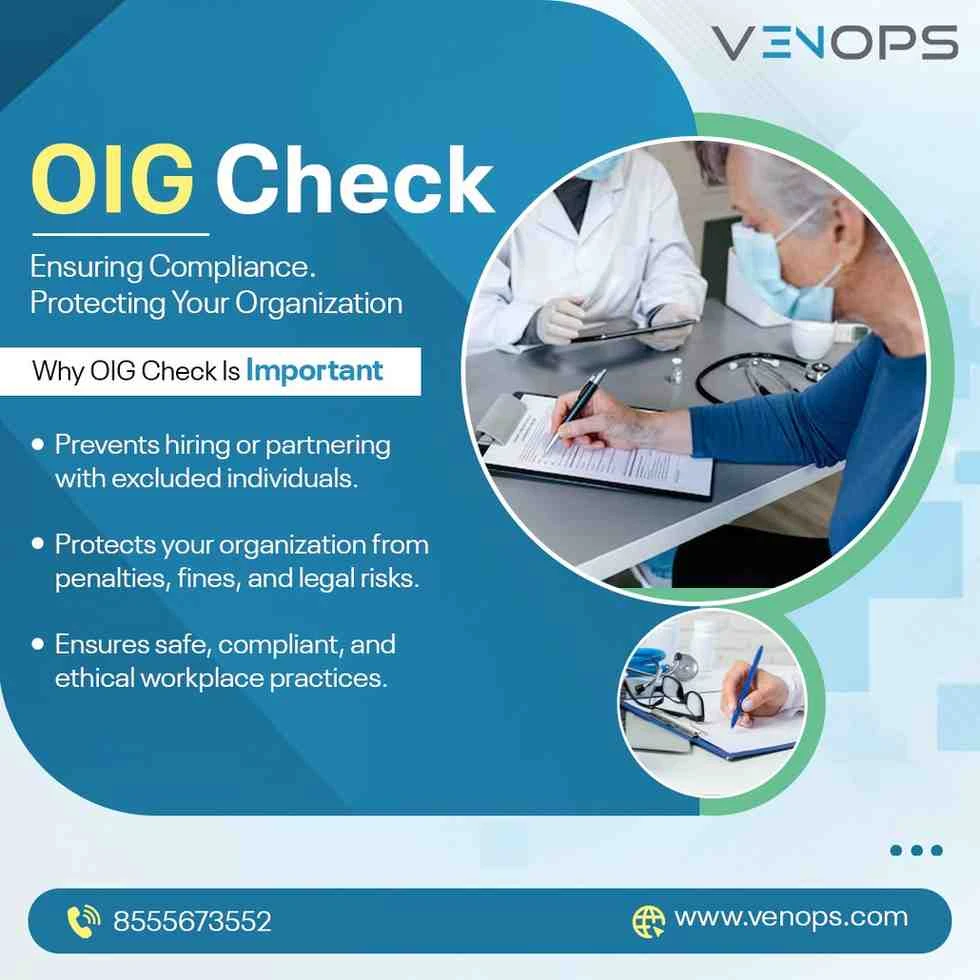
To complement exclusion-list monitoring, healthcare organizations can also review OIG Exclusion resources and establish procedures that make screening a consistent part of their compliance operations.
Build a proactive healthcare screening strategy with Venops and make exclusion monitoring easier to manage.




















Sign in to leave a comment.