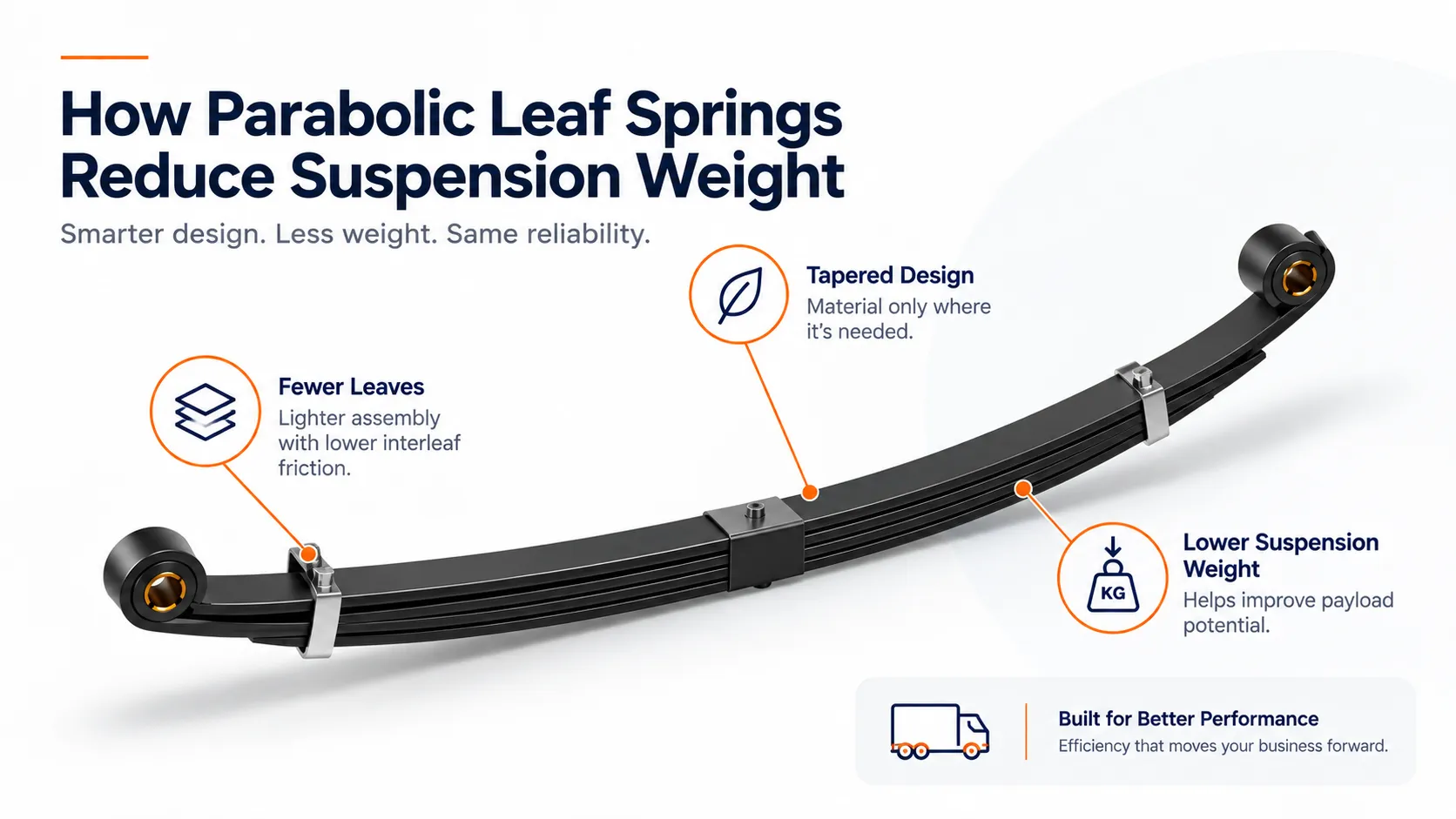

Reducing suspension mass is not achieved simply by cutting steel from a conventional spring. Parabolic leaf springs use a tapered, variable-thickness leaf profile so material is concentrated where the spring carries the required stress. The result can be a lower-mass spring assembly, while retaining the load and spring-rate characteristics needed by the vehicle. The amount of savings depends on the specific design, duty, and comparison spring.
Why the Geometry Can Reduce Mass
A conventional multi-leaf pack often uses several leaves of relatively similar section thickness. In a parabolic design, the leaf is shaped so that thickness changes along its length in relation to the spring’s stress distribution.
That allows material to be reduced in regions where it contributes less to the required bending capacity. Fewer leaves can also reduce the amount of steel moving within the pack.
The weight advantage is therefore a consequence of spring geometry and material use, not simply fewer parts.
Weight Reduction Can Be Substantial, But It Is Not Universal
Published manufacturer data for some parabolic designs reports weight reductions of up to 70% against a conventional multi-leaf equivalent. That is an upper figure for particular designs and duty ratings, not a value that transfers to every parabolic spring. Treat it as an indication of what the geometry can achieve, not as a specification.
For procurement, the better comparison is the actual spring assembly specified for the vehicle. Compare mass, rated capacity, dimensions, spring rate, mounting configuration, and expected duty rather than applying a headline percentage to every application.
Fewer Leaves Also Change Interleaf Friction
A multi-leaf spring has friction between adjacent leaves. Reducing the number of leaves can reduce interleaf friction and related hysteresis effects.
That can alter ride behaviour as well as mass, but it does not mean every parabolic design produces the same ride result. Vehicle axle layout, damping, load distribution, tyre characteristics, and spring tuning still matter.
Material and Manufacturing Still Matter
Lower mass is only useful when the spring retains adequate fatigue strength and dimensional stability. Heat treatment, steel quality, shot peening where specified, forming, surface condition, and manufacturing consistency all influence the finished component.
A light spring that cannot meet the required duty is not a successful weight-reduction strategy.
Where the Saving Matters Most in Parabolic Leaf Springs
For commercial fleets, reducing suspension mass can create more payload headroom within legal gross-vehicle-weight limits. It can also reduce the mass carried by the suspension itself.
However, payload benefit should be calculated from the actual complete assembly and vehicle weights. A nominal spring saving does not automatically translate into the same saving at vehicle level if other components change.
Common Selection Mistakes
1. Applying a universal percentage saving. The weight reduction depends on the specific spring design and the conventional spring used for comparison.
2. Comparing leaf count instead of assembly mass. Two springs with different numbers of leaves can still have similar total mass.
3. Ignoring duty and spring rate. A lighter component still has to meet the vehicle’s load, fatigue, and deflection requirements.
4. Treating weight reduction as the only performance measure. Ride behaviour, durability, maintenance, and mounting compatibility remain part of the suspension specification.
What Should Engineers Compare?
For a fleet or OEM specification, compare actual assembly mass, rated load, dimensions, material and manufacturing requirements, spring rate, test evidence, and vehicle compatibility. A design-level comparison is much more meaningful than comparing leaf count or marketing percentages.
To Sum Up
The weight advantage of parabolic leaf springs comes from using material more efficiently through tapered geometry and fewer leaves. Some designs can achieve substantial savings, but the result depends on the specific application and baseline spring. For engineers and fleet buyers, comparing complete assemblies against load, fatigue, spring-rate, and mounting requirements gives a more reliable basis for evaluating the weight reduction.

























Sign in to leave a comment.