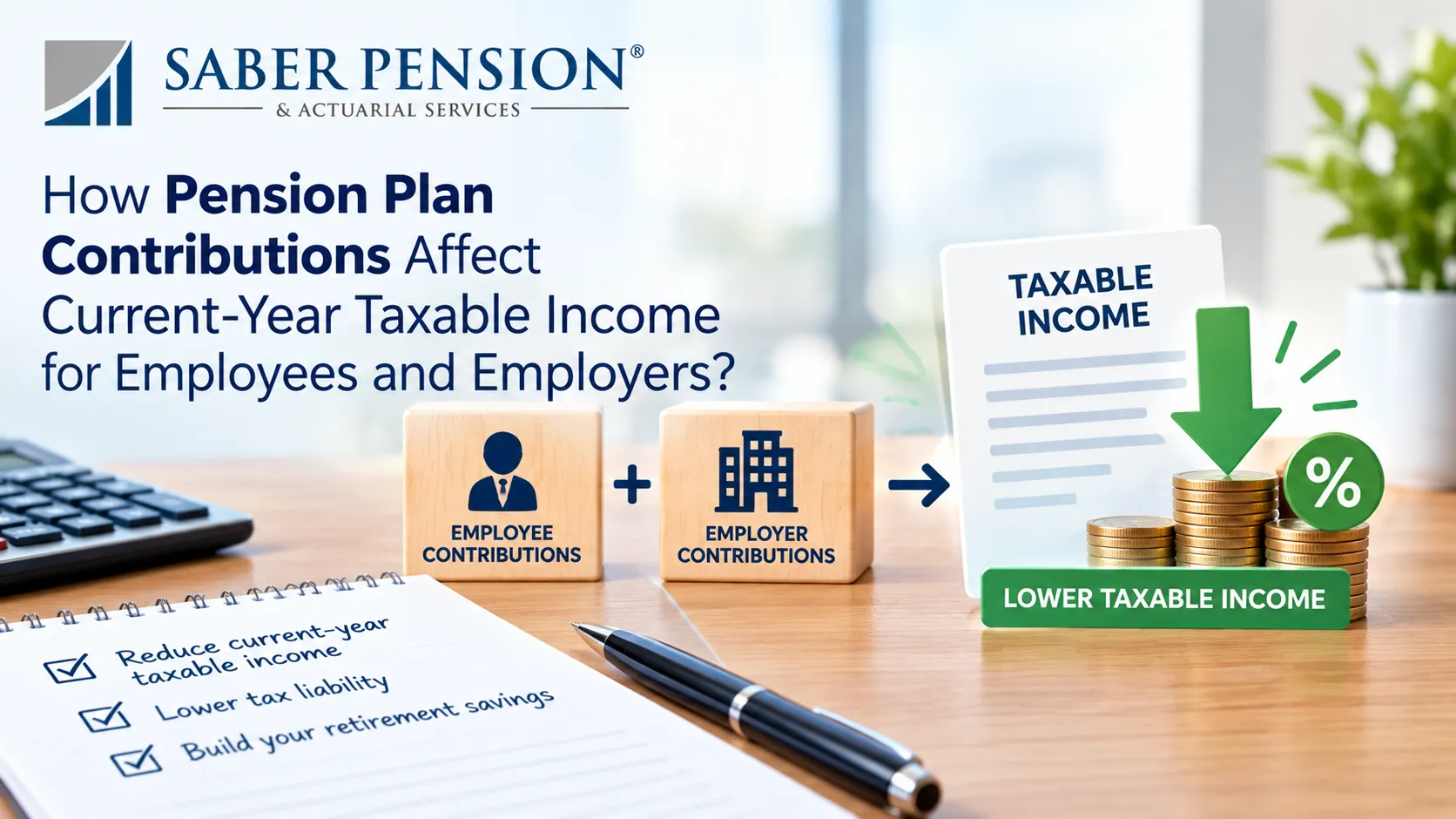

A pension contribution can look like a simple line item on a payroll statement or company balance sheet. Yet behind that number is a tax decision that can affect an employee’s current income, an employer’s deductible expenses, and the long-term cost of maintaining a retirement plan. Understanding how these contributions interact with taxable income is essential for making informed compensation and retirement planning decisions. The tax treatment depends on the type of pension arrangement, who makes the contribution, and applicable IRS rules. For both employees and employers, understanding pension plan taxes can help prevent costly assumptions and improve retirement planning.
How Pension Contributions Affect Employees?
For employees participating in a qualified employer-sponsored pension plan, contributions are generally designed to provide a tax advantage during the working years.
In a traditional defined benefit pension plan, employees typically do not make the actuarially determined employer contributions themselves. Instead, the employer funds the plan according to requirements established under the plan and applicable pension regulations. The employee generally does not include the employer’s pension contribution in current taxable wages simply because the contribution was made on their behalf.
This creates an important distinction: tax deferral is not the same as tax elimination. The employee may avoid current federal income taxation on certain retirement benefits while working, but distributions received from a traditional qualified pension plan are generally taxable when paid, subject to applicable rules.
For employees who make contributions to certain qualified retirement arrangements, the tax treatment can differ depending on whether contributions are made on a pre-tax or after-tax basis. Payroll treatment and individual circumstances therefore matter.
The Employer Tax Advantage
For employers, pension contributions can represent both a compensation expense and a tax-planning consideration.
Contributions made by an employer to a qualified pension plan may generally be deductible for federal income tax purposes, provided the contribution satisfies applicable requirements and limitations. However, employers cannot simply contribute any amount they choose and automatically claim the entire amount as a deduction.
Defined benefit pension plans are particularly complex because the amount required or permitted to be contributed is influenced by actuarial calculations, funding rules, plan provisions, participant demographics, and other factors.
This is where actuarial services become valuable. Actuaries evaluate factors such as employee ages, compensation, expected retirement patterns, mortality assumptions, interest rates, and plan benefits to determine appropriate funding requirements under applicable standards.
The resulting contribution can therefore affect an employer’s taxable income differently from an employee’s wages.
Understanding Pension Plan Taxes
The phrase pension plan taxes covers several different tax considerations rather than one single tax.
At the contribution stage, qualified pension contributions may receive favorable tax treatment. During the accumulation period, investment earnings within a qualified pension trust are generally not taxed to participants as current income. Later, when retirement benefits are distributed, taxable income may arise depending on the type of benefit and the participant’s basis, if any.
This timing is fundamental to understanding pension taxation. Instead of treating the contribution as an immediate taxable benefit, the tax system generally separates the funding stage from the distribution stage.
For employers, the key question is often whether a contribution qualifies as a deductible business expense in the relevant tax year. For employees, the question is more likely to involve whether employer contributions or eventual pension payments are included in taxable income.
Defined Benefit Plans Require More Analysis
Defined benefit pension plans require particular attention because contributions are not determined simply by selecting a percentage of payroll.
The plan promises a specified retirement benefit, and funding must be evaluated against that future obligation. Actuarial valuations help determine the amount needed to support promised benefits while complying with applicable funding requirements.
Several factors can influence contribution levels, including:
- Participant demographics
- Salary and service history
- Expected retirement dates
- Interest-rate assumptions
- Mortality assumptions
- Investment performance
- Plan benefit formulas
- Funding requirements
A significant employer contribution may therefore be driven by funding needs rather than an attempt to reduce taxable income.
This distinction matters when interpreting year-to-year changes. A larger contribution in one year does not necessarily indicate that an employer is simply pursuing a tax deduction. It may reflect changes in the plan’s funded status, actuarial assumptions, regulatory requirements, or participant population.
How Timing Can Affect Taxable Income?
The timing of a pension contribution can be important for employers.
A contribution made during or after the close of a tax year may have different consequences depending on applicable tax rules, the employer’s tax year, the plan year, and whether the contribution meets requirements for deduction in that year.
Businesses should therefore avoid treating pension contributions like ordinary discretionary expenses that can be moved between tax years without consequences.
Accurate coordination among the plan administrator, tax professionals, and actuarial services provider can help establish whether contributions are required, when they must be made, and how they should be reflected for tax purposes.
Taxable Income Is Not the Same as Cash Flow
One of the most important concepts for employers and employees is the difference between taxable income and cash flow.
An employer may contribute a substantial amount to a pension plan, reducing available cash in the current period while potentially receiving a tax deduction. Conversely, an employee may receive valuable retirement benefits through an employer-sponsored pension without receiving additional current-year cash compensation.
The tax treatment therefore cannot be understood simply by looking at money entering or leaving a bank account.
Businesses should also consider the accounting treatment of pension obligations, while employees should distinguish between taxable wages, retirement contributions, and future pension distributions.
Why Professional Analysis Matters?
Pension taxation involves overlapping rules involving retirement plans, income taxation, funding requirements, and actuarial calculations. Small differences in plan design or contribution timing can produce materially different outcomes.
Employers should evaluate pension contributions alongside broader compensation and tax strategies rather than viewing them as isolated expenses. Employees, meanwhile, should understand whether their retirement benefits create current taxable income or future tax obligations.
Professional actuarial services can provide the calculations necessary to evaluate funding obligations and plan liabilities, while qualified tax professionals can address the applicable tax treatment.
Planning for the Tax Year Ahead
Pension contributions can influence current-year taxable income, but their impact depends heavily on plan structure, contribution source, timing, and applicable tax rules. For employees, employer-funded pension benefits generally do not function like ordinary current wages, while qualified employer contributions may provide businesses with valuable tax deductions when requirements are satisfied.
The most effective approach is to look beyond the immediate tax benefit. Proper pension planning considers current deductions, future retirement obligations, funding requirements, and the eventual taxation of distributions. By combining accurate actuarial analysis with sound tax planning, employers can make informed funding decisions while employees gain a clearer understanding of how retirement benefits fit into their overall financial picture.


























Sign in to leave a comment.